
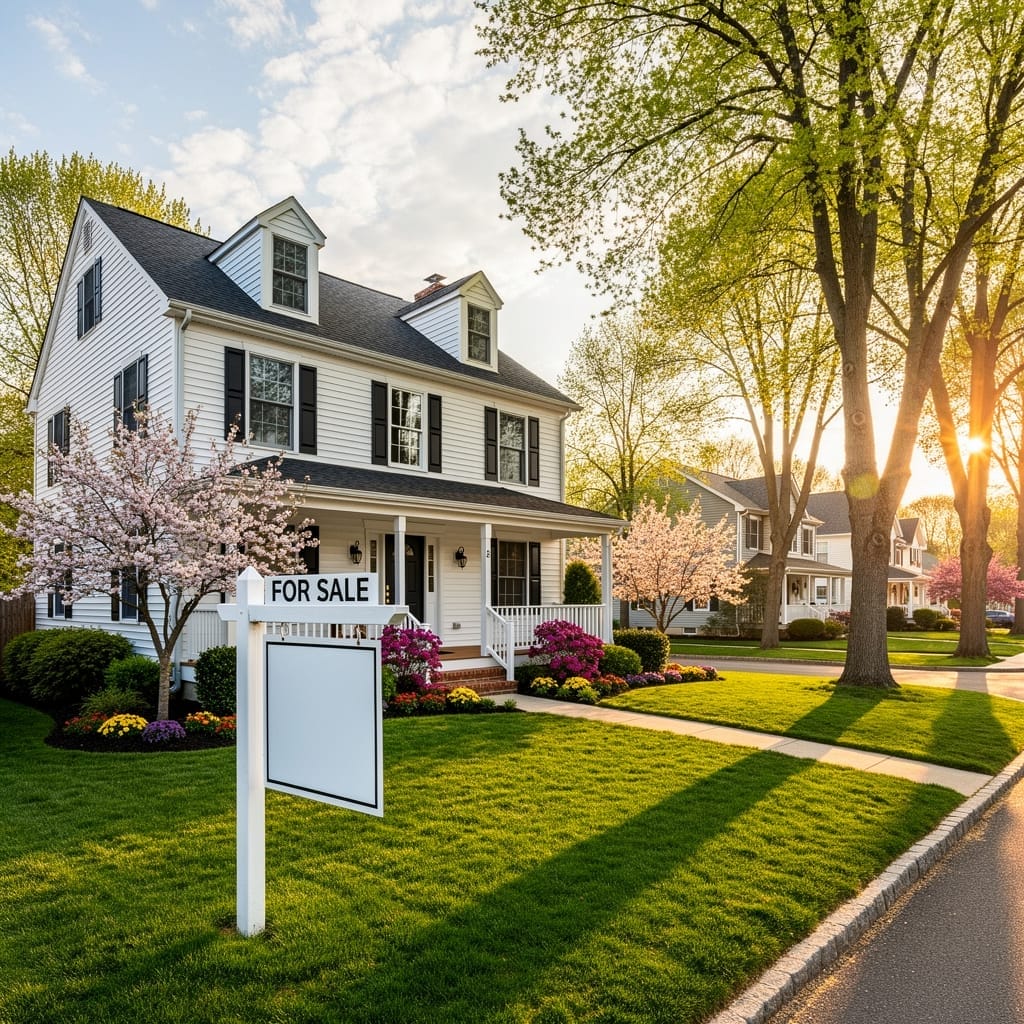
Selling a house in New Jersey involves more legal steps, tax obligations, and paperwork than most homeowners expect. Between the GIT withholding (often called the “exit tax”), realty transfer fees, mandatory seller disclosures, and a three-day attorney review period, NJ sellers face a process that looks very different from selling in other states.
This guide walks you through every step of selling a house in New Jersey in 2026, from preparing your home for market to collecting your proceeds at the closing table.
Table of Contents
The New Jersey Housing Market in 2026: What Sellers Need to Know
Before listing your home, you need to understand what buyers are doing right now. The New Jersey housing market entered 2026 with moderate price growth, rising inventory, and stabilizing mortgage rates.
Here is the snapshot:
- Median home price: $525,000 statewide (up 5.4% year-over-year as of late 2025)
- Single-family median: $585,000 (up 6.4% annually)
- Inventory: Up 8.9% year-over-year, with roughly 3 months of supply statewide
- Days on market: 58 days median in early 2026 (up 9 days from the prior year)
- Mortgage rates: Low-6% range, with projections showing rates between 5.9% and 6.1% by year-end
What does this mean for you as a seller? Pricing precision matters more than it did during the pandemic-era bidding wars. Buyers have more options, they are taking more time, and overpriced listings sit. Well-priced homes in desirable areas still sell quickly, especially in Bergen County (36-44 days on market for single-family) and Monmouth County.
Spring 2026 is shaping up as a strong selling window. If you want to learn when to list for top dollar, check out the best time to sell in NY and NJ.
Step 1: Hire a Real Estate Agent and Attorney
Selling a house in New Jersey starts with assembling your team. You need two professionals: a licensed real estate agent and a real estate attorney.
Why You Need an Agent
A good listing agent brings pricing strategy, marketing reach, MLS access, buyer qualification, and negotiation skill. In the current NJ market, homes listed with agents sell for significantly more than those sold by owner. According to the National Association of Realtors, FSBO homes sold at a median of $360,000 in 2025 compared to $425,000 for agent-assisted sales, an 18% gap. The FSBO vs agent comparison breaks down the real math.
Agent commissions in New Jersey typically run 5-6% of the sale price, split between the listing agent and buyer’s agent. On a $525,000 home, that is $26,250 to $31,500. This commission comes out of seller proceeds at closing.
Why You Need an Attorney
New Jersey real estate contracts include a mandatory three-business-day attorney review period. During this window, either party’s attorney can propose changes, renegotiate terms, or cancel the contract entirely. Your attorney also reviews the title, handles closing documents, and protects you from post-sale liability.
Attorney fees in NJ range from $1,000 to $2,500 depending on deal complexity and location. The New Jersey Real Estate Commission oversees transaction requirements that your attorney will help you meet.
Step 2: Price Your Home Correctly
Pricing is the single biggest factor in how fast your home sells and how much you net at closing. Overpricing by just 5% can add 60 or more days to your market time and result in a final sale price below where you would have started with correct pricing.
How to Set the Right Price
Your agent will prepare a Comparative Market Analysis (CMA) that compares your home to recently sold properties in your area. The CMA accounts for:
- Square footage, bedrooms, and bathrooms
- Lot size and condition
- Recent upgrades and renovations
- School district quality
- Neighborhood-level pricing trends
- Current competition (active listings)
Do not rely on Zillow Zestimates or tax assessments for pricing. Tax assessments in NJ can lag actual market value by years, and automated online estimates miss property-specific factors.
Pricing Strategies That Work in 2026
In the current market, sellers who price at or slightly below market value generate more showings and often receive competing offers. Properties that sit on market for 60-plus days develop “stale listing” stigma and typically sell for less than their original asking price.
If your home is in a high-demand area like Bergen County, Middlesex County, or parts of Monmouth County, competitive pricing can trigger multiple offers. In slower markets or for higher-priced properties, a realistic initial price paired with strong marketing produces better results than “testing the market” high.
Browse current homes for sale in New Jersey to see what your competition looks like.
Step 3: Prepare Your Home for Market
First impressions sell homes. Before your first showing, invest time and money in making your property look its best.
Repairs and Upgrades Worth Making
Not every renovation pays for itself. Focus your budget on:
- Kitchen and bathroom refreshes: Fresh paint, updated hardware, new light fixtures. Full remodels rarely return 100% at resale.
- Curb appeal: Power washing, fresh mulch, trimmed landscaping, a painted front door. Buyers form opinions within 7 seconds of pulling up to your home.
- Paint: Neutral, light colors throughout the interior. This is the highest-ROI improvement a seller can make.
- Flooring: Replace worn carpet. Refinish hardwood floors if they are scratched or dull.
- Address deferred maintenance: Fix leaky faucets, squeaky doors, cracked tiles, and broken window screens. Small defects signal bigger problems to buyers.
If you are considering selling without making repairs, the guide to selling a house as-is explains what that costs you in real dollars.
Staging Your Home
Staged homes sell faster and for more money. The National Association of Realtors reports that staged homes sell 73% faster on average. Staging does not require a full professional redesign. Start with:
- Decluttering every room (remove at least 50% of personal items)
- Deep cleaning, including carpets, windows, and grout
- Depersonalizing (take down family photos, children’s artwork, political signs)
- Arranging furniture to make rooms feel open and bright
For specific staging techniques, review the home staging tips guide.
Image suggestion: Before-and-after staging photos of a New Jersey living room showing decluttered, neutral-toned staging with natural light. Alt text: “Staged living room in a New Jersey home prepared for sale.”
Step 4: Complete Mandatory NJ Seller Disclosures
New Jersey law requires sellers to disclose known defects and conditions. Unlike New York, where sellers can pay a $500 credit to skip the disclosure form, NJ has no opt-out. You must complete the forms honestly and thoroughly.
Seller’s Property Condition Disclosure Statement
This is the main disclosure document. It covers:
- Structural condition (foundation, roof, walls)
- Plumbing, electrical, and HVAC systems
- Water damage and flooding history
- Environmental hazards (asbestos, radon, underground storage tanks)
- Boundary disputes, easements, and zoning violations
- Pest infestations (termites, carpenter ants)
- Utility details and known defects
Disclose everything you know. Hiding a known defect exposes you to post-closing lawsuits that can cost tens of thousands of dollars. The seller disclosures guide for NY and NJ covers every line item in detail.
Lead Paint Disclosure
Federal law requires sellers of homes built before 1978 to disclose known lead-based paint hazards and provide buyers with an EPA pamphlet on lead paint risks. This applies in every state, including New Jersey. Buyers also get a 10-day window to conduct a lead paint inspection.
Radon Disclosure
New Jersey has some of the highest radon levels in the country, especially in the northern counties. While NJ does not require radon testing before a sale, sellers must disclose known radon test results. Many buyers request a radon test during the inspection period. If levels exceed 4 picocuries per liter (pCi/L), the EPA recommends mitigation. A radon mitigation system costs $800 to $1,500 to install.
Flood Zone Disclosure
If your property sits in a FEMA-designated flood zone, you must disclose this to buyers. Many NJ communities along the coast, rivers, and tidal areas fall within flood zones. Flood zone status affects insurance costs and can impact buyer financing. Check your property’s flood status at FEMA’s flood map service center.
Well and Septic Disclosures
Properties with private wells or septic systems face additional requirements. Sellers must provide well water test results and septic system inspection reports. Some NJ municipalities require septic inspection and certification before transfer. Your attorney and agent will confirm what your specific town requires.
Step 5: Understand the NJ Realty Transfer Fee
The realty transfer fee is one of the biggest surprises for first-time NJ sellers. The state charges a fee on every property transfer, and the seller pays it.
How the Fee Is Calculated
The base fee is $2 per $500 of the sale price, which works out to roughly 0.4% of the sale price. On a $525,000 home, that is about $2,100.
For properties selling above $1 million, New Jersey adds a 1% mansion tax on top of the standard realty transfer fee. On a $1.2 million home, the mansion tax alone adds $12,000.
Here is how it breaks down at different price points:
| Sale Price | Realty Transfer Fee | Mansion Tax | Total |
|---|---|---|---|
| $350,000 | $1,400 | $0 | $1,400 |
| $525,000 | $2,100 | $0 | $2,100 |
| $750,000 | $3,000 | $0 | $3,000 |
| $1,200,000 | $4,800 | $12,000 | $16,800 |
Some NJ cities add local transfer taxes on top of the state fee. Jersey City, for example, charges an additional 1% on sales above $150,000. Check with your attorney about local fees in your municipality.
Step 6: Plan for the NJ Exit Tax (GIT Withholding)
The so-called “NJ exit tax” creates more confusion than any other part of selling a house in New Jersey. Let’s break it down.
What It Actually Is
New Jersey requires sellers to pay an estimated income tax withholding at closing. The state calls it the Gross Income Tax (GIT) withholding, and it applies to sellers who are moving out of New Jersey or are non-residents.
The amount is the higher of:
- 2% of the sale price, or
- An estimate of the actual NJ income tax owed on the gain
On a $525,000 sale, the 2% withholding comes to $10,500. This money goes to the New Jersey Division of Taxation as a prepayment toward your state income tax.
Who Must Pay It
You must pay the GIT withholding if:
- You are selling your NJ property and moving out of state
- You are a non-resident seller
- The property is owned by an entity (LLC, partnership, corporation)
Who Is Exempt
You may be exempt if:
- You are staying in New Jersey (buying or renting within the state)
- The sale results in a loss (no taxable gain)
- The property is your primary residence and you qualify for a gain exclusion
To claim an exemption, you file form GIT/REP-3 (for residents staying in NJ) or GIT/REP-4 (for sellers claiming a loss or gain exclusion). Your attorney typically handles these filings.
Getting Your Money Back
Here is the good news: the GIT withholding is not an extra tax. It is a prepayment. If you overpay, you claim the overage as a credit on your NJ income tax return and receive a refund. If you sold your primary residence and your gain falls under the federal exclusion ($250,000 for single filers, $500,000 for married couples), you will likely get most or all of the withholding back.
Use the capital gains tax calculator to estimate your actual tax liability.
Step 7: List, Market, and Show Your Home
Once your home is prepared and priced, your agent lists it on the MLS (Multiple Listing Service), which syndicates to Zillow, Realtor.com, Redfin, and hundreds of other sites.
Marketing Your Listing
Strong marketing includes:
- Professional photography (buyers scroll past dark, phone-quality photos)
- Virtual tour or 3D walkthrough (especially for out-of-area buyers relocating to NJ)
- Compelling listing description highlighting your home’s best features
- Social media promotion and targeted advertising
- Open houses during the first two weekends on market
- Broker open houses to build agent interest
Showing Your Home
Keep your home “show-ready” at all times during the first two to three weeks on market. That means clean surfaces, made beds, lights on, and pets out of the house during showings. The first 14 days generate the most buyer interest, so you want every showing to impress.
Image suggestion: Professional real estate photography setup showing a bright, well-lit New Jersey kitchen with staging elements. Alt text: “Professionally photographed kitchen in a staged New Jersey home listing.”
Step 8: Review Offers and Negotiate
When offers come in, your agent presents each one with a breakdown of price, contingencies, financing type, closing timeline, and buyer qualifications.
What to Look for in an Offer
Price is not the only factor. Evaluate:
- Financing type: Cash offers close faster with fewer complications. Conventional loans are more reliable than FHA or VA for sellers.
- Contingencies: Inspection, appraisal, mortgage, and sale contingencies each add risk. Fewer contingencies mean a cleaner deal.
- Down payment percentage: Higher down payments signal financially strong buyers.
- Closing timeline: Match the timeline to your needs. If you are buying another home, coordinate both closings.
- Earnest money deposit: A larger deposit shows buyer commitment.
Negotiation Tactics
Your agent handles negotiations, but you make the final decisions. Common negotiation points include:
- Countering on price while accepting favorable terms
- Requesting a shorter inspection period
- Limiting repair credits to a fixed dollar amount
- Including or excluding personal property (appliances, light fixtures)
- Adjusting the closing date
For guidance on what buyers may ask for, review the seller concessions guide.
Step 9: Handle the Inspection and Appraisal
Most NJ buyers request a home inspection within 7-10 days of the accepted offer.
Home Inspection
The inspector examines the roof, foundation, HVAC, plumbing, electrical, and overall structure. Expect the inspection report to list dozens of items. Most are minor, but buyers often request repairs or credits for:
- Roof issues (missing shingles, aging materials)
- HVAC systems at or past their expected lifespan
- Electrical panel concerns (Federal Pacific panels, knob-and-tube wiring)
- Water intrusion or drainage problems
- Structural concerns (foundation cracks, settling)
You can agree to make repairs, offer a credit at closing, reduce the price, or decline and risk the buyer walking away. Your agent will advise on what is reasonable.
If you are wondering whether a home warranty makes sense as a negotiation tool, it can sometimes reassure buyers about older systems.
Appraisal
If the buyer is financing the purchase, their lender orders an appraisal. The appraiser determines the home’s market value based on comparable sales. If the appraisal comes in below the contract price, three things can happen:
- The buyer covers the difference in cash (an “appraisal gap”)
- You reduce the price to the appraised value
- You negotiate a meeting point and split the difference
Appraisal gaps are less common in 2026 than during the 2021-2022 market frenzy, but they still occur in competitive areas.
Step 10: Close the Sale
Closing day is when ownership officially transfers. In New Jersey, closing typically happens 45-60 days after the accepted offer.
What Happens at Closing
You will sign:
- The deed transferring ownership to the buyer
- Settlement statements showing all financial debits and credits
- Affidavit of title (confirming you have the right to sell)
- Tax forms and withholding documents (GIT/REP forms)
- Any seller certifications required by your municipality
Closing Costs for NJ Sellers
Selling a house in New Jersey comes with specific closing costs. Here is a typical breakdown for a $525,000 sale:
| Cost | Estimated Amount |
|---|---|
| Agent commissions (5-6%) | $26,250 – $31,500 |
| Realty transfer fee (~0.4%) | $2,100 |
| GIT withholding (2%) | $10,500 |
| Attorney fees | $1,000 – $2,500 |
| Title search/insurance (if offered to buyer) | $1,000 – $2,000 |
| Prorated property taxes | Varies |
| Outstanding mortgage payoff | Varies |
| Recording fees | $50 – $200 |
| Total estimated seller costs | $40,900 – $48,800 |
That means on a $525,000 sale, you can expect to pay roughly 8-9% of the sale price in total closing costs before considering your mortgage payoff. For a full breakdown of every fee, read the closing costs in New Jersey guide.
Title Insurance
In New Jersey, the seller traditionally pays for the owner’s title insurance policy, which protects the buyer against title defects. This cost ranges from $1,000 to $2,000 depending on the sale price. Read the title insurance explanation for details on what it covers.
Capital Gains Tax on Your NJ Home Sale
If you sell your primary residence at a profit, you may owe federal and state capital gains tax on the gain.
Federal Exclusion
Under IRS Section 121, you can exclude up to $250,000 of gain (single filers) or $500,000 (married filing jointly) if you owned and lived in the home for at least two of the last five years. Most NJ homeowners selling a primary residence fall under this exclusion and owe zero federal capital gains tax.
New Jersey State Tax
New Jersey taxes capital gains as ordinary income. The state income tax rate ranges from 1.4% to 10.75% depending on your total income. If your gain exceeds the federal exclusion, the taxable portion gets added to your NJ income. The GIT withholding at closing covers this liability.
Run the numbers with the capital gains calculator for NY and NJ to estimate your tax bill.
NJ Property Tax Implications
New Jersey has the highest property taxes in the nation, with an average effective rate of 2.23%. When selling, your property taxes are prorated at closing so you only pay for the days you owned the home that year. If you prepaid for the full year, you receive a credit at closing. For more on how NJ taxes compare, see the NJ property tax analysis and the NJ property taxes alert.
Special Situations When Selling in New Jersey
Selling an Inherited Property
Inherited properties in NJ involve estate settlement, potential probate, and different tax rules. Your cost basis is the fair market value at the date of the decedent’s death (stepped-up basis), not what the original owner paid. New Jersey eliminated its estate tax in 2018 but still has an inheritance tax for non-lineal heirs.
Selling an Investment Property
Investment properties do not qualify for the federal $250,000/$500,000 capital gains exclusion. You owe tax on the full gain. Consider a 1031 exchange to defer capital gains by reinvesting in another investment property within 180 days. NJ conforms to federal 1031 exchange rules but still requires GIT withholding at closing.
For ideas on where to reinvest, browse NJ investment towns.
Selling During a Divorce
In a divorce sale, both parties must agree to the listing price, agent selection, and offer acceptance. A court order or divorce agreement typically governs how proceeds are split. Your attorney coordinates with the divorce counsel to keep the transaction on track.
Selling With a Mortgage Balance Higher Than Home Value
If you owe more than your home is worth (underwater), you have three main options: bring cash to closing to cover the shortfall, negotiate a short sale with your lender, or wait for the market to recover. Short sales in NJ require lender approval and can take 3-6 months to close.
Image suggestion: Infographic showing the NJ seller closing cost breakdown as a pie chart, with slices for commissions, realty transfer fee, GIT withholding, attorney fees, and other costs. Alt text: “Pie chart showing New Jersey seller closing costs breakdown for a typical home sale.”
Timeline: How Long Does It Take to Sell a House in New Jersey?
Here is a realistic timeline for selling a house in New Jersey in 2026:
| Phase | Timeframe |
|---|---|
| Hire agent, prepare home, set price | 2-4 weeks |
| Active marketing and showings | 2-8 weeks (58 days median statewide) |
| Attorney review period | 3 business days |
| Inspection and negotiations | 1-2 weeks |
| Buyer mortgage processing | 4-6 weeks |
| Closing day | 1 day |
| Total from listing to closing | 10-20 weeks |
Homes priced correctly in strong markets like Bergen County sell in 36-44 days, shortening the total timeline to about 10-12 weeks. Overpriced homes or properties in softer markets can take 4-6 months.
Frequently Asked Questions About Selling a House in New Jersey
What is the NJ exit tax and how much is it?
The NJ exit tax is a GIT (Gross Income Tax) withholding of 2% of the sale price or your estimated NJ income tax on the gain, whichever is higher. It applies when you sell your NJ home and move out of state. On a $525,000 sale, the withholding is $10,500. You can claim any overpayment as a refund on your NJ income tax return.
Do I need an attorney to sell a house in New Jersey?
While NJ law does not strictly require an attorney, the mandatory three-day attorney review period built into standard NJ real estate contracts makes legal representation practically necessary. Most agents, title companies, and lenders expect both parties to have attorneys.
What disclosures are required when selling a home in NJ?
NJ sellers must complete a Seller’s Property Condition Disclosure covering structural, environmental, mechanical, and utility conditions. You must also disclose lead paint hazards (homes built before 1978), known radon test results, flood zone status, and well or septic system conditions.
How much are closing costs for sellers in New Jersey?
Total seller closing costs in NJ typically run 8-9% of the sale price. This includes agent commissions (5-6%), realty transfer fee (~0.4%), GIT withholding (2%), attorney fees ($1,000-$2,500), and title insurance costs.
Can I sell my NJ house without paying the exit tax?
Yes. If you are staying in New Jersey after the sale (buying or renting within the state), you can file form GIT/REP-3 to claim an exemption. You can also avoid the withholding if the sale results in a loss or if you qualify for a full gain exclusion.
How long does it take to sell a house in New Jersey in 2026?
The median days on market statewide is 58 days as of early 2026. Add 45-60 days for the closing process after accepting an offer. Total timeline from listing to closing runs 10-20 weeks depending on your market and pricing.
What is the realty transfer fee in New Jersey?
The NJ realty transfer fee is $2 per $500 of the sale price (about 0.4%). Properties selling for over $1 million also pay a 1% mansion tax. The seller pays this fee at closing.
Should I sell my NJ house as-is or make repairs first?
Making targeted repairs (paint, landscaping, minor fixes) almost always increases your net proceeds. Selling as-is typically costs you 5-15% of the sale price in buyer discounts. Read the full analysis of selling as-is to see the real cost.
Do I pay capital gains tax when selling my NJ home?
If the home was your primary residence for at least two of the last five years, you can exclude up to $250,000 (single) or $500,000 (married) of gain from federal taxes. NJ taxes gains as ordinary income at rates from 1.4% to 10.75%, but the same exclusion applies.
What happens during the NJ attorney review period?
The three-business-day attorney review period begins after both parties sign the contract. During this time, either attorney can propose changes, request modifications, or cancel the contract without penalty. Most attorneys use this period to negotiate inspection terms, contingency deadlines, and repair responsibilities.
Ready to Sell Your New Jersey Home?
Selling a house in New Jersey is a process with real financial stakes. Between the GIT withholding, realty transfer fees, disclosure requirements, and closing costs, NJ sellers need a plan and a team they trust.
Robert DeFalco Realty helps homeowners across New Jersey sell with confidence. Our agents know the NJ market, the legal requirements, and the pricing strategies that deliver top-dollar results. Whether you are selling in Bergen County, Middlesex County, Monmouth County, or anywhere in the Garden State, we are here to guide you.
Contact Robert DeFalco Realty to get a free home valuation and start your selling plan today.
Looking at selling in New York instead? Check out the complete guide to selling a house in New York.