
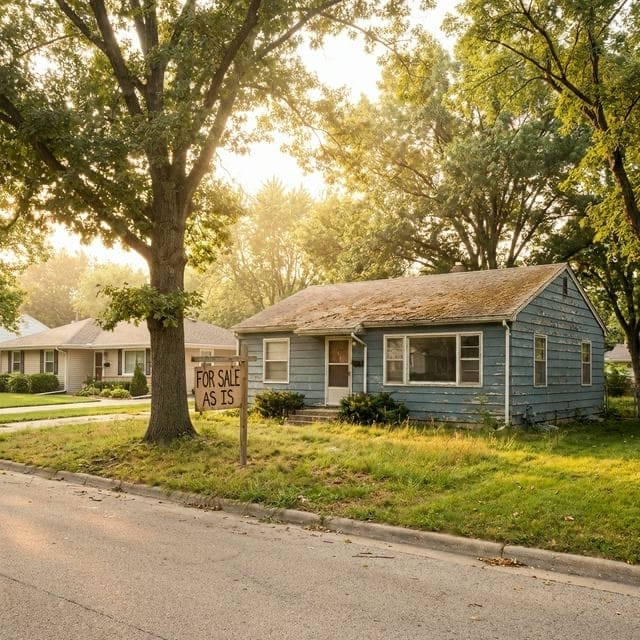
How much do you lose selling a house as is? Most homeowners see a 5% to 20% reduction from fair market value, with properties needing major structural work losing as much as 25% to 30%. Those numbers can feel alarming, but they only tell part of the story.
The actual loss depends on your property’s condition, local market demand, the type of buyer you attract, and whether you handle the sale strategically. Let’s break down the real math so you can decide whether selling your house as is makes sense for your situation.
In this Guide
What Does “Selling As Is” Actually Mean?
Selling a house as is signals to buyers that you will not make repairs or improvements before closing. The buyer accepts the property in its current condition, whether that means cosmetic wear or major structural issues.
Here is what selling as is does not mean:
- You can skip property disclosures (you cannot)
- Buyers cannot get inspections (they can)
- You avoid all negotiations (buyers may still walk away)
In New York and New Jersey, sellers must still complete property disclosure forms. New York mandates a Property Condition Disclosure Statement (PCDS) with up to 56 questions about the property’s condition. As of March 2024, sellers can no longer pay a $500 credit to skip this requirement. You can review the official NY PCDS form on the Department of State website.
New Jersey requires disclosure of known material latent defects and, as of March 2024, specific information about flood history and risk. Hiding known problems exposes you to legal liability even with an as-is clause. Buyers also retain the right to include an inspection contingency, which means they can back out or renegotiate if the inspection reveals issues beyond what they expected.
The Real Numbers: How Much Less Will You Get?
The discount buyers expect depends primarily on repair costs they will inherit. Here is how the percentages typically break down:
| Property Condition | Expected Discount | Example on $500K Home |
|---|---|---|
| Cosmetic issues only (paint, carpet, dated finishes) | 5-10% | $25,000 – $50,000 |
| Moderate repairs (roof patches, HVAC service, flooring) | 10-20% | $50,000 – $100,000 |
| Major repairs (foundation, full roof, plumbing/electrical) | 20-30% | $100,000 – $150,000 |
| Distressed or uninhabitable condition | 30-50% | $150,000 – $250,000 |
Cash buyers and investors typically offer the steepest discounts because they factor in repair costs, carrying costs, their own profit margins, and risk premiums. Quick cash offer companies often pay 70% to 85% of after-repair value, meaning you could lose 15% to 30% off current market value.

Who Buys As-Is Properties?
Understanding your likely buyer pool helps explain the pricing pressure:
Real estate investors and house flippers represent the largest segment of as-is buyers. They calculate offers using the 70% rule: they pay no more than 70% of the after-repair value, minus repair costs. On a home worth $400,000 after $50,000 in repairs, that formula yields a maximum offer of $230,000.
Cash buyers seeking deals move fast but expect steep discounts for the convenience and certainty they provide. They eliminate financing contingencies and often close in 2-3 weeks versus 45-60 days for traditional sales.
Budget-conscious first-time buyers willing to do sweat equity may offer closer to market value, but they often require financing. FHA and VA loans have property condition requirements that may disqualify homes needing major repairs. Some buyers in this category request a home warranty as part of the deal, adding $400 to $600 to your closing costs but keeping the sale on track.
Market Conditions Change the Math
The same as-is property can command very different prices depending on market dynamics:
In a seller’s market with low inventory and high demand, buyers may overlook needed repairs to secure a home. The as-is discount shrinks because competition drives prices up even for imperfect properties.
In a buyer’s market with more homes than buyers, as-is properties sit longer and attract lower offers. Buyers have options, reducing their motivation to take on a project.
Staten Island and parts of New Jersey have seen strong seller conditions recently, which can minimize the as-is penalty. Check current market supply data before pricing your home.
When Selling As Is Makes Financial Sense
Despite the lower sale price, selling as is can be the right choice in these situations:
You Inherited a Property
Inherited homes often need updates and come with carrying costs you did not budget for. The stepped-up cost basis for inherited property means selling soon after inheritance minimizes capital gains tax, even at a lower price. The IRS covers this rule in detail in Publication 551. Holding the property to make repairs means paying property taxes, insurance, and maintenance while the estate remains unsettled.
The Repair Costs Exceed the Value Added
Not every repair returns its cost in added sale price. If your home needs $60,000 in repairs but would only sell for $40,000 more after completion, the numbers favor selling your house as is.
High-ROI improvements like garage door replacement (194% average ROI) and steel entry doors (188% ROI) can be worth doing, according to the 2024 Cost vs. Value Report. Major structural work rarely recoups its full cost.
You Need Speed Over Maximum Price
Divorce settlements, job relocations, foreclosure prevention, and estate settlements all create timelines that make repairs impractical. An as-is sale can close in 2-3 weeks versus 3-6 months for a repair-then-list approach. If your mortgage balance exceeds the as-is value, you may need to explore a short sale, which requires lender approval and comes with its own timeline.
You Lack the Funds or Credit for Repairs
Without cash or home equity for improvements, selling as is may be your only option. Some seller concession strategies can bridge the gap, but they still reduce your net proceeds.
When You Should Make Repairs Instead
The math sometimes favors investing in repairs before listing:
Cosmetic Updates With High ROI
Minor kitchen remodels recoup about 96% of their cost. Fresh paint, new flooring, and updated fixtures can shift buyer perception from “fixer-upper” to “move-in ready,” potentially adding 10-15% to your sale price for a 3-5% investment.
Repairs Required for Conventional Financing
Homes that fail to qualify for FHA or conventional loans lose most of their buyer pool. Fixing health and safety issues (faulty electrical, roof leaks, mold) opens your property to financed buyers who typically pay more than cash investors.
Properties in High-Demand Locations
In premium neighborhoods like Todt Hill or Holmdel, buyer expectations run higher. A slightly dated home might still sell well, but serious deferred maintenance can create outsized discounts in markets where buyers expect quality.
How to Minimize Your Loss on an As-Is Sale
Even when selling as is, strategic choices can narrow the discount:
Get an Honest Pre-Listing Assessment
Know exactly what your home needs before pricing it. A pre-listing inspection gives you ammunition to counter lowball offers from buyers claiming hidden problems.
Price Aggressively From Day One
Overpriced as-is listings sit on market and attract even lower offers. Research comparable sales in your area and price slightly below to generate multiple offers.
Market to the Right Buyer Pool
Cash investors, house flippers, and contractors actively seek as-is properties. Your agent should know how to reach these buyers directly rather than relying only on MLS exposure.
Disclose Everything Upfront
Complete transparency builds buyer confidence. Surprises during inspection tank deals or trigger last-minute price renegotiations. Full disclosure protects you legally and keeps transactions on track.
Consider a Pre-Listing Appraisal
Professional appraisals establish fair market value before negotiations begin. This prevents drastic under-pricing while giving buyers confidence your ask reflects reality.
How Much Do You Lose Selling a House As Is vs. Repairing First?
Let’s run the numbers on a hypothetical $450,000 Staten Island home needing $40,000 in repairs:
Scenario A: Sell House As Is
- Market value: $450,000
- As-is discount (15%): -$67,500
- Gross sale price: $382,500
- Closing costs (6%): -$22,950
- Net proceeds: $359,550
- Time to close: 3-4 weeks
Scenario B: Repair Then Sell
- Market value: $450,000
- Repair costs: -$40,000
- Gross sale price: $450,000
- Closing costs (6%): -$27,000
- Net proceeds: $383,000
- Time to close: 4-6 months
The repaired sale nets $23,450 more, but requires $40,000 upfront and 3-5 additional months. For sellers without cash reserves or facing urgent timelines, the as-is path may still make sense despite lower proceeds. Factor in carrying costs during the repair period (mortgage payments, property taxes, insurance, utilities) and the gap shrinks further.

NY and NJ Disclosure Requirements for As-Is Sales
Selling as is does not eliminate your disclosure obligations. Here is what each state requires:
New York Requirements
The Property Condition Disclosure Statement (PCDS) covers:
- Structural components (foundation, roof, walls)
- Mechanical systems (HVAC, plumbing, electrical)
- Environmental hazards (lead paint, asbestos, radon)
- Known defects and past issues (flooding, fire damage, pest infestations)
Sellers must deliver the completed PCDS before the buyer signs a binding contract. Failure to provide it previously allowed a $500 credit, but this option ended in March 2024.
New Jersey Requirements
New Jersey requires disclosure of:
- Known material latent defects not discoverable through reasonable inspection
- Flood history and flood risk (mandatory as of March 2024)
- Any conditions affecting habitability
The state maintains an implied warranty of habitability even in as-is sales. Intentional or negligent concealment of material facts can result in contract rescission or monetary damages.
Work with a real estate attorney familiar with NY/NJ requirements to ensure your disclosures meet legal standards.

Frequently Asked Questions
Does selling as is mean I can skip the home inspection?
No. Buyers can still hire a home inspector and may negotiate price reductions or walk away based on findings. “As is” means you will not make repairs before closing, not that buyers forfeit their right to investigate. In fact, most buyers include an inspection contingency in their offer, giving them a window to back out if they find problems beyond what they expected. Your best protection is a pre-listing inspection so nothing catches you off guard.
Will I still pay realtor commissions on an as-is sale?
Yes. Unless you sell directly to a cash buyer without agent representation, standard real estate commissions still apply. In New York and New Jersey, combined agent commissions typically run 5% to 6% of the sale price. Some cash buyer companies eliminate commissions but factor that savings into a lower purchase price, so the net difference to you is often small.
Can I sell as is if I have a mortgage?
Yes, as long as the sale proceeds cover your remaining mortgage balance. If you owe more than the as-is value, you may need to pursue a short sale with lender approval. Short sales involve the bank agreeing to accept less than the outstanding loan balance, and they typically add 2-4 months to the closing timeline. Talk to your lender early if you think this applies to your situation.
How long does an as-is sale take to close?
Cash as-is sales can close in 1-3 weeks because there is no lender appraisal or financing approval process. Sales involving buyer financing typically take 30-45 days, similar to traditional closings. The real time savings comes from skipping the repair phase entirely. A traditional seller might spend 2-4 months on renovations before listing, followed by another 30-60 days to close. Selling as is compresses that entire window.
Should I list as is or just price lower?
Listing as is sets clear expectations upfront. Pricing lower without the as-is label may attract buyers who expect you to handle repairs after inspection, leading to difficult renegotiations or deal cancellations. The “as is” designation filters your buyer pool to people who understand the trade-off: they accept the property’s current condition in exchange for a lower price. This alignment reduces friction and keeps closings on schedule.
The Bottom Line on Selling As Is
How much do you lose selling a house as is? The answer ranges from 5% for cosmetically dated homes to 30% or more for properties with deep structural problems. But “losing” money on the sale price is only half the equation. You also save on repair costs, carrying costs during a renovation period, and months of uncertainty.
The right move depends on your property’s condition, your financial situation, and your timeline. If you have the cash and patience for repairs that return more than they cost, fixing up before listing will almost always net more. If speed, simplicity, or limited funds drive your decision, a well-priced as-is sale to the right buyer can still be a smart financial outcome.
Ready to see where your property stands? Get a free home valuation to compare your as-is and after-repair options side by side.