
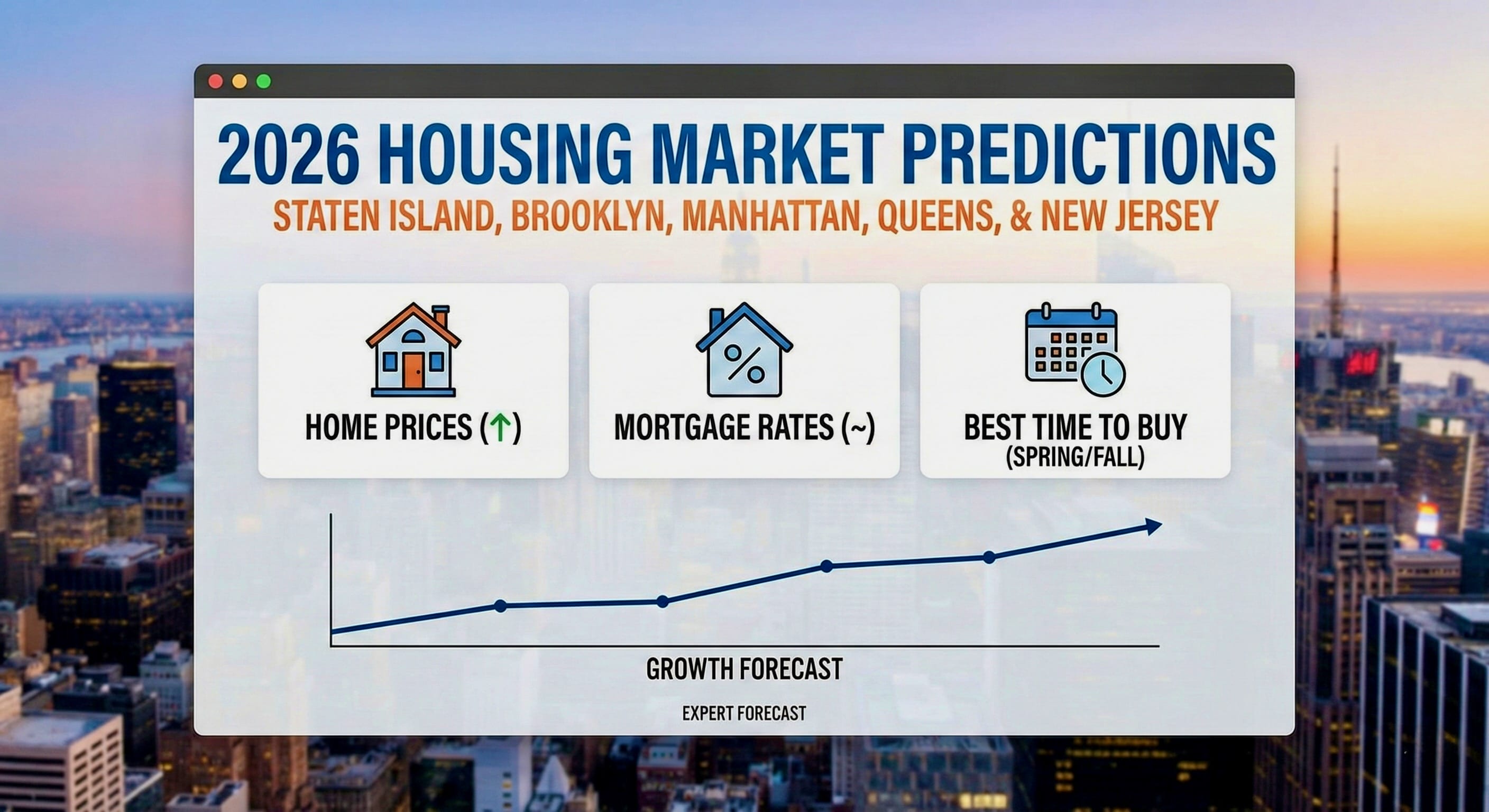
Housing market predictions 2026 point toward gradual stabilization across the NYC metro area. After years of rapid price increases and record-low inventory, the market shows signs of returning to a more balanced state. For buyers and sellers in Staten Island, Brooklyn, Manhattan, Queens, and New Jersey, the year ahead brings both opportunities and challenges worth understanding.
This guide covers what leading economists from Zillow, Redfin, and the National Association of Realtors forecast for home prices, mortgage rates, and sales activity. You will also find specific predictions for each borough and Northern New Jersey markets served by Robert DeFalco Realty.
Table of Contents
National Housing Market Outlook 2026
The U.S. housing market in 2026 enters a phase of modest growth rather than the dramatic swings seen in recent years. Here is what the data shows:
Home Price Forecasts
Multiple sources converge on a similar outlook for national home prices:
| Source | 2026 Price Forecast |
|---|---|
| Zillow | +1.2% to +1.9% |
| Redfin | +1% |
| Realtor.com | +2.2% |
| National Association of Realtors | +4% |
The average across forecasts suggests approximately 1.4% appreciation nationally. This modest growth reflects strong job numbers and persistent housing shortages providing a floor under prices.
Mortgage Rate Predictions
Mortgage rates remain the wildcard for housing market predictions 2026. Current forecasts show:
- National Association of Realtors: 6.0% by year-end 2026
- Redfin: 6.3% average for 2026
- Fannie Mae: 5.9% by end of 2026
- Mortgage Bankers Association: 6.4% average Q1 2026
Most economists expect rates to stay in the low-6% range through 2026, with potential dips toward 5.5% if inflation continues cooling. This gradual decline offers modest relief compared to the sub-4% rates of 2021, but represents improvement over the 7%+ peaks of 2023.
Inventory and Sales Volume
Housing inventory shows encouraging signs of recovery. According to Realtor.com, new listings increased compared to 2025, while existing home sales are projected to rise 1.7% to 14% depending on the forecast source.
The market is shifting subtly toward buyers. Increased inventory means less pressure to make rushed decisions, though NYC remains seller-favorable due to persistent supply constraints.
Housing Market Predictions 2026: Staten Island
Staten Island continues to offer NYC’s best value for single-family homes. The 2026 forecast shows steady appreciation with strong demand from first-time buyers.
Current Market Conditions
| Metric | Staten Island 2026 Forecast |
|---|---|
| Median Sale Price | $779,000 to $787,000 |
| Year-over-Year Growth | 3% to 4% |
| Days on Market | 40 to 50 days |
| Primary Buyers | First-time buyers, families relocating from Brooklyn |
The persistent inventory deficit creates what analysts call a “price floor” for Staten Island real estate. Sellers benefit from constrained supply while buyers face continued competition for well-priced properties.
Best Staten Island Neighborhoods for 2026
For buyers searching for homes for sale on Staten Island, several neighborhoods stand out:
South Shore: Tottenville, Great Kills, and Annadale attract families seeking larger lots and suburban character. Median prices range from $650,000 to $850,000.
Mid-Island: Arden Heights and Huguenot offer starter homes under $600,000, making them popular with first-time homebuyers.
North Shore: St. George and New Brighton provide ferry access to Manhattan, attracting commuters willing to trade space for location.
Staten Island Investment Potential
According to recent data on Staten Island real estate market trends, the borough shows the highest homeowner turnover rate in NYC. This creates opportunities for investors and house flippers, though the 3-4% appreciation forecast suggests renovation profits require careful calculation.
Housing Market Predictions 2026: Brooklyn
Brooklyn’s housing market predictions 2026 show resilience despite national headwinds. The borough’s diverse neighborhoods create a fragmented market where conditions vary block by block.
Brooklyn Market Overview
| Metric | Brooklyn 2026 Forecast |
|---|---|
| Median Sale Price | $998,000 |
| Price per Square Foot | $1,019 (up 6.4% YoY) |
| Sales Volume | Highest since 2022 |
| Inventory | Below 10-year average |
The price per square foot increase of 6.4% tells the real story. Buyers pay more for less space as tight inventory persists. This trend hits hardest in brownstone Brooklyn, where competition for townhouses remains fierce.
Hot Brooklyn Neighborhoods for 2026
For buyers exploring Brooklyn homes for sale, consider these areas:
Crown Heights: Typical home values projected to reach $1.25 million to $1.35 million by late 2026. Crown Heights real estate attracts investors and families priced out of Park Slope.
Gowanus: New rental and condo inventory coming online. The rezoning has transformed this formerly industrial area into a development hotspot.
Bay Ridge: Remains relatively affordable for Brooklyn at $750,000 to $950,000 median. Strong for families seeking good schools and transit access.
Carroll Gardens: Premium brownstone pricing above $2 million. Inventory exceptionally tight in this established neighborhood.
Brooklyn Rental Market 2026
Renters in Brooklyn face accelerating rent growth. Declining vacancy rates and persistent demand, driven by return-to-office policies since 2022, continue pushing rents higher. The Brooklyn real estate market guide covers both purchase and rental trends in detail.
Housing Market Predictions 2026: Manhattan
Manhattan’s housing market enters what analysts describe as a “steady, healthier cycle” in 2026. The luxury segment shows renewed activity after the pandemic uncertainty.
Manhattan Market Data
| Metric | Manhattan 2026 Forecast |
|---|---|
| Sales Volume Growth | Up 14% over 2025 |
| Price Growth | 4% to 6% citywide |
| Inventory | Tight; supply dropping faster than demand |
| Mortgage Rates | Above 6%, gradually moderating |
Sales volume projections of 14% growth represent the highest levels since 2022. Buyers who paused during 2024-2025 rate volatility are returning to the market.
Manhattan Luxury Real Estate Trends
The ultra-luxury segment along Billionaires Row shows continued international demand. Developments featuring advanced amenities like air filtration systems, whole-house water purification, and meditation rooms command premium pricing.
For those seeking more attainable options, Manhattan homes under $900,000 exist primarily in upper Manhattan and select co-op buildings requiring board approval.
What Manhattan Buyers Should Know
Competition will favor well-priced listings. Homes in good condition that are priced realistically will move quickly. The Manhattan real estate market report tracks monthly trends for serious buyers.
Housing Market Predictions 2026: Queens
Queens emerges as NYC’s most dynamic market for 2026. Several neighborhoods show massive search increases, signaling strong buyer demand ahead of price movements.
Queens Market Snapshot
| Metric | Queens 2026 Forecast |
|---|---|
| Median Home Price | $718,000 to $975,000 |
| Year-over-Year Growth | 7% to 12% |
| Hot Neighborhoods | Sunnyside, Ridgewood, Long Island City |
| Inventory Trend | Moderate increases from new developments |
The 12.3% price growth in Q4 2025 positions Queens as the appreciation leader among NYC boroughs. Buyers seeking relative value compared to Brooklyn are driving demand.
Hottest Queens Neighborhoods for 2026
According to StreetEasy data, these areas lead search activity:
Sunnyside: A 43.7% increase in searches makes Sunnyside the most in-demand neighborhood among NYC’s top 10. Median asking price of $475,000 represents exceptional value for a Queens location.
Ridgewood: Proximity to Brooklyn draws buyers seeking similar character at lower prices. Two-family homes remain popular for owner-occupants seeking rental income.
Long Island City: Waterfront developments add inventory while capturing downtown Manhattan commuters. New construction condos lead the market.
Queens Buyer Demand Patterns
Single-family and multi-family homes that are vacant, or guaranteed delivered vacant, command premium interest. Two-bedroom co-ops priced correctly sell quickly, especially units with parking or outdoor space.
Housing Market Predictions 2026: New Jersey
New Jersey’s housing market forecast shows stabilization after years of rapid appreciation. The 2026 outlook favors informed buyers willing to move decisively.
New Jersey Market Forecast
| Metric | New Jersey 2026 Forecast |
|---|---|
| Price Growth | 2% to 4% |
| Inventory | Rising 8.9% (Realtor.com projection) |
| Mortgage Rates | Low-6% range |
| Market Dynamic | More balanced; buyers gain negotiating power |
This represents a significant shift from the double-digit gains seen in 2021-2023. The market favors those who understand local conditions rather than national headlines.
Best New Jersey Towns for NYC Commuters
For buyers exploring New Jersey homes for sale, commute access drives value:
Bayonne: Light rail connects to Hoboken and Jersey City. Median prices remain below $500,000 for condos, making it popular with first-time buyers. The Bayonne neighborhood guide covers living details.
Jersey City: PATH train access to Manhattan attracts Brooklyn refugees. The Heights and Journal Square offer value plays compared to downtown waterfront pricing.
Hoboken: Premium pricing reflects walkability and transit. Young professionals and empty nesters dominate the buyer pool.
Hudson County overall attracts buyers priced out of Manhattan and Brooklyn, with appreciation rates often exceeding statewide averages.
New Jersey Property Tax Considerations
Property taxes remain a key factor for New Jersey buyers. The NJ property tax comparison calculator helps buyers understand true carrying costs. Towns like Bayonne and Jersey City often have higher rates than suburban alternatives, though lower home prices can offset this.
Understanding closing costs in New Jersey proves essential for accurate budgeting.
Mortgage Rate Forecast 2026
Mortgage rates dominate any housing market predictions 2026 discussion. Here is what current forecasts suggest:
Rate Projections by Source
| Source | Rate Forecast |
|---|---|
| National Association of Realtors | 6.0% by year-end |
| Redfin | 6.3% average |
| Fannie Mae | 5.9% by year-end |
| Mortgage Bankers Association | 6.4% Q1 average |
What Rate Changes Mean for Buyers
Every 0.5% rate decrease translates to roughly $50 to $60 per month in payment savings on a $500,000 mortgage. A drop from 6.5% to 5.5% would save approximately $120 monthly, or $1,440 annually.
If rates approach 5.5%, expect a surge of buyers re-entering the market. This could compress inventory and spark bidding competition in desirable neighborhoods. Buyers waiting for lower rates may face higher prices when those rates arrive.
The mortgage prequalification vs preapproval guide explains how to prepare for rate movements.
When Will Housing Market Improve for Buyers?
Many buyers ask when housing market predictions 2026 will favor them. The honest assessment: NYC is not projected to become a buyer’s market in 2026. Zillow ranks New York City 47th out of 49 metros for buyer-friendliness.
Why NYC Remains Challenging for Buyers
- Inventory stays below historical averages: Years of underbuilding created supply deficits that won’t resolve quickly
- Demand remains strong: Both local and out-of-state buyers compete for limited properties
- New construction lags population: Building permits don’t match housing formation rates
- Rent increases push renters toward buying: High rents make ownership relatively more attractive
Incremental Improvements Expected
Affordability should improve gradually as wages grow faster than home prices. According to Zillow, mortgage payments as a percentage of median income should drop from 32.6% to 31.8% by year-end 2026. This represents progress, though not a dramatic shift.
Will Housing Market Crash in 2026?
No credible forecast predicts a housing market crash for NYC metro or New Jersey in 2026. Here is why:
Crash Risk Factors Are Absent
Strong lending standards: Unlike 2008, today’s mortgages require verified income, substantial down payments, and reasonable debt-to-income ratios.
Homeowner equity cushion: Owners who bought before 2020 have substantial equity buffers against price declines.
Employment stability: NYC’s job market continues recovering, supporting housing demand.
Supply constraints: A crash requires supply overwhelming demand. Current NYC conditions show the opposite.
What to Expect Instead
Rather than a crash, expect a “housing reset”: gradual normalization of prices, modest corrections in overheated pockets, and slowly improving affordability as incomes catch up to housing costs.
Pros and Cons: Buying in 2026
Advantages of Buying in 2026
- Rates likely peaked: Mortgage rates appear past their highs, with gradual declines expected
- Inventory improving: More choices than 2024-2025 in most markets
- Sellers more realistic: Pricing expectations have adjusted from frenzied 2022 levels
- Building equity beats renting: Rising rents make ownership cost-competitive in many areas
- Less competition than 2021-2022: Bidding wars are less common, allowing more thoughtful decisions
Challenges of Buying in 2026
- Prices still elevated: No dramatic discounts expected in NYC metro
- Rates remain historically high: 6% mortgages cost more than the 3-4% rates of 2020-2021
- Affordability stretched: Income-to-price ratios remain challenging
- Carrying costs high: Property taxes, insurance, and maintenance add significantly to ownership costs
Investment Strategies Based on Housing Market Predictions 2026
For real estate investors analyzing housing market predictions 2026, the NYC metro offers distinct opportunities by property type and location.
Cash Flow Investment Targets
Investors seeking rental income should focus on:
Staten Island Multi-Family: Two- and three-family properties in South Shore neighborhoods generate steady cash flow. Entry prices between $600,000 and $900,000 offer better cap rates than Brooklyn or Manhattan.
Queens Two-Family Homes: Sunnyside and Ridgewood attract renter demand from Brooklyn overflow. Owner-occupied financing with rental income helps qualify for larger purchases.
New Jersey Multi-Family: Edison and Perth Amboy offer more affordable multi-family options with strong rental demand.
Appreciation Investment Targets
Investors prioritizing long-term value growth should consider:
Crown Heights and Bedford-Stuyvesant: Brooklyn’s price appreciation continues outpacing citywide averages. Bed-Stuy properties benefit from Manhattan proximity and improving transit.
Long Island City: New developments add inventory while waterfront appeal and LIRR access drive demand. This Queens location bridges Manhattan convenience with Brooklyn alternative pricing.
Jersey City Heights: Gentrification continues pushing prices upward in this Hudson County neighborhood with PATH access.
First-Time Investor Considerations
New investors entering based on housing market predictions 2026 should understand local landlord regulations. New York City’s rent stabilization laws and recent FARE Act changes affect rental property economics. Running the numbers with buying vs renting calculations helps determine investment viability.
Rental Market Outlook 2026
The rental market directly impacts housing market predictions 2026 as high rents push some tenants toward purchasing.
NYC Rent Growth Forecast
| Borough | 2026 Rent Forecast |
|---|---|
| Manhattan | +5% to +7% |
| Brooklyn | +4% to +6% |
| Queens | +3% to +5% |
| Staten Island | +2% to +4% |
Vacancy rates remain near historic lows across NYC. Return-to-office policies continue driving demand, particularly in Manhattan and transit-accessible Brooklyn and Queens neighborhoods.
When Does Buying Beat Renting?
In high-rent markets, the buy vs. rent calculation often favors purchasing sooner than traditional wisdom suggests. Key factors include:
- Rent increases compound: A 5% annual rent increase on a $3,500 apartment adds $175 monthly in year two, $366 in year three
- Mortgage payments stay flat: Fixed-rate mortgages lock in your largest housing expense
- Equity builds wealth: Principal payments reduce loan balance while you build ownership stake
- Tax benefits apply: Mortgage interest and property tax deductions reduce effective housing costs
For detailed analysis, the saving for a down payment guide covers NYC-specific strategies.
New Construction Impact on Rents
Brooklyn and Queens lead new construction activity. Areas like Downtown Brooklyn and Long Island City see significant rental inventory additions. This new supply may moderate rent growth in specific submarkets while older inventory in stable neighborhoods faces less pressure.
What First-Time Buyers Should Know for 2026
First-time homebuyers face unique challenges in the NYC metro market. The housing market predictions 2026 suggest preparation makes the difference between success and frustration.
Getting Pre-Approved Early
Understanding the difference between mortgage prequalification and preapproval matters in competitive markets. Full pre-approval with documentation shows sellers you can close, strengthening your offers.
Down Payment Programs
New York and New Jersey offer first-time home buyer programs that reduce down payment requirements. These programs have income limits and property restrictions but can make the difference for qualified buyers.
Avoiding Common Mistakes
The most common first-time homebuyer mistakes in NYC include:
- Underestimating closing costs (typically 3-5% beyond down payment)
- Overlooking co-op maintenance fees when comparing to condos
- Skipping home inspections in competitive situations
- Not budgeting for post-purchase repairs and improvements
A thorough home inspection checklist protects against costly surprises after closing.
Frequently Asked Questions
Will house prices drop in NYC in 2026?
Significant price drops are not expected. Most forecasts show modest appreciation of 1% to 6% depending on borough and neighborhood. Some overpriced pockets may see flat pricing, but dramatic declines remain unlikely given tight inventory across the metro area.
Is 2026 a good time to buy a house in New York?
For buyers who are financially ready, 2026 offers improving conditions compared to 2024-2025. Mortgage rates are expected to moderate, and inventory is slowly growing. Waiting for a “crash” risks missing opportunities as competition increases when rates drop further.
What are the hottest real estate markets in NYC for 2026?
Queens leads with Sunnyside, Ridgewood, and Long Island City showing strong search increases. Brooklyn’s Crown Heights and Gowanus continue attracting buyers. Staten Island remains the affordability leader for single-family homes.
Will mortgage rates go down in 2026?
Most economists expect modest rate relief, with 30-year fixed rates potentially dropping to the low-6% range. Some projections show rates approaching 5.5% to 5.9% by late 2026. This depends heavily on Federal Reserve policy and inflation trends.
When will housing market become a buyers market?
NYC is not projected to become a true buyer’s market in 2026. The combination of limited inventory, strong demand, and persistent housing shortages keeps negotiating power with sellers in most neighborhoods. Buyers can find opportunities, but should expect competition for desirable properties.
Is New Jersey a good place to invest in real estate in 2026?
Northern New Jersey, especially towns with NYC commuter access, offers solid investment potential. Hudson County and the Gold Coast continue attracting buyers priced out of Manhattan and Brooklyn. The New Jersey housing market analysis covers investment specifics.
How much will interest rates drop in 2026?
Rate forecasts suggest a gradual decline of 0.3% to 0.7% over the year. If starting at 6.5%, rates may reach 5.8% to 6.2% by December 2026. The pace depends on economic conditions and Federal Reserve decisions.
Should I wait to buy a house until 2027?
This depends on your financial situation and goals. Waiting may bring slightly lower rates but could also mean higher prices if inventory tightens. Running the numbers on how much house you can afford helps clarify timing decisions.
Next Steps: Finding Your Home in 2026
Housing market predictions 2026 favor prepared buyers who understand local conditions. The NYC metro market rewards those who research neighborhoods, get pre-approved early, and move decisively when the right property appears.
Whether you’re searching for a starter home in Staten Island, a Brooklyn brownstone, or a New Jersey townhouse with NYC access, having local expertise makes the difference.
Robert DeFalco Realty has guided buyers and sellers through NYC metro real estate for over 35 years. Our agents understand these neighborhoods block by block, from Staten Island’s South Shore to Brooklyn’s brownstone belt to New Jersey’s Gold Coast.
Ready to start your search? Contact our team for a free consultation, or browse current listings across Staten Island, Brooklyn, Manhattan, Queens, and New Jersey.
Sources: