
If you’ve been reading the national headlines about a “cooling” U.S. housing market and waiting for prices to drop on Staten Island, you’re looking at the wrong map.
Real estate is hyper-local. What’s happening in Phoenix or Austin has nothing to do with what’s happening in Tottenville or Westerleigh. And the data coming out of our borough for early 2026 paints a very specific picture: Staten Island isn’t cooling off. It’s locking in.
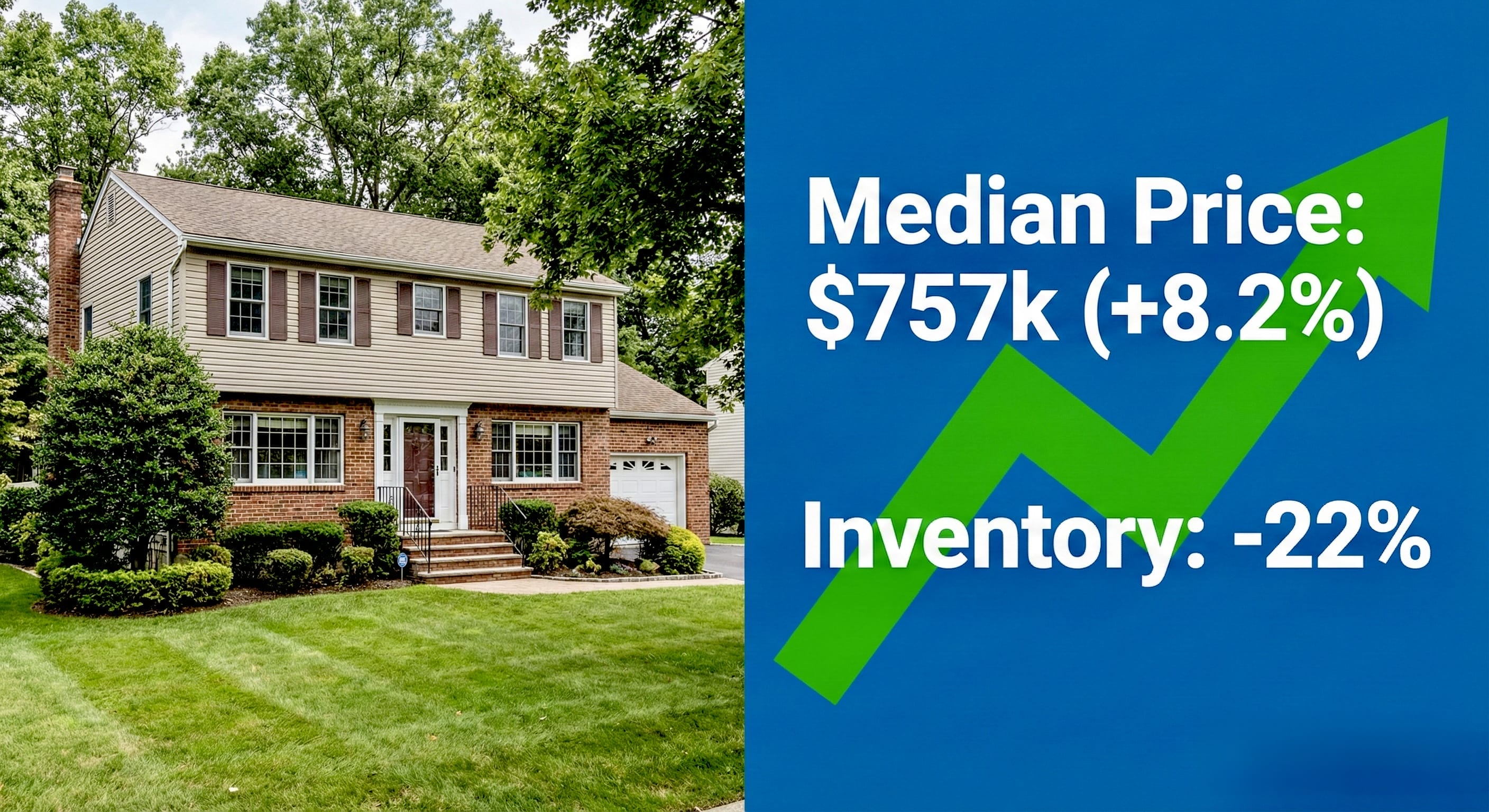
While pundits predicted a crash, Staten Island real estate has done what it historically does best—retain value. As of early 2026, the median sales price here sits at $755,000, holding steady with a 3.4% year-over-year increase.
But that number only tells half the story.
Whether you’re a homeowner sitting on equity, a buyer trying to time your entry, or an investor looking for a safe harbor, you’re likely feeling paralyzed by the same three questions:
- “With rates settling into the low 6% range (currently 6.23%), is it better to buy now or wait for a drop?”
- “Did I miss the peak for selling my home?”
- “Is this sustainable, or is a correction coming later in 2026?”
The “Inventory Gap” Reality
The reason prices haven’t dropped—despite higher borrowing costs—is simple supply and demand. We’re currently seeing an inventory deficit of roughly 29% compared to balanced market norms — just 887 active listings and 2.7 months of supply.
Many homeowners are “locked in” to their sub-3% mortgage rates from 2020-2021, meaning they aren’t selling unless they absolutely have to. This has created a floor for home prices. There simply aren’t enough homes for the buyers who want them.
In this market update, we’re going deeper than the Zillow estimates. We’re breaking down exactly what this “Lock-In Market” means for your bottom line, identifying the neighborhoods that are outperforming the average, and providing the mathematical truth about the cost of waiting.
If you’re looking for generic advice, check the national news. If you want a strategy for Staten Island wealth retention, keep reading.
For Sellers: The “Inventory Gap” is Your Greatest Leverage
If you’re a homeowner on Staten Island, you’re likely sitting on a mortgage rate under 4%. The thought of trading that for a rate near 6.5% feels counterintuitive. We get it.
But that hesitation is exactly what has created the most favorable selling environment we’ve seen in years—scarcity.
Because so many Staten Islanders are “locked in” to their current homes, new listing volume has plummeted. In a typical balanced market, buyers have dozens of options in every neighborhood. Today, a buyer looking for a move-in ready colonial in Great Kills or a semi-attached in New Springville might only see two viable options.
Supply vs. Demand: By the Numbers
Here’s why the math works in your favor in early 2026:
- The 29% Deficit: Active inventory has dropped 29% year-over-year to just 887 units — the tightest supply since 2022.
- Price Retention: Because supply is low, the median price has held firm at $755,000. We’re not seeing the price slashing common in other U.S. markets.
- The Equity Buffer: If you bought your home 5+ years ago, consistent annual appreciation (3.4% YoY as of January 2026) means you likely have significant equity. This equity can be used to buy down the rate on your next home or make a larger down payment, reducing the impact of the higher interest rate environment.
The Caveat: Pricing Strategy is Everything
While it’s a seller’s market, it’s not the “wild west” of 2021. Buyers are savvy and stretched thin by rates. They won’t overpay for aspirational pricing.
- Days on Market (DOM): The average home is sitting for about 78 days, down 12.7% from last year..
- The Danger Zone: Homes priced 10% above market value are stagnating.
- The Sweet Spot: Homes priced at market value are seeing multiple offers because they stand out against the overpriced, stale inventory.
The Takeaway: You have less competition today than you will likely have in 2026. If rates drop significantly next year, a flood of sellers will unlock and hit the market, diluting your leverage. Selling now makes you a big fish in a small pond.
What’s your home actually worth in this low-inventory climate?
Automated online estimates can lag behind the market by months.
For Buyers: The “Cost of Waiting” is Higher Than the Rate
If you’re a buyer, you’re likely staring at mortgage rates hovering near 6.5% and wondering if you should wait for them to drop back to 5%.
It’s a valid question. But in real estate, time is rarely your friend.
While you’re waiting for rates to drop, Staten Island home prices aren’t standing still. They’re rising at roughly 8% per year. Let’s break down the math of “waiting” on a typical $750,000 Staten Island home.
The “Wait vs. Buy” Calculation
Let’s say you decide to wait 12 months, hoping rates drop from 6.23% to 5.5%.
- Scenario A (Buy Now): You buy at $750,000. You pay a higher rate for a year, but you lock in the price.
- Scenario B (Wait 1 Year): You wait. If prices rise just 3-4% (in line with current trends), that $755,000 house is now $777,650 to $785,200.
The Result: You might save $300/month on interest by waiting, but you just paid $22,650 to $30,200 more for the asset. You would need years of lower interest payments just to break even on the higher purchase price.
The Strategy: “Marry the House, Date the Rate”
This isn’t just a catchy slogan; it’s the financial strategy of 2026.
- Lock in the Asset Price: Secure the home now before inventory tightens further and prices climb to $780k+.
- Refinance Later: When rates dip (as analysts predict for late 2026/27), you refinance into a lower rate. You cannot refinance a higher purchase price.
Where’s the Opportunity?
While the market is competitive, it’s not impossible. We’re seeing savvy buyers succeed by targeting “sleeping” listings—homes that have been on the market for 60+ days because they were initially overpriced.
- Tip: Ask us to filter your search for homes with >60 Days on Market (DOM). These sellers are often motivated and willing to offer “rate buy-downs” (credits at closing to lower your interest rate for the first 2 years).
Stop Guessing Your Monthly Payment.
Taxes, insurance, and HOA fees vary wildly from Tottenville to St. George.
Calculate your real affordability before you start searching.
Neighborhood Watch: Where the Smart Money is Moving in 2026
Staten Island isn’t a monolith. It’s a collection of micro-economies, each behaving differently in this high-rate environment. To succeed in 2025, you need to know which “zone” matches your financial goals.
1. The “North Shore Growth” Play (St. George, Stapleton, West Brighton)
- The Vibe: Urban, transit-oriented, and evolving.
- The Data: While historically more volatile, the North Shore is currently the “Value Leader.” Median listing prices here are hovering around $640,000, significantly more accessible than the island average.
- The “Insider” Driver: Keep your eyes on the $400M North Shore Action Plan. With the Mary Cali Dalton Recreation Center (slated for 2027) and the ongoing New Stapleton Waterfront infrastructure, this area is arguably the best “long-term hold” for investors looking for appreciation over immediate cash flow.
2. The “South Shore Safe Harbor” (Tottenville, Prince’s Bay, Huguenot)
- The Vibe: Established wealth, manicured streets, and high ownership pride.
- The Data: Prices here are resilient. Tottenville and Prince’s Bay are seeing median values between $870,000 and $1.25M+.
- The Reality: This isn’t a “flipper’s” market. This is a “wealth preservation” market. Buyers here are paying a premium for stability and school districts. If you’re selling here, patience is key—luxury inventory moves slower (90+ days), but the price floor is solid.
3. The “Mid-Island Sweet Spot” (Westerleigh, New Springville)
- The Vibe: The practical heart of the island.
- The Data: This is where the volume is. Families priced out of Brooklyn but wanting a suburban feel are flocking here. Homes priced correctly ($720k–$810k) in these zip codes are still seeing bidding wars if they’re move-in ready.
Advanced Strategy: The “Hidden” Costs (and Gains) of 2025
Before you make a move, you need to clear a few hurdles that online calculators often miss.
The “Flood Zone” Factor
Insurance premiums are reshaping affordability on the East Shore (Midland Beach/South Beach).
- The Warning: If you’re buying in a flood zone, factor in an additional $1,200–$5,000+ annually for flood insurance.
- The Tip: Ask us for the specific “Elevation Certificate” status of a home before making an offer. A home raised above the Base Flood Elevation (BFE) can save you thousands a year—and has higher resale value.
The “Renovation ROI” Myth
In 2021, you could buy a fixer-upper and instantly force equity. In 2025, with labor and material costs still high, the math has changed.
- What Pays Off: Cosmetic updates. A modern kitchen refresh or new flooring can return $3 for every $1 spent because buyers are cash-poor and want “turnkey.”
- What to Avoid: Major structural additions. Unless you plan to stay for 10+ years, adding a second story often costs more than the immediate value it adds in this specific market.
Frequently Asked Questions About the 2026 Staten Island Market
Q: Will Staten Island home prices drop later in 2026?
A: It’s highly unlikely. Despite higher interest rates, Staten Island has an inventory deficit of roughly 29%. This lack of supply has created a “price floor.” Major forecasts predict modest appreciation (3-4%), in line with the 3.4% growth we’ve already seen rather than a decline, making waiting a risky financial strategy.
Q: Is it a Buyer’s or Seller’s market right now?
A: It’s currently a Seller’s Market. Inventory is down 29% YoY, keeping prices firm, but homes are taking 78 days to sell as buyers remain rate-sensitive. Sellers are getting their asking price (median $755k) because inventory is low, but homes are sitting on the market for about 78 days (down 12.7% from 2025) as buyers are more selective.
Q: How much are closing costs for a buyer on Staten Island?
A: You should budget between 3% and 5% of the purchase price. This includes the NY State Mortgage Tax (approx. 1.8% for loans under $500k), title insurance, and attorney fees. On a $755,000 home, expect to bring an additional $25,000+ to the closing table. Learn more about the complete home buying process on Staten Island.
Q: Is it better to buy a condo or a house on Staten Island in 2026?
A: For cash flow, condos are currently winning. The median condo price (~$475k) offers a lower barrier to entry than single-family homes ($755k). But single-family homes on the South Shore are historically safer for long-term equity growth and wealth retention.
Q: What’s the current average mortgage rate on Staten Island?
A: As of early 2026, rates for a 30-year fixed mortgage are hovering around 6.23% for borrowers with strong credit. While higher than 2021 levels, these rates have stabilized, and Fannie Mae projects they’ll ease to 5.9% by year-end.
The Bottom Line: Don’t Time the Market, Time Your Life
If there’s one takeaway from the 2026 Staten Island real estate market, it’s this: The headlines are wrong about our borough.
While the national media talks about cooling trends, Staten Island homeowners are seeing their equity grow steadily, up 3.4% in the past year with further appreciation expected. The “Lock-In Effect” has preserved home values, making real estate here one of the few reliable hedges against inflation.
- Sellers: You have a window of low competition right now.
- Buyers: You have a window to secure a price before it climbs another $25-30k by year-end.
You don’t need a crystal ball to win in real estate; you need a calculator and a strategy.
Ready to see your real numbers?
- Sellers: Click here to get your Official 2026 Home Valuation (It’s more accurate than Zillow).
- Buyers: Start your search here to find the hidden deals.
Stop guessing. Start building wealth.
External Resources
For additional perspective on the 2026 real estate landscape, consider these resources:
- Federal Reserve Economic Data (FRED) – Current 30-Year Mortgage Rate Trends
- NYC Department of Buildings – Building permits, certificates of occupancy, and property data
- FEMA Flood Map Service Center – Official flood zone maps and insurance requirements
- Zillow Research – National housing market data and trends