
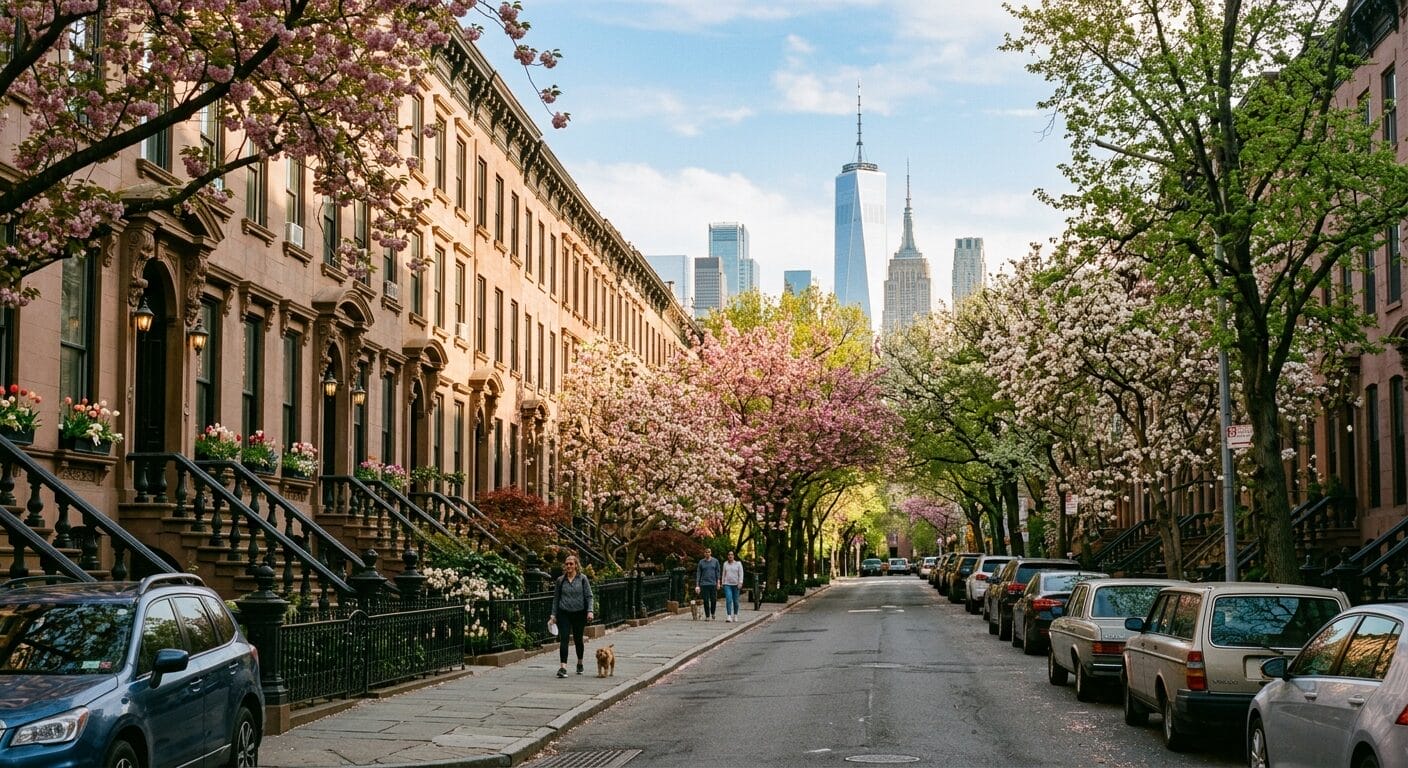
The Brooklyn housing market spring 2026 is balancing a $850,000 median sale price with 55 days on market and 3.8 months of supply, a setup that still tilts toward sellers but no longer punishes patient buyers. Borough-wide prices climbed 4.2% year over year through April 2026, while contract volume softened compared with 2025 and mortgage rates settled near 6.09% on the Freddie Mac Primary Mortgage Market Survey. Brooklyn remains expensive relative to most of the country, yet the spring buying season opened with more breathing room than the frantic 2022 rebound or the locked-up 2024 stretch.
Robert DeFalco Realty has tracked Brooklyn pricing alongside our Staten Island base for years, and our complete Brooklyn market guide gives a longer view of how the borough trades. This quarterly report focuses on April 2026 data, what changed in Q1, and where Brooklyn likely heads through summer. Buyers searching homes for sale in Brooklyn should read this side by side with the evergreen guide so the date-specific numbers sit on top of the structural context.
In This Post
Brooklyn Housing Market Spring 2026: Key Metrics at a Glance
| Metric | April 2026 Reading | Year-Over-Year |
|---|---|---|
| Median sale price (borough) | $850,000 | +4.2% |
| Median price per sqft | $1,074 | +13.4% (composition-weighted) |
| Days on market | 55 days | -13 days from 68 |
| Months of supply | 3.8 months | Tightened from 4.4 |
| Single-family median | $950,000 | +5.1% |
| Co-op median | $460,000 | -1.3% |
| Condo median | $1,100,000 | +2.8% |
| Two-family median | $1,200,000 | +6.2% |
| 30-year fixed rate (Freddie Mac PMMS) | 6.09% | Down from 6.83% peak |
| Contract volume vs 2025 | Below | Slowdown trend |
Sources for the data points across this report include the PropertyShark Brooklyn market trends dashboard, the Corcoran Inhabit Q1 2026 Brooklyn report, and the Freddie Mac PMMS weekly mortgage rate series.
Brooklyn Spring 2026 Price Trends
The Brooklyn real estate market spring 2026 closed Q1 with a borough-wide median of $850,000, up 4.2% from $815,500 a year earlier. Price per square foot moved more sharply, hitting $1,074 in April 2026, although that figure is composition-weighted because more two-family and brownstone closings dragged the average up.
By property type, the picture splits cleanly:
- Single-family detached homes hit a $950,000 median, with the strongest gains in southern Brooklyn neighborhoods like Bay Ridge, Marine Park, and Mill Basin.
- Two-family homes posted a $1.2 million median, up 6.2% year over year, fueled by buyers who want rental income to offset mortgage payments.
- Condos landed at a $1.1 million median, up 2.8%, but the average masks a split market where Manhattan-adjacent luxury performed well and mid-tier condo buildings softened.
- Co-ops slipped to a $460,000 median, down 1.3% from spring 2025, reflecting tighter board scrutiny and buyer hesitation about share-loan limits.
Month-over-month from March to April 2026, the borough median rose roughly 1.2% as the spring inventory wave cleared and listings priced under $900,000 traded inside two weeks in several pockets. April closings still tilted heavily toward homes that came to market between February and early March, so the brooklyn home prices spring 2026 picture reflects winter-priced inventory more than any sudden spring spike.
Brooklyn Neighborhood Price Map: Spring 2026
Brooklyn does not trade as a single market. The 70-plus neighborhoods stretch from waterfront luxury to outer-borough value, and prices reflect that range.
| Tier | Neighborhoods | Typical Spring 2026 Range |
|---|---|---|
| Premium waterfront and prime brownstone | Brooklyn Heights, DUMBO, Park Slope, Cobble Hill, Carroll Gardens, Boerum Hill | $1.4M-$3M+ brownstones; $1M-$2M condos |
| Mid-tier hipster and pre-war | Williamsburg, Greenpoint, Prospect Heights, Fort Greene, Clinton Hill | $900K-$1.6M condos; $1.5M-$2.5M townhouses |
| Value tier with strong demand | Bedford-Stuyvesant, Sunset Park, Crown Heights, Bushwick, Kensington | $700K-$1.2M |
| Affordable southern Brooklyn (DeFalco’s footprint) | Bay Ridge, Bensonhurst, Sheepshead Bay, Marine Park, Gravesend, Canarsie, Mill Basin | $550K-$900K |
| Outer and up-and-coming | East Flatbush, Flatlands, Brownsville, East New York | $400K-$700K |
For buyers who want a deeper neighborhood read, our team publishes dedicated guides like the Park Slope neighborhood profile, the Bay Ridge neighborhood guide, and the Gravesend neighborhood guide. StreetEasy also flagged a handful of hottest Brooklyn neighborhoods for 2026, and budget-focused buyers should review our roundup of affordable Brooklyn neighborhoods.
Brooklyn Inventory and Supply Spring 2026
Months of supply is the cleanest read on whether buyers or sellers hold the upper hand. The Brooklyn housing market spring 2026 ended Q1 at 3.8 months of supply, up from 3.1 months at the same point in 2025. A balanced market sits near 6 months of supply, so the borough is still officially a seller’s market. The trend matters more than the label, though, because supply has crept up four straight quarters.
Active listings in April 2026 sat about 14% above April 2025 levels, with the largest gains in:
- Co-op buildings throughout central Brooklyn, where carrying costs and board approvals stretched timelines.
- Mid-tier condo product in Williamsburg, Long Island City-adjacent Greenpoint, and the new construction towers along the Gowanus rezoning corridor.
- Higher-priced single-family homes above $1.5 million in Park Slope, Cobble Hill, and Brooklyn Heights, where the Brooklyn contract drop story we covered earlier in the year already showed signs of softening.
Inventory remains thin in two specific lanes. First, single-family homes in southern Brooklyn under $900,000 still go fast, and our Gravesend neighborhood guide walks through why that pocket trades so quickly. Second, brownstones in the prime row-house belt rarely list, and when they do they price aggressively.
Days on Market and Buyer Demand
In the Brooklyn housing market spring 2026, homes spent a median of 55 days on market, down from 68 days in early 2025. Speed varies sharply by price band and product type:
- Single-family homes priced under $1 million in southern Brooklyn moved in 18 to 28 days.
- Mid-tier condos between $900,000 and $1.4 million averaged 60 to 75 days.
- Co-ops above $700,000 stretched past 90 days, with several premium-tier buildings showing listings older than 120 days.
- Brownstones priced realistically against recent comps cleared in 30 to 45 days; aspirational pricing pushed several over 100 days.
Buyer demand picked up in March 2026 as rates dipped and Wall Street bonus deposits hit checking accounts. April web traffic on Brooklyn IDX pages tracked roughly 9% above April 2025 for our office, and showings per active listing rose week over week through mid-April. The brooklyn days on market figure compresses further when a listing is staged, photographed well, and priced within 2% of the recent comparable closing.
Mortgage Rate Impact on Brooklyn Spring Buying
In the Brooklyn housing market spring 2026, the 30-year fixed conforming rate sat at 6.09% on the Freddie Mac PMMS in mid-April 2026, with several lenders quoting at or just below 6% for strong-credit, full-doc Brooklyn buyers. Jumbo product, which kicks in above the 2026 high-balance limit of $1,209,750 in NYC, generally priced 0.10 to 0.30 points wider, with portfolio jumbo as low as 5.875% for relationship buyers at the big banks.
A buyer purchasing a $850,000 Brooklyn home with 20% down ($680,000 loan) at 6.09% on a 30-year fixed pays roughly $4,121 per month in principal and interest. Add an estimated $700 for property taxes (Brooklyn class 1 effective rate near 0.99% on assessed value, with NYC abatements applying in some condos and co-ops) and $150 for homeowners insurance, and the all-in monthly housing payment lands near $4,971 before HOA or co-op maintenance.
For shoppers running affordability math, our calculator-style breakdown in how much house can I afford in NYC and NJ walks through debt-to-income ratios for Brooklyn buyers. Rates remain the single biggest swing factor for spring 2026 contracts: every 50 basis point move shifts purchasing power on a Brooklyn median home by roughly $44,000.
Property Type Breakdown: Winners and Losers
The Brooklyn housing market spring 2026 quarterly read shows a market splitting along property-type lines.
Single-family homes (winner): In the Brooklyn housing market spring 2026, detached and semi-detached single-family product gained 5.1% year over year. Demand concentrated in southern Brooklyn, where buyers from Manhattan, Park Slope, and Brooklyn Heights traded space for distance. Marine Park, Mill Basin, and parts of Bay Ridge saw multiple offers on well-priced listings, although the bidding wars stayed disciplined rather than the 15%-over-ask frenzy of 2022.
Two-family homes (winner): A $1.2 million median, up 6.2%, captured strong demand from buyers using rental income to qualify. Two-family product in Bensonhurst, Sheepshead Bay, and Bay Ridge moved fast when priced near $1.0 to $1.3 million. The owner-occupant strategy of “live in one floor, rent the other” returned as a serious affordability play.
Condos (split): The $1.1 million median masked a divided market. Manhattan-adjacent luxury buildings in DUMBO and Brooklyn Heights held value and traded briskly. Mid-tier condo product in Crown Heights, Bedford-Stuyvesant, and parts of Williamsburg softened, with inventory rising and several developer-held units offering closing-cost concessions or temporary rate buy-downs.
Co-ops (loser): Co-op pricing slipped 1.3% year over year. The slip reflects buyer caution about board approvals, post-purchase liquidity requirements, and rising flip-tax sensitivities. Several pre-war buildings on the upper Park Slope and Brooklyn Heights borders saw listings sit through Q1 before trimming asking prices 5% to 8%.
Brooklyn vs. Manhattan, Queens, Staten Island: Spring 2026 Comparison
Borough comparisons matter in the Brooklyn housing market spring 2026 because buyers shop the boroughs side by side. Here is how the brooklyn housing market 2026 stacks against neighbors as of April 2026:
| Borough | Median Sale Price | Months Supply | DOM (median) |
|---|---|---|---|
| Manhattan | $1,180,000 | 6.4 | 88 |
| Brooklyn | $850,000 | 3.8 | 55 |
| Queens | $740,000 | 4.2 | 62 |
| Staten Island | $720,000 | 3.5 | 48 |
Manhattan sits in a softer phase with longer marketing times and a luxury segment digesting the NYC pied-a-terre tax conversation that gained traction this year. Buyers cross-shopping Brooklyn and Manhattan should read our Manhattan vs Brooklyn buyers guide for tradeoffs on space, taxes, and commute.
Staten Island offers the closest substitute for southern Brooklyn buyers who want detached homes, a yard, and lower price points. Our just-published Staten Island April 2026 market report shows the borough trading at a $720,000 median with 3.5 months of supply and a faster 48-day timeline. Buyers comparing the two should also look at the ultimate guide to buying a home in Staten Island for a structural primer.
Queens splits the difference on price but lacks Brooklyn’s neighborhood diversity in any single sub-market.
What This Means for Brooklyn Buyers
The Brooklyn housing market spring 2026 is the friendliest spring buyers have seen since 2019, although friendly is relative when the median is still $850,000. Practical guidance:
- Get fully underwritten before offers. A pre-approval letter that has gone through underwriting, not just credit pull, lets you compete with cash buyers on premium listings.
- Run the property-tax math. Brooklyn assessment ratios differ by class. A $1.2 million two-family in Bensonhurst can carry meaningfully different annual taxes than a $1.2 million condo in Williamsburg, especially with 421-a or J-51 abatements rolling off.
- Work the gap between asking and pricing reality. Listings sitting more than 60 days are negotiable on price, closing date, repair credits, and rate buy-downs.
- Consider co-ops if you can clear board hurdles. Co-op weakness creates a buyer’s lane where well-qualified shoppers face less competition. The $460,000 co-op median is the lowest entry into Brooklyn ownership outside the outer-tier neighborhoods.
- Cross-shop Staten Island for detached homes. If commute logistics work, Staten Island offers detached single-family product at a $720,000 median with shorter timelines.
For affordability frameworks, the how much house can I afford NYC and NJ breakdown is the right starting point. Once you know your monthly cap, the active listings on Brooklyn IDX filter cleanly by price, beds, and neighborhood.
What This Means for Brooklyn Sellers
Sellers entering the brooklyn real estate market spring 2026 face a market where good listings still command premiums and average listings sit. Practical guidance:
- Price to the most recent closing, not last year’s peak. The 4.2% YoY median gain disguises sub-segment softness. Co-op sellers in particular need to anchor on Q1 2026 comps, not 2024 closings.
- Stage and shoot professionally. The 55-day median DOM compresses to roughly 30 days on listings with professional photos, video walkthroughs, and a stager-prepared interior.
- Time the listing window. Listings hitting the market between mid-April and Memorial Day capture peak spring buyer traffic. After mid-June, demand slides until early September.
- Be ready to negotiate concessions. Rate buy-downs, closing-cost credits, and flexible closing dates help close deals when the buyer’s debt-to-income ratio sits at the edge.
- Use the borough-comparison story. Brooklyn at $850,000 looks like value next to Manhattan at $1,180,000. Make sure listing copy and broker remarks frame the price as a relative bargain for the buyer profile you target.
If you are weighing list timing and pricing strategy, a Brooklyn-focused listing consultation from our team gives you the specific micro-market data your block trades on.
Brooklyn Housing Market Spring 2026 Forecast (May to Summer)
Our base-case forecast for May through August 2026 calls for:
- Borough median holding between $850,000 and $880,000, with month-over-month moves of less than 2%.
- Mortgage rates ranging 5.85% to 6.30% on the Freddie Mac PMMS, with a bias toward the lower end if Treasury yields cooperate.
- Days on market continuing to compress in southern Brooklyn detached product to a 35 to 45 day median, while co-op and mid-tier condo DOM stays elevated near 75 to 90 days.
- Months of supply rising slightly into early summer as new spring listings hit, then trimming again in late summer when sellers pull listings that did not move.
- Contract volume catching up to 2025 levels by July if rates dip below 6%, or staying 8% to 12% behind 2025 if rates re-test 6.30%.
Two wildcard factors: a Federal Reserve rate cut earlier than expected would compress mortgage rates and pull demand forward; a renewed flight-to-quality away from Manhattan would push more brownstone buyers into prime Brooklyn at the high end.
The Redfin Brooklyn data feed updates weekly at the Redfin Brooklyn housing market page for readers who want to track week-to-week changes between our quarterly reports.
This Brooklyn market report was prepared by the brokerage team at Robert DeFalco Realty, a Staten Island and Brooklyn-focused firm with more than three decades of NYC residential experience. Our agents close transactions across all five boroughs each year and source data from MLS feeds, PropertyShark, the Corcoran Inhabit reports, Redfin’s borough dashboards, and Freddie Mac’s weekly Primary Mortgage Market Survey. We update this report every quarter to reflect current closings, contract activity, and rate movement. For property-specific advice, contact a licensed agent.
Frequently Asked Questions
What’s the median home price in the Brooklyn housing market spring 2026?
The borough-wide median sale price in Brooklyn for April 2026 is $850,000, up 4.2% from $815,500 in April 2025. By property type, single-family detached homes carry a $950,000 median, two-family homes $1.2 million, condos $1.1 million, and co-ops $460,000. Median price per square foot reached $1,074, although that figure reflects the heavier mix of brownstone and two-family closings in the spring window.
Is the Brooklyn housing market spring 2026 still a seller’s market?
Yes, but barely. Months of supply sits at 3.8, where 6 months marks a balanced market. The borough has tilted toward sellers for four straight quarters, although the gap is closing. Sellers still command list price or above on well-priced single-family homes in southern Brooklyn, while buyers hold pricing power on co-ops and mid-tier condos that have sat past 60 days. The label fits, but the experience inside individual sub-markets ranges from competitive to clearly buyer-friendly.
How many days are Brooklyn homes spending on the market?
The Brooklyn days on market figure is 55 days as of April 2026, down from 68 days in early 2025. Single-family homes priced under $1 million in southern Brooklyn move in 18 to 28 days. Mid-tier condos between $900,000 and $1.4 million average 60 to 75 days. Co-ops above $700,000 stretch past 90 days. Properly priced and well-staged listings cut the borough median in half regardless of property type.
What’s the cheapest neighborhood in Brooklyn for buyers?
The most affordable Brooklyn neighborhoods in spring 2026 are East Flatbush, Flatlands, Brownsville, and East New York, where typical prices range $400,000 to $700,000. Southern Brooklyn neighborhoods like Bensonhurst, Sheepshead Bay, Marine Park, and Gravesend offer the next tier up at $550,000 to $900,000 with stronger schools and faster appreciation. Our roundup of affordable Brooklyn neighborhoods walks through tradeoffs across each pocket.
What are mortgage rates in Brooklyn right now?
The Freddie Mac PMMS recorded a 6.09% average for the 30-year fixed conforming rate in mid-April 2026, and several Brooklyn-focused lenders quoted at or just below 6% for strong-credit, full-doc buyers. Jumbo loans, which apply above the 2026 NYC high-balance limit of $1,209,750, priced 0.10 to 0.30 points wider on average. Portfolio jumbo product from the big banks went as low as 5.875% for relationship buyers willing to consolidate deposits.
Is the Brooklyn condo market falling?
The Brooklyn condo market is split, not falling outright. Manhattan-adjacent luxury condos in DUMBO and Brooklyn Heights held or gained value through Q1 2026. Mid-tier condo product in Crown Heights, Bedford-Stuyvesant, and parts of Williamsburg softened, with rising inventory and several developer-held units offering closing-cost credits. The borough condo median of $1.1 million is up 2.8% year over year, but that headline number hides meaningful weakness in the $700,000 to $1.2 million band.
How do Brooklyn brownstone prices compare to other boroughs?
Brooklyn brownstones in the prime row-house belt (Park Slope, Cobble Hill, Brooklyn Heights, Boerum Hill, Carroll Gardens) trade between $1.4 million and $3 million in spring 2026, with restored, single-family configurations clearing $4 million in tight blocks. Manhattan townhouses in comparable neighborhoods trade meaningfully higher, often $5 million and up. Queens and Staten Island lack a direct equivalent product. The brownstone tier in Brooklyn is the deepest stock of authentic 19th-century row-house product available anywhere in NYC at current price points.
Where are bidding wars happening in Brooklyn?
Bidding wars in spring 2026 cluster in two specific lanes. First, single-family detached homes priced under $900,000 in Bay Ridge, Marine Park, Mill Basin, and Gravesend regularly receive multiple offers, although the spreads stay disciplined at 2% to 5% over ask rather than the 10%-plus spreads of 2022. Second, well-renovated brownstones priced realistically in Park Slope, Cobble Hill, and Boerum Hill see competition. Co-ops, mid-tier condos, and listings priced more than 5% above the recent comparable closing rarely attract multiple bids.
What’s the spring 2026 forecast for Brooklyn?
Our base case for the Brooklyn market through summer 2026 calls for the borough median to hold between $850,000 and $880,000, mortgage rates to range 5.85% to 6.30%, days on market to compress for southern Brooklyn detached homes while staying elevated for co-ops, and supply to rise slightly into early summer before trimming in late summer. Contract volume should close the gap with 2025 if rates dip below 6% by July.
How does Brooklyn compare to Staten Island for buyers?
Staten Island runs at a $720,000 median with 3.5 months of supply and a 48-day median DOM in April 2026. The borough trades roughly 15% below Brooklyn’s median and offers more detached single-family stock at every price point. Brooklyn’s advantages are subway access, neighborhood density, and broader property-type variety. Staten Island’s advantages are lower prices, more land, and faster transactions. Buyers cross-shopping should read our Staten Island April 2026 market report and the ultimate guide to buying a home in Staten Island.
Your Next Move in the Brooklyn Spring 2026 Market
Looking for fresh Manhattan numbers? See our Manhattan Real Estate Market Spring 2026 quarterly report for Q1 closings, neighborhood breakdowns, and Q2/Q3 forecast.
The Brooklyn housing market spring 2026 rewards prepared buyers and disciplined sellers. Whether you are pricing a Park Slope brownstone, shopping a $750,000 single-family in Bay Ridge, or weighing Brooklyn against Staten Island, the right next step is a conversation with an agent who closes deals in your specific micro-market every month. Browse current Brooklyn listings on our IDX, request a comparative market analysis, or reach the team at Robert DeFalco Realty to talk through your spring 2026 plan.