
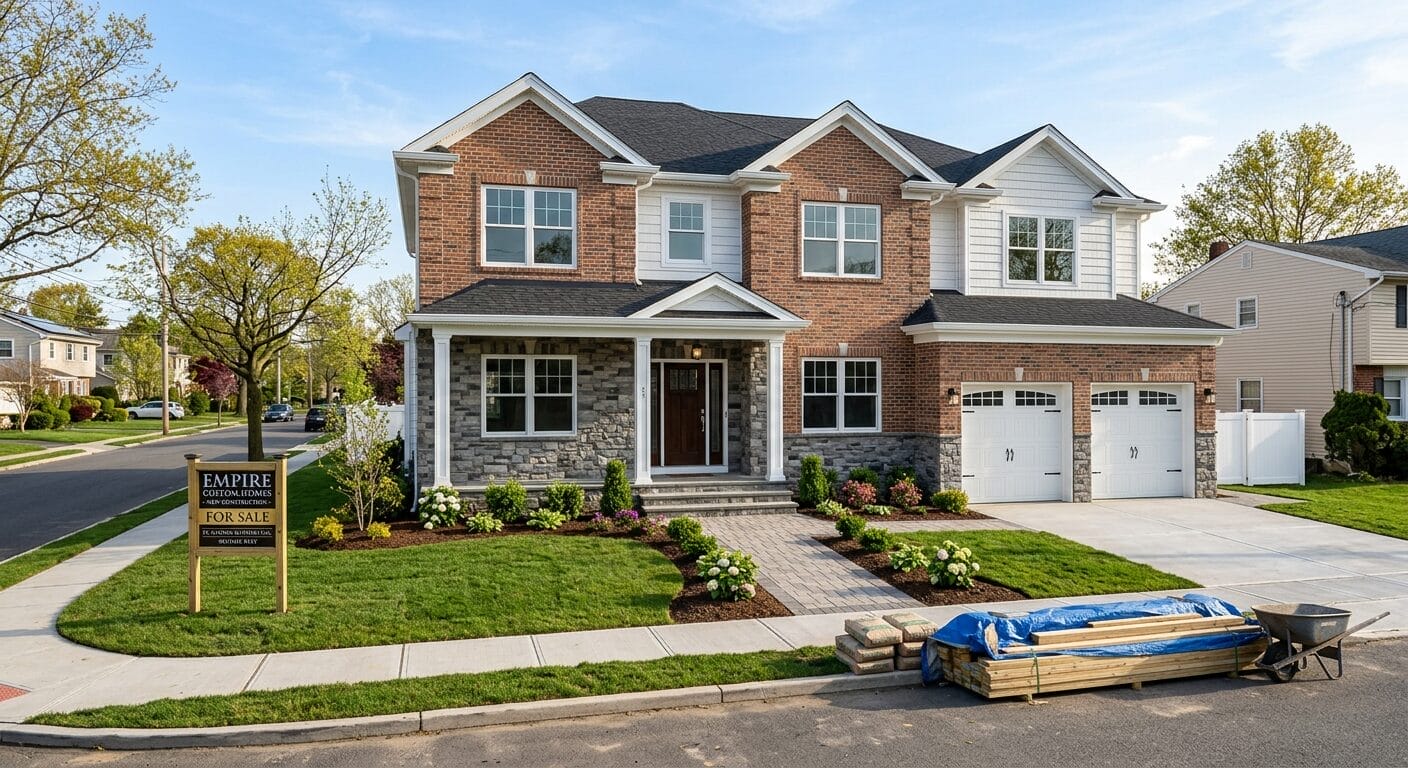
Buying new construction homes on Staten Island in 2026 means tracking a tighter price band than many expect for New York City. A typical brand-new single-family on the South Shore lists between $850,000 and $1.4 million, while new construction 2-family homes run from $1.1 million to $1.5 million. Townhouses and condos in newer Mid-Island and North Shore developments start near $550,000 and stretch to about $850,000 for larger floor plans with private outdoor space. With Freddie Mac reporting a 6.19% 30-year fixed rate in April 2026, monthly payments on a $1.1 million new build with 20% down land near $5,400 in principal and interest before taxes and insurance.
If you are starting from scratch, pair this guide with our ultimate guide to buying a home in Staten Island and our affordability tool at how much house can I afford in NYC and NJ. The April 2026 Staten Island real estate market report gives you the macro view that frames every new construction decision below.
In This Post
Buying New Construction Homes on Staten Island in 2026: Market Overview
Inventory of true new construction sits at roughly 80 to 150 active listings across the borough at any time. That count includes spec homes finished by the builder, pre-construction reservations, and homes inside larger subdivisions where 5 to 30 units are released in phases. Demand is strongest in two pockets. First, families upgrading from older Staten Island ranches and capes who want open floor plans with a great room, primary suite, and finished basement. Second, owner-occupant investors buying new 2-family homes for the rental income upstairs while they live downstairs. Browse current builds on our new construction listings page, or look at the broader pool of homes for sale in Staten Island for context.
Where to Find New Construction Homes on Staten Island
New construction is not spread evenly across the borough. Knowing where builders are active lets you target your search instead of bouncing between listings that all sit in different neighborhoods.
South Shore (the largest cluster of new builds):
- Tottenville. Top-tier pricing for new single-family homes, often $1.1 million to $1.4 million. Larger lots, water-adjacent locations, and excellent schools draw families. See our deep dive on buying a home in Tottenville.
- Charleston and Rossville. A wave of new subdivisions built over the past decade. Single-family pricing $900,000 to $1.2 million. Newer infrastructure, planned street layouts.
- Eltingville, Annadale, Huguenot. Infill new construction on lots cleared from older homes. Single-family $850,000 to $1.15 million. Express bus access to Manhattan is a draw.
Mid-Island:
- Heartland Village and New Springville. Townhouse and condo developments dominate. Pricing $600,000 to $850,000. Walking distance to the Staten Island Mall and Eger Park.
- Dongan Hills and Grant City. Smaller infill projects, usually 2-family new builds at $1.1 million to $1.4 million. Strong rental demand from SI Rail commuters.
North Shore:
- Stapleton and St. George. Condo-style new construction at Urby, Stapleton Beacon, and Lighthouse Point. Pricing from $550,000 for one-bedroom condos to $850,000 for two-bedroom corner units. See the Stapleton neighborhood guide and St. George neighborhood guide for area context.
- New Brighton and West Brighton. Smaller infill 2-family new builds at $950,000 to $1.2 million.
If you want quieter beach-adjacent options with newer code-compliant elevations, the Midland Beach neighborhood guide and New Dorp neighborhood guide cover the post-Sandy rebuild story and what to ask about elevation certificates.
Types of New Construction Homes Staten Island Builders Sell
Staten Island new construction breaks into four product types, and each fits a different buyer.
Single-family detached. The classic SI new build. Three to five bedrooms, two and a half to four bathrooms, 2,400 to 3,800 square feet, attached one or two-car garage, full basement. Typical price $850,000 to $1.4 million. Best fit: growing families and downsizers who want one level living with the option of a primary suite on the main floor. Search active inventory on the single-family homes for sale page.
New construction 2-family. Staten Island’s signature product. Two separate legal units stacked or side by side, each with its own kitchen, baths, and entrance. Total square footage 2,800 to 4,200. Typical price $1.1 million to $1.5 million. The owner-occupant lives in one unit and rents the other for $2,200 to $3,200 per month, which can cover a meaningful share of the mortgage. Read the full owner-occupant playbook at how to buy a 2-family home on Staten Island and current inventory at multi-family homes for sale.
Townhouse. Attached new construction with shared walls, usually three stories. 1,800 to 2,400 square feet. Typical price $650,000 to $900,000. Lower entry point than single-family, often with HOA fees of $200 to $400 per month covering exterior maintenance and shared amenities.
Condo. Vertical new construction with elevator buildings, mostly on the North Shore. 700 to 1,500 square feet. Typical price $550,000 to $850,000. HOA fees $400 to $750 per month. Strongest in Stapleton, St. George, and along the Bay Street corridor. See active listings on the condos in Staten Island page.
New Construction Homes on Staten Island: Pricing & What to Expect
The sticker price you see on a new construction listing rarely matches what you sign at closing. Staten Island builders price their base homes lean and add upgrades at the design center.
Base price covers the standard floor plan with builder-grade finishes: laminate counters, basic cabinets, builder-tier appliances, vinyl plank flooring in living areas, carpet in bedrooms.
Lot premium can add $20,000 to $80,000 for corner lots, deeper backyards, or cul-de-sac positions. Premium lots in Tottenville waterfront blocks have hit $150,000 in 2025 and 2026.
Upgrades are where buyers spend most. Realistic upgrade budgets:
- Quartz or granite counters: $4,000 to $9,000
- Hardwood throughout main level: $6,000 to $12,000
- Upgraded kitchen cabinets and pantry: $8,000 to $18,000
- Stainless appliance package upgrade: $3,000 to $7,000
- Finished basement: $35,000 to $75,000
- Deck or paver patio: $12,000 to $30,000
- Smart home and EV-charging package: $3,500 to $8,000
A $1.0 million base price with $90,000 in upgrades and a $40,000 lot premium turns into a $1.13 million purchase. Plan for that math up front.
Closing-in costs include New York mansion tax (1% of the purchase price for homes $1 million and up, with a sliding scale that climbs to 3.9% above $25 million), title insurance, mortgage tax, and recording fees. New construction also typically charges builder concession fees and HOA setup fees on townhouse or condo product. Our closing costs in New Jersey guide covers cross-bridge comparisons; for SI itself, expect 4% to 6% of purchase price total in closing costs after factoring mansion tax. The Staten Island property tax rate guide is required reading for understanding what your monthly carry will look like.
Pros of Buying New Construction Homes on Staten Island
The pros of buying new construction homes on Staten Island are real, and they go beyond “it’s shiny.” Here is what actually matters.
- Modern open floor plans. A new SI build typically has a great room kitchen-living combination, primary suite with walk-in closet, and a flex room. Older Staten Island stock tends to have smaller, walled-off rooms that feel cramped to younger buyers.
- Energy efficiency. Most 2026 new builds meet or exceed Energy Star New Homes standards. Spray foam insulation, low-E windows, high-efficiency HVAC, and tankless water heaters cut utility bills by 30% to 50% compared to a 1970s SI cape. Reference the Energy Star New Homes program for what to ask the builder about.
- Builder warranties and new appliances. Every appliance and system is under manufacturer or builder warranty. The big-ticket items, roof, HVAC, water heater, will not need replacement during your first decade.
- Customization during construction. If you sign before drywall, you choose finishes, lighting layout, additional outlets, structural options like a finished attic.
- Lower maintenance for 10 to 15 years. New roofs last 25 to 50 years. New HVAC lasts 15 to 20. New windows last 20 to 30. The deferred maintenance pile that kills older home owners simply does not exist yet.
- Smart home and EV charging readiness. Most new builds pre-wire for ethernet, smart thermostats, ring-style cameras, and 240V garage outlets for EV charging.
- Modern code compliance. Post-Sandy elevations, hurricane-resistant roof connections, fire sprinklers in many townhouse products, GFCI everywhere. The International Code Council sets the baseline that NYC has adopted in its 2022 building code, which now governs all SI new construction.
Cons & Tradeoffs to Know Before Buying New Construction
Honest tradeoffs are what separate a real guide from a builder brochure. Here are the cons buyers underestimate.
- 15% to 25% premium over comparable existing homes. A 2,400-square-foot new build in Eltingville at $1.05 million is a 1995 colonial across the street at $850,000 with a $200,000 markup. You are paying for new, not for square footage.
- Smaller lots in newer subdivisions. Many new SI subdivisions sit on 30-by-95 or 40-by-100 lots versus 50-by-100 or 60-by-125 on older blocks. Yard space matters if you have kids or pets.
- Less character and no mature trees. A new street takes 15 to 25 years to grow into itself. Older Annadale or Westerleigh blocks have canopy that new Charleston cul-de-sacs simply lack.
- HOA fees on townhouse and condo product. Monthly HOA between $200 and $750 covers exterior maintenance, snow, sometimes amenities. Factor it into affordability.
- Construction delays. A 3 to 6 month delay is normal. A 9 to 12 month delay happens, often because of supply chain or labor issues. If you have a lease ending in May, do not commit to a build that promises June completion. Plan for September minimum.
- Builder contracts favor the builder. The standard builder purchase agreement gives the builder more rights to delay, change specs, and substitute materials than the seller in a resale transaction. Read every page with a real estate attorney before signing.
- Required new construction inspection. This is not optional. We cover the why and how in section 9.
Major Builders of New Construction Homes on Staten Island
Knowing who built the home is part of due diligence. Here are the active SI builders in 2026, listed neutrally with no endorsement.
- PreReal Properties. Active across the South Shore, mostly single-family and 2-family infill. Reputation for tight lot use and standard finish packages.
- Jaguar Construction. Mid-Island and South Shore. Known for 2-family product on infill lots in Dongan Hills and Grant City.
- BNV Homes. South Shore subdivisions in Charleston and Rossville. Larger volume, spec-built, frequent inventory turnover.
- Empire Group. Mid-Island townhouse and small condo developments. Active in Heartland Village.
- La Mer Group. Custom builds and larger luxury single-family homes in Tottenville and Annadale at the $1.3 million-plus tier.
- Pyramid Construction. Smaller infill projects, mixed product types, often single-lot teardowns.
- Dilkash Homes. South Shore single-family and 2-family. Strong activity in Eltingville and Annadale infill.
- Plaza Homes. Mid-Island and North Shore townhouse and condo developer.
How to vet any builder regardless of name: pull their NYC Department of Buildings record at the property address, request three completed addresses from the past 24 months, and call the homeowners. The New York Department of State consumer protection page on real estate lists builder license complaints and is a free public check.
Negotiating With Builders: What’s Negotiable, What Isn’t
Builders rarely cut the base sticker price because every cut sets a comparable for the next buyer in the development. They will give value in other ways. The goal is to know which lever to pull.
Usually negotiable:
- Upgrade credits at the design center (a builder might toss in $10,000 to $25,000 of free upgrades to close a deal)
- Closing cost credits (builders will often cover 1% to 2% of price toward your closing costs if you use their preferred lender)
- Appliance package upgrades
- Finished basement credits
- Window treatment and blind packages
- Extended walkthrough and punch-list windows
Sometimes negotiable:
- Base price (only on aged spec inventory or end-of-quarter pressure)
- Lot premium (occasionally on slower-selling lots)
- HOA fee abatement for the first year on townhouse and condo product
Rarely negotiable:
- Earnest money percentage (usually fixed at 5% to 10%)
- Builder’s right to substitute materials of equal or greater value
- Mortgage contingency timeline
- Inspection access during construction
A buyer’s agent who has closed multiple new construction deals knows which builders are tight on what. We work this every day at Robert DeFalco Realty and the right ask at the right moment is worth tens of thousands.
New Construction Home Inspection: Why It Matters (and How It Differs From Used Home Inspection)
A new construction home inspection on Staten Island is not the same as inspecting a 1970s resale. Builders cut corners. Subcontractors miss steps. Inspectors hired by the builder are paid by the builder. Your independent inspection is the only thing standing between you and five-figure repair bills.
The right approach is a three-phase inspection.
Phase 1: Pre-drywall (framing) inspection. After framing, plumbing rough, electrical rough, and HVAC rough are in but before insulation and drywall close everything up. You can see the bones. Inspectors check stud spacing, header sizing, plumbing slope, electrical box placement, ductwork sealing, and waterproofing of foundation walls.
Phase 2: Final inspection (pre-walkthrough). Conducted 5 to 10 days before closing. The home is finished. Inspectors check every appliance, fixture, system, GFCI outlet, window operation, attic ventilation, grading and drainage, and roof installation. This generates the punch list the builder fixes before closing.
Phase 3: 11-month warranty inspection. Conducted in month 11 of the 12-month builder warranty. Catches settlement cracks, drywall pops, HVAC quirks, paint touchups, and window seal failures while the items are still covered. Skipping this inspection means paying for fixes the builder would have covered.
Budget $700 to $1,200 for each of the three phases, total $2,100 to $3,600. That is meaningful money but tiny compared to a single missed structural or moisture issue. Use our home inspection checklist for Staten Island and bring it to every walk. The National Association of Home Builders publishes good consumer-facing resources on what to look for at each phase.
Mortgages, Warranties & Closing When Buying New Construction Homes on Staten Island
The financing and closing for new construction differ from a resale in three ways.
Mortgage. Most SI buyers use a conventional 30-year fixed mortgage with a long lock or a float-down feature, since the build may take 4 to 9 months. Some buyers use a true construction-to-permanent loan, but on production-built SI new construction, the builder usually carries the construction risk and you finance only the finished product with a standard purchase mortgage. If you are buying pre-construction, ask the lender about a 270-day rate lock. Use how much house can I afford in NYC and NJ to size your monthly payment first.
Warranties under New York law. The New York Home Warranty Act (General Business Law Article 36-B) gives every new home buyer three layers of statutory protection:
- One year on materials and workmanship from the date of warranty (typically date of closing or first occupancy)
- Two years on plumbing, electrical, heating, cooling, and ventilation systems
- Six years on major structural defects
These are floors, not ceilings. Builders can offer longer warranties but cannot waive these. The New York Department of State handles disputes when builders refuse legitimate claims.
Closing process. New construction closings have a final walkthrough 24 to 72 hours before signing. Bring your inspector. Test every outlet, every faucet, every window, every appliance, every door swing. The walkthrough generates the punch list, and either the builder agrees to escrow funds for incomplete items or completes the items before closing. Wire transfer goes the morning of closing, deed records same day, keys hand over at the table. Title insurance is mandatory at New York closings; we walk every client through this in detail. The Staten Island home value guide helps you confirm your appraisal lines up with comps.
If you are buying in a Sandy-affected zone, also read buying a home in a flood zone in NYC and NJ, since flood insurance interacts with new construction elevation certificates.
New Construction vs. Existing Homes on Staten Island
Use this side-by-side framework to make the call.
| Factor | New Construction | Existing Home |
|---|---|---|
| Price per square foot | Higher (15% to 25% premium) | Lower |
| Lot size | Often smaller | Often larger on older blocks |
| Maintenance for first 10 years | Minimal | Variable, can be heavy |
| Energy efficiency | Best in class | Wide range |
| Customization | High (during build) | Renovation required |
| Mature trees and character | Limited | Established |
| Closing timeline | 4 to 12 months | 30 to 60 days |
| Surprises during inspection | Workmanship issues | Deferred maintenance |
| Warranty | 1, 2, 6 year statutory | None unless added |
| Property tax assessment | Builds up over first 3 years | Stable |
Pick new construction if you value modern layout, energy savings, and zero deferred maintenance, and you have the patience for a longer timeline. Pick existing if you want a larger lot, mature neighborhood, faster move-in, and a lower entry price.
For a deeper view on SI’s investor and pipeline side, our Staten Island multifamily development pipeline analysis covers what is being built at scale across the borough through 2027.
About the author: This guide was written by the buyer-side team at Robert DeFalco Realty, the largest independent brokerage on Staten Island since 1992. Our agents have closed more than 600 new construction transactions across SI in the past 10 years, working with builders including PreReal Properties, Jaguar Construction, BNV Homes, Empire Group, La Mer Group, Pyramid Construction, Dilkash Homes, and Plaza Homes. Every recommendation in this guide reflects what we have actually seen at closing tables, not theory. Our team holds active New York real estate broker licenses and trains continuously on the New York Home Warranty Act, NYC Department of Buildings procedures, and SI-specific code requirements.
Frequently Asked Questions
What’s the price range for new construction homes on Staten Island in 2026?
Staten Island new construction in 2026 ranges from $550,000 for one-bedroom condos in Stapleton and St. George to $1.5 million for new 2-family homes in Tottenville. Single-family new construction typically lists between $850,000 and $1.4 million depending on neighborhood, lot, and square footage. Add 8% to 12% to the base price for typical upgrade and lot premium spend.
Which Staten Island neighborhoods have the most new construction inventory?
The South Shore leads by volume. Tottenville, Charleston, Rossville, Eltingville, Annadale, and Huguenot all have active single-family and 2-family new builds. Mid-Island activity centers on Heartland Village, New Springville, Dongan Hills, and Grant City. The North Shore is dominated by condo and townhouse new construction in Stapleton and St. George.
Is buying new construction better than buying an existing home on Staten Island?
Not universally. New construction wins on energy efficiency, modern layout, builder warranty, and minimal maintenance for 10 to 15 years. Existing homes win on lot size, mature character, faster move-in, and 15% to 25% lower price for comparable square footage. Match the choice to your priorities, your timeline, and your tolerance for upgrade budgets and construction delays.
Do new construction homes come with warranties in NY?
Yes. The New York Home Warranty Act gives every new home buyer one year of materials and workmanship coverage, two years on plumbing, electrical, heating, cooling, and ventilation systems, and six years on major structural defects. These are statutory minimums. Many SI builders offer longer warranties on specific items like roofs and windows, often through manufacturer warranties that transfer to you.
How is a new construction home inspection different?
A new construction inspection happens in three phases: pre-drywall framing, pre-closing final, and 11-month warranty. A typical resale inspection is one phase that focuses on deferred maintenance and end-of-life systems. New construction inspection focuses on workmanship errors, code compliance, and items the builder can still fix while the home is being built or under warranty. Budget $2,100 to $3,600 total for all three phases.
Can I negotiate with a new construction builder?
Yes, but the negotiation looks different from a resale. Base price moves rarely. Builders will give value through upgrade credits ($10,000 to $25,000 is common), closing cost credits if you use their preferred lender, and appliance package upgrades. End-of-quarter and end-of-year deals on aged spec inventory are the strongest negotiation windows.
Are 2-family new construction homes a good investment?
Often yes, for owner-occupant investors. A new $1.3 million 2-family in Eltingville rents the second unit for $2,400 to $3,000 per month, covering 35% to 50% of the mortgage payment. That improves your debt-to-income ratio for the loan and builds equity faster than a single-family at the same price. Read our full breakdown at how to buy a 2-family home on Staten Island.
What’s the closing process for new construction?
Reserve a lot, sign the builder purchase agreement, deposit earnest money (5% to 10%), choose finishes at the design center, complete inspections at framing and final stages, lock your mortgage rate, attend the walkthrough 24 to 72 hours before closing, sign at the closing table, wire funds, record the deed, and receive keys. Total timeline runs 4 to 12 months from contract to closing.
Is there a 421-a tax abatement on Staten Island new construction?
The 421-a abatement is rare on SI single-family new construction since the program targeted multifamily affordable housing. Some larger SI multifamily projects qualify, mostly along the North Shore corridor. If a builder advertises 421-a benefits, ask for the New York City Department of Housing Preservation and Development certificate of eligibility before signing.
How do I find new construction homes on Staten Island to tour right now?
Search active SI new construction inventory at our new construction listings page and the broader homes for sale in Staten Island database. Both update with new builder releases as they hit the market. Working with a buyer-side agent who has new construction experience is the cleanest path, since many builder releases happen through the agent network before public listing.
Next Steps: Find New Construction Homes on Staten Island
Three steps to take this week if you are buying new construction homes on Staten Island.
- Set your budget using our affordability tool, with a 10% buffer for upgrades and lot premiums.
- Browse current SI new construction inventory at our new construction listings page, and shortlist three to five.
- Connect with a buyer-side agent at Robert DeFalco Realty who closes new construction every month and knows which builders are flexible on which terms.
Buying new is a longer process than buying resale, and the rewards (energy savings, low maintenance, modern layouts) compound over your time in the home. Done right, with the right inspections and the right negotiation posture, a Staten Island new construction purchase delivers value that lasts the full mortgage term and beyond.