
If you’re reading this, you’re likely in one of two positions.
You might be a Brooklyn or Queens resident, staring at a lease renewal or a listing price that makes no sense, wondering, “Can I actually get a driveway, a backyard, and a spare bedroom in New York City without winning the lottery?”
Or, you’re relocating from out of state, looking at a map of NYC, and noticing that big green island at the bottom. You’ve heard the jokes, you’ve seen the reality TV shows, but you’re also seeing the home prices and wondering if you’ve found a hidden gem.
Here’s the truth that savvy buyers and investors have known for years: Staten Island is the last frontier of value in the five boroughs.
But moving here isn’t just about changing your zip code; it’s about changing your lifestyle. It’s a shift from vertical living to horizontal living. It’s trading the noise of the subway for the schedule of an express bus or the ferry. It’s navigating a market that varies wildly from the urban, historic hills of the North Shore to the manicured, suburban enclaves of the South Shore.
At Robert DeFalco Realty, we don’t just sell houses here; we define the market here. For decades, we’ve guided thousands of families, professionals, and investors through the Verrazzano Bridge toll and into their dream homes. We know that Staten Island isn’t a monolith—it’s a collection of over 60 distinct neighborhoods, each with its own micro-economy, school zone, and commute reality.
In this 2025 guide, we’re stripping away the myths. We aren’t just going to tell you where to live; we’re going to break down exactly what it costs, how the commute really works, and why moving to “The Rock” might be the smartest financial decision you make this decade.
Whether you’re looking for luxury on Todt Hill, a starter home in Westerleigh, or waterfront living in Tottenville, this is your roadmap home.
Table of Contents
1. Why Move to Staten Island?
The migration to Staten Island usually starts with a calculator, but it ends with a realization: you don’t have to compromise on “quality of life” to stay in New York City.
While the other boroughs have seen saturation and skyrocketing density, Staten Island has maintained a balance that’s rare in a metropolis. Here’s why buyers are crossing the bridge in 2025.
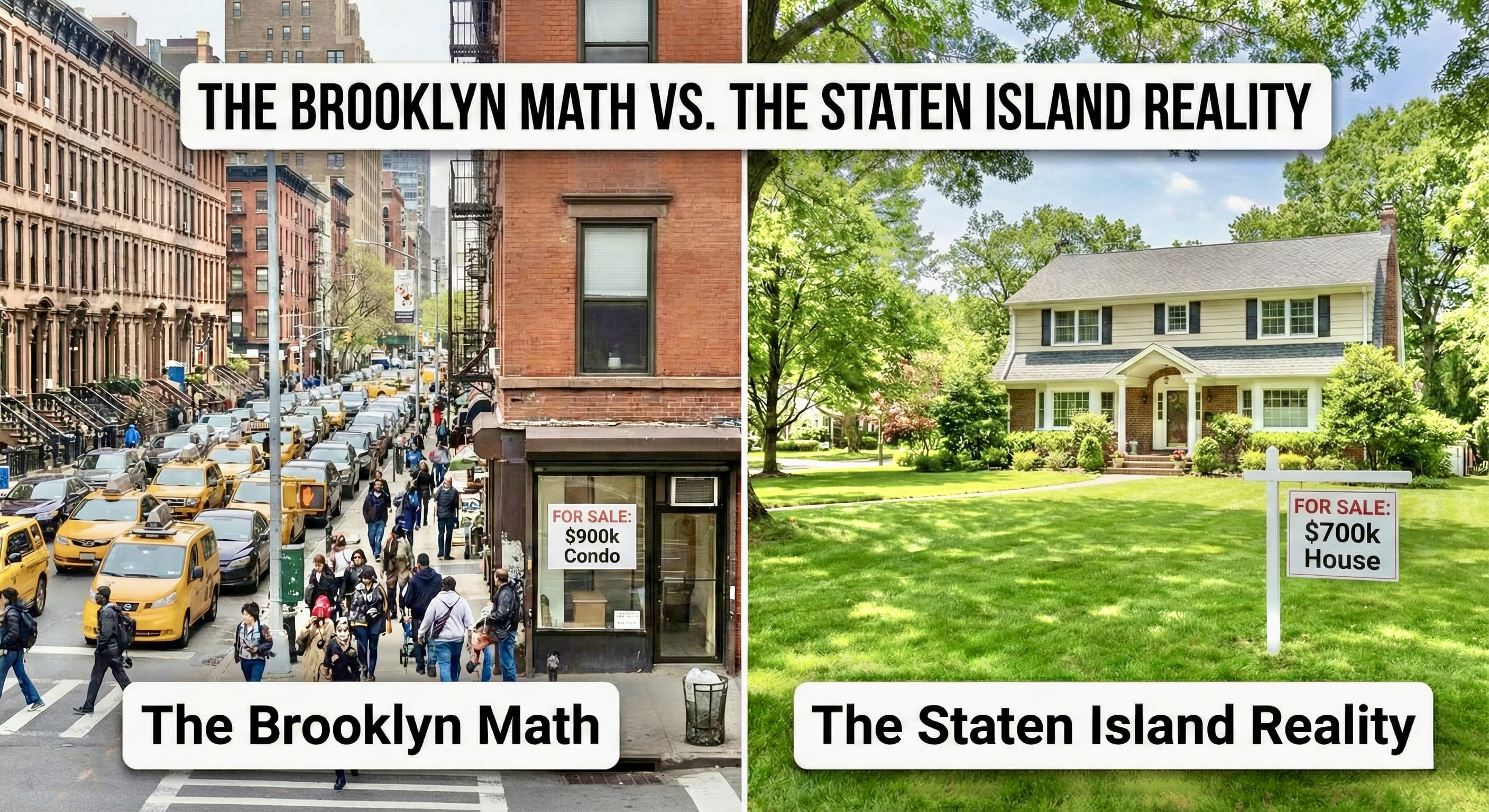
More Space for Your Money (The “Brooklyn Math”)
The primary driver for relocation is simple math. In 2025, the price per square foot in Staten Island remains significantly lower than its neighbors.
In Brooklyn: Your budget might get you a two-bedroom condo with a monthly maintenance fee that rivals a mortgage payment.
In Staten Island: That same budget often secures a detached or semi-detached single-family home with a private driveway, a backyard for the kids (or the dog), and a finished basement.
We call this “The Brooklyn Math.” When you calculate the trade-off, you aren’t just buying square footage; you’re buying privacy.
The “Suburban City” Feel
Staten Island offers a hybrid lifestyle that’s unique in the United States. You’re technically in the City of New York—you have access to the NYPD, the FDNY, the NYC public school system, and city water—but your day-to-day life feels suburban.
Green Space: Known as the “Borough of Parks,” we have thousands of acres of protected Greenbelt. You can hike in High Rock Park in the morning and be at a Broadway show in the evening.
Zoning: Strict zoning laws in many neighborhoods prevent the construction of high-rise towers, preserving light, air, and neighborhood character.
Safety and Stability
Staten Island consistently ranks as the safest borough in New York City. For families, this peace of mind is non-negotiable. The community culture here is tight-knit; neighbors tend to know each other, block parties are common, and there’s a strong sense of civic pride that translates into well-maintained streets and active community boards.
A Culinary and Cultural Renaissance
The days of Staten Island being a “food desert” are ancient history. While we’re famous for having arguably the best pizza in the world (a hill we’re willing to die on), the culinary scene has exploded. From authentic Sri Lankan cuisine in Tompkinsville to high-end steakhouses and trendy gastropubs on the South Shore, the island has become a destination for foodies.
The Commuter’s Best Kept Secret
Yes, we don’t have a subway line that connects to Manhattan. But we do have something better: The Staten Island Ferry.
It runs 24/7, it provides the most beautiful views of the Statue of Liberty in the world, and best of all, it’s absolutely free. For those working in Lower Manhattan, the commute from the St. George terminal is often faster and more pleasant than a crowded subway ride from Queens.
Key Takeaway: Moving to Staten Island means upgrading your home size and safety without leaving the economic opportunities of NYC.
2. Staten Island Basics
Before we talk dollars and cents, you need to understand the lay of the land. Staten Island is not a single suburban sprawl; it’s a collection of three distinct “towns,” each with its own personality, commute style, and housing stock.
Geography: The Three Shores
The island is roughly 14 miles long and 7 miles wide, divided into three main sections:
The North Shore (Urban & Historic): Closest to Manhattan and the ferry. This is where you find Victorian homes, walkability, and a Brooklyn-esque creative vibe. It’s hilly, diverse, and boasts the best harbor views.
Mid-Island (Convenience & Space): The logistical heart of the island. Home to the Staten Island Mall, the College of Staten Island, and the easiest access to the bridges into New Jersey and Brooklyn. The housing here is a mix of high-ranch semi-attached homes and larger colonials.
The South Shore (Suburban & Coastal): As you move south, the lots get bigger, the trees get older, and the “city” feels miles away. This area feels remarkably like the affluent suburbs of New Jersey, complete with manicured lawns and shopping plazas, but you still pay NYC taxes.
Demographics & Vibe
With a population hovering around 495,000, Staten Island is the least populated borough, giving it a density that feels manageable.
The “Small Town” Factor: It’s often said that everyone on Staten Island knows everyone else. While that’s an exaggeration, the degree of separation here is smaller than anywhere else in NYC.
Green Space: We have 12,300 acres of parkland. That’s more than 1/3 of the island.
3. Cost of Living Comparison
This is where the decision to move usually happens. Let’s look at the hard numbers for 2025.
Housing Costs: The “Price Per Square Foot” Victory
In 2025, the gap between Staten Island and Brooklyn has widened slightly, making the value proposition even stronger.
- Staten Island Median Home Price: ~$695,000 – $705,000
- Brooklyn Median Home Price: ~$995,000
- Manhattan Median Home Price: ~$1.15 Million
The Reality Check: For $700,000 in Brooklyn, you’re likely looking at a one-bedroom condo or a fixer-upper in a transit desert. In Staten Island, that same $700,000 buys a move-in ready, 3-bedroom semi-attached home with a finished basement and a parking spot.
Rental Market:
If you’re testing the waters before buying, rents typically range from $2,000 to $3,500 for whole-home rentals or luxury apartments. In comparison, Brooklyn’s median rent hovers near $3,500—often for significantly less space.
Property Taxes: The “Effective Rate” Secret
This is the most misunderstood part of Staten Island real estate. You’ll often hear that “taxes are high.” This is relative.
Vs. New Jersey/Long Island: Our taxes are significantly lower. A typical home in Central Jersey might have a $12,000–$15,000 tax bill. That same house in Staten Island often pays $6,000–$8,000. Compare this to New Jersey property taxes.
The “Effective” Rate: While the NYC Class 1 tax rate looks high on paper (~20%), it’s applied to a very low “Assessed Value” (often just 6% of market value).
2025 Estimate: Most homeowners pay an effective tax rate of roughly 0.85% – 1.0% of their home’s actual market value.
The Commuter Math (Tolls & Fares)
“But the bridge is so expensive!” We hear this every day. Here’s the insider truth: You don’t pay what the tourists pay.
Verrazzano-Narrows Bridge:
- Standard Rate: $10.17
- Staten Island Resident Rate: $2.75 (Yes, you read that right. With a resident E-ZPass, it costs less than a latte to drive to Brooklyn).
Express Bus: The fare is currently $7.00 (rising slightly in 2026). It’s a premium service with cushioned seats and WiFi.
Staten Island Ferry: Always $0.00.
2025 Cost of Living Breakdown
| Expense Category | Staten Island | Brooklyn | New Jersey (Suburbs) |
|---|---|---|---|
| Median Home Price | $705,000 | $995,000 | $650,000+ |
| Annual Property Tax | $6,500 – $8,500 | $5,000 – $7,000 | $12,000 – $18,000 |
| City Income Tax? | Yes (NYC Tax) | Yes (NYC Tax) | No (but higher property tax) |
| Commute Cost (Monthly) | ~$150 – $300 | ~$132 (MetroCard) | ~$350+ (NJ Transit) |
| Parking | Free / Included | $300+/mo (Garage) | Free / Included |
| Bridge Tolls | $2.75 (Resident) | N/A | $16.00+ (GWB/Lincoln) |
The Verdict: When you combine the lower mortgage payment with the resident bridge discount, Staten Island offers a monthly savings of $1,500 – $2,500 compared to a comparable lifestyle in Brooklyn or Manhattan.
4. Complete Neighborhood Guide
Staten Island is not a monolith. It’s a collection of over 60 distinct neighborhoods, each with its own micro-economy and lifestyle. To help you navigate, we’ve broken the island down into its three main “shores.”
THE NORTH SHORE: The Urban & Cultural Hub
Best for: Commuters, Young Professionals, Investors, and Lovers of Historic Architecture.
If you’re moving from Brooklyn or Manhattan and aren’t ready to give up walkability or city energy, this is your landing spot. The North Shore is currently undergoing a massive $1 Billion+ revitalization, making it the hottest investment zone on the island in 2025.
St. George
The Vibe: The “Downtown” of Staten Island. Home to the Ferry Terminal, the historic St. George Theatre, and the administrative center. It feels like a localized version of Brooklyn Heights.
2025 Update: A new master plan was just unveiled (Nov 2025) for the waterfront, promising 2,500+ new homes and expanded retail where the “Wheel” was once planned.
Real Estate: High-rise condos with harbor views and historic Victorian mansions on the hills.
Commute: Best on the island (25 mins to Manhattan).
Explore St. George Homes for Sale
Stapleton
The Vibe: Gritty, artistic, and rapidly gentrifying. This is the island’s “Bushwick.”
The Opportunity: The New Stapleton Waterfront project is active, with Phase 1 of the esplanade open and luxury rentals rising on the old Navy Homeport site.
Real Estate: A mix of affordable fixer-uppers and brand-new luxury waterfront apartments.
Explore Stapleton Homes for Sale
West Brighton
The Vibe: “The Upper West Side of Staten Island.” Forest Avenue is the island’s best restaurant row, packed with bars, boutiques, and cafes.
Real Estate: Stunning Tudors and Colonials on tree-lined streets. Highly sought after by families who want a yard but also want to walk to dinner.
Explore West Brighton Homes for Sale
MID-ISLAND: The Convenient Suburban Core
Best for: Practical Families, CUNY Employees, and Mall Lovers.
This is the logistical heart of the island. You’re 15 minutes from everything—the bridge to NJ, the bridge to Brooklyn, and the Mall.
New Springville
The Vibe: Retail central. Home to the Staten Island Mall and the newly completed Freshkills Park (North Park), which has transformed the area into a green recreation destination.
Real Estate: High inventory of semi-attached homes and townhouse communities.
Explore New Springville Homes for Sale
Todt Hill
The Vibe: “The Beverly Hills of NYC.” At 401 feet, it’s the highest elevation on the entire Eastern Seaboard south of Maine.
Real Estate: Multi-million dollar estates, private roads, and strict zoning that prevents overcrowding. It’s home to Staten Island Academy (Private).
Explore Todt Hill Luxury Homes
Willowbrook
The Vibe: Quiet, green, and park-adjacent. It borders the Greenbelt, offering hiking trails right in your backyard.
Real Estate: A solid mix of ranch homes and high-ranches. Very popular with civil servants (NYPD/FDNY).
Explore Willowbrook Homes for Sale
THE SOUTH SHORE: The Coastal Suburbs
Best for: Families seeking “The White Picket Fence,” Beach Lovers, and Two-Car Households.
As you cross Richmond Avenue heading south, the density drops. The streets get wider, the lawns get greener, and the “City” feels like a distant memory.
Great Kills
The Vibe: The perfect middle ground. It has its own marina, a walkable town center (Amboy Road), and excellent express bus service.
Real Estate: Everything from capes to center-hall colonials. It’s the gold standard for South Shore family living.
Explore Great Kills Homes for Sale
Tottenville
The Vibe: The end of the line. It’s as far south as you can go in New York State. It feels like a wealthy New Jersey suburb, with a quaint Main Street and historic homes.
Real Estate: Large detached homes and waterfront mansions.
Commute Warning: The commute to Midtown can take 90+ minutes. Best if you work in Lower Manhattan, NJ, or remotely.
Explore Tottenville Homes for Sale
Huguenot
The Vibe: Prestigious and quiet. Known for the South Shore Golf Course and massive custom homes.
Real Estate: Almost exclusively detached single-family homes on large lots (60×100 or larger).
Explore Huguenot Homes for Sale
5. Transportation & Commuting: Mastering the Logistics
The number one question we get at DeFalco Realty is: “Is the commute a nightmare?”
The honest answer: It depends on where you live and how you travel. If you try to drive into Midtown at 8:00 AM, yes, it’s tough. But if you hack the system like a local, your commute can actually be more comfortable than a crowded subway ride from Brooklyn.
The Staten Island Ferry: The Iconic (and Free) Route
Best for: Residents of the North Shore (St. George, Tompkinsville, Stapleton).
The Cost: $0.00. It’s the only free mass transit in NYC.
The Experience: The boat runs 24/7/365. During rush hour (6:00 AM – 9:30 AM), it departs every 15-20 minutes. The ride is a consistent 25 minutes to Whitehall Terminal in Lower Manhattan.
Insider Tip: Avoid the “tourist crush” on the weekends. Commuters know to stand at the front gates on the lower level (Level 1) for the fastest exit to the 1/R/W subway lines.
Reliability: Extremely high. The Ferry runs in snow, rain, and fog when other transit systems fail.
The Express Bus: The “Executive” Commute
Best for: South Shore and Mid-Island residents who work in Midtown or Wall Street.
The Cost: $7.00 per ride (payable via OMNY or MetroCard).
The Experience: This isn’t a city bus; it’s a coach bus. You get a cushioned seat, air conditioning, and often WiFi. Many Islanders use this 60–90 minute ride to sleep or catch up on emails.
Key Routes:
- X1 / SIM1C (Hylan Blvd): The workhorse of the East Shore, running from Tottenville to Midtown.
- X17 / SIM17 (Richmond Ave): Serves the Mid-Island/Mall area, using the HOV lane for a faster trip.
- SIM30: The “Super Express” from the South Shore (park-and-ride) direct to Midtown.
Driving: Bridges, Tolls & The “Resident Discount”
If you’re moving here, you likely own a car. The Verrazzano-Narrows Bridge is your gateway to the rest of NYC, and while the sticker price looks scary, residents get a massive break.
- Standard Toll (Non-Resident): ~$10.17 (E-ZPass) / ~$11.19 (Tolls by Mail).
- Staten Island Resident Rate: $2.75.
How to get it: You must have a NY E-ZPass registered to your Staten Island address. This discount applies to up to 3 cars per household.
Parking: Unlike Brooklyn, parking in Staten Island is generally abundant and free. Most homes come with driveways, and street parking is rarely a “sport” like it is in Queens.
Local Transportation: The SIR and Ride-Shares
Staten Island Railway (SIR): A single 24-hour rapid transit line that runs from the Ferry Terminal (St. George) down to the bottom of the island (Tottenville). It looks like a subway train but runs above ground. It’s free unless you enter/exit at the St. George or Tompkinsville stations ($2.90).
Uber/Lyft: Availability is excellent island-wide. Wait times in 2025 average 5–8 minutes, even on the South Shore.
Commuter Verdict: If you work in Lower Manhattan, the North Shore offers a breezy 45-minute door-to-door commute. If you work in Midtown, prepare for a 60–90 minute trip, but enjoy the luxury of a guaranteed seat on the Express Bus.
6. Schools and Education: A Borough-Wide Campus
For many of our clients, the school zone isn’t just a factor; it is the factor. Staten Island is unique in NYC because it operates as a single geographic district (District 31), yet the experience varies wildly depending on your zip code.
The Public School System (District 31)
Staten Island’s public schools generally outperform the citywide averages, but “zoning” is strict. Your address dictates your elementary and middle school, which is why moving three streets over can sometimes change your home’s value by $50,000.
Top-Rated Elementary Schools:
- P.S. 35 (The Clove Valley School): Located in the Sunnyside/Grymes Hill area, this is consistently one of the highest-rated elementary schools in the entire city, known for its academic rigor.
- P.S. 42 (Eltingville): A South Shore powerhouse with a “Blue Ribbon” reputation.
- P.S. 5 (Huguenot): Another top-tier South Shore option known for strong parental involvement.
- P.S. 65 (The Academy of Innovative Learning): Located in Tompkinsville (North Shore), offering a strong arts and technology curriculum.
High School Giants
Staten Island is home to some of the most competitive high schools in New York State.
Staten Island Technical High School (“SITHS”): This is a Specialized High School (requires the SHSAT exam). In 2025, it’s ranked #3 in New York State and often top 50 nationally. It’s an engineering and math powerhouse.
Tottenville High School: It feels like a small college campus. With nearly 4,000 students, it offers virtually every AP course, sport, and club imaginable. It’s the “classic American high school” experience.
Michael J. Petrides School: A unique K-12 campus in Sunnyside. Admission is by lottery, not zone, making it a coveted option for parents who want a seamless education from kindergarten to graduation.
Private & Parochial Options
If you prefer private education, the island has a deep bench of institutions.
Staten Island Academy: The premier non-sectarian private school (Pre-K to 12). It’s the “Ivy League feeder” of the borough, with a price tag to match, offering a country-day school environment on a sprawling Todt Hill campus.
Catholic Education: The Archdiocese system is massive here. St. Joseph Hill (All-Girls) and Monsignor Farrell (All-Boys) are institutions with alumni networks that run the city’s business and legal sectors.
Yeshivas: For the Jewish community, the Willowbrook and Mid-Island areas have seen a significant expansion of Yeshiva options in recent years, catering to the growing Orthodox population.
Realtor’s Tip: When looking at homes, don’t just ask “Are the schools good?” Ask specifically: “Is this house zoned for P.S. X or P.S. Y?” We can show you the exact boundary lines. Learn more about NYC school district rankings and home values.
7. Lifestyle and Culture: The “Borough of Parks” and Hidden Eats
If you think Staten Island culture begins and ends with the Mall, you’re missing the best parts. In 2025, the island has evolved into an outdoor enthusiast’s dream and a hidden culinary destination.
The Greenest Borough
We don’t just have parks; we have forests.
The Greenbelt: A 2,800-acre contiguous network of natural areas that rivals national parks. You can hike the 12-mile Blue Trail without ever seeing a car.
Freshkills Park (North Park Phase 1): The biggest transformation story in NYC history. Now open to the public, this area offers kayaking, birdwatching towers, and cycling paths with sweeping views of the creeks. It’s the Central Park of the 21st Century.
The Beaches: From the FDR Boardwalk in South Beach (great for cycling) to the quieter shores of Wolfe’s Pond Park, you’re never more than 15 minutes from the ocean.
The Food Scene: Beyond the Pizza
Yes, we have world-class pizza (Denino’s, Joe & Pat’s, Lee’s Tavern). But the real insider secret is the Sri Lankan Corridor.
Little Sri Lanka: Located in Tompkinsville and Stapleton, this neighborhood hosts one of the largest Sri Lankan populations in the world outside of Sri Lanka. Authentic spots like Lakruwana offer award-winning buffets that attract food critics from Manhattan regularly.
The South Shore Dining Boom: Towns like Tottenville and Eltingville have seen a surge in “Manhattan-style” steakhouses and rooftops, meaning you no longer have to cross a bridge for a high-end Saturday night dinner.
Shopping & Arts
The Mall vs. The Towns: The Staten Island Mall is a massive economic engine (Apple, Primark, Shake Shack), but the real charm is in the “towns.” Richmond Road and Amboy Road are lined with independent boutiques that give the island its small-town feel.
St. George Theatre: A stunning historic venue that hosts national acts (Jerry Seinfeld, Diana Ross, etc.). It’s the crown jewel of the North Shore arts district.
8. Job Market and Economy: The “Hybrid” Sweet Spot
Staten Island has quietly become the most strategic location for the 2025 workforce. Why? Because the way we work has changed, and our housing stock matches the new reality better than anywhere else.
The “Hybrid Haven”
In 2025, the dominant work model is hybrid (2-3 days in office).
The Problem: In Brooklyn or Manhattan, working from home means a laptop on your kitchen table.
The Staten Island Solution: Here, a 3-bedroom home is standard. That means you have a dedicated home office. You can work comfortably in silence 3 days a week, and on the 2 days you need to be in Manhattan, the express bus or ferry gets you there.
Remote Work Appeal: We’ve seen a massive influx of tech and finance workers who realized that paying $4,000 for a 1-bedroom in the city was bad ROI for a hybrid job.
Major Employers & Growth Sectors
You don’t have to leave the island to find a career.
Healthcare Giant: Northwell Health is the largest private employer in New York State and a massive presence here (Staten Island University Hospital). In 2025, they were ranked the #3 Healthiest Workplace in America. For nurses, doctors, and admins, SI is a career hub.
Green Energy Hub: The Arthur Kill Terminal is currently under construction on the South Shore. Set to be a major staging ground for offshore wind projects, this development is creating a wave of union construction jobs now and operations/engineering jobs for the next decade.
Logistics: With our proximity to the Goethals Bridge and New Jersey ports, the West Shore remains a logistics powerhouse (Amazon, Matrix Global Logistics Park), offering steady employment in supply chain management.
Economic Forecast: While the citywide economy cools, Staten Island’s “essential worker” economy (Healthcare, Civil Service, Education) remains recession-resistant, keeping home values stable even when other boroughs fluctuate.
9. Moving Tips and Resources: Your “Day 1” Survival Guide
Moving to a new borough involves more than just unpacking boxes. The logistics in Staten Island are specific. Here’s your checklist for a smooth transition.
Utility Setup:
- Electric: Con Edison (1-800-75-CONED). Pro Tip: Ask about “Level Billing” right away to avoid summer AC spike shock.
- Gas: National Grid (718-643-4050).
- Water: Department of Environmental Protection (DEP). In NYC, water is billed by usage; make sure your new home has a wireless meter reader installed.
The DMV Shift:
You have 30 days to update your address. The Staten Island DMV is notoriously busy. Don’t just walk in. Book an appointment online for the West Shore DMV (South Ave) or the smaller office in Richmondtown.
Healthcare Navigation:
If you’re coming from Manhattan, you don’t need to keep your city doctors. Northwell Health (SIUH) and NYU Langone have massive, state-of-the-art campuses here.
Urgent Care: CityMD and Northwell GoHealth locations are in almost every major shopping plaza.
Voter Registration:
Staten Island is a “purple” borough politically. Your vote carries significant weight here in local elections. Update your registration at the Board of Elections office on Targee Street or online via the NY State DMV portal.
Best Time to Move:
Target Window: Late June to Mid-August.
Why: The school year is the rhythm of the island. You want to be settled by August 15th to handle school registration (which requires proof of residency like a utility bill) before the September rush.
10. FAQ: The “People Also Ask” Section
Q: Is Staten Island actually safe?
A: Yes. Statistically, Staten Island is consistently the safest borough in New York City. In 2024-2025, the serious crime rate was approximately 6.6 per 1,000 residents, compared to the citywide average of 13.6. Neighborhoods like Tottenville and Huguenot rank among the safest communities in the entire United States.
Q: Do I need a car to live in Staten Island?
A: In 90% of the borough, yes. While the North Shore (St. George/Stapleton) is walkable and transit-rich, the rest of the island is designed for driving. Relying solely on the bus system for grocery shopping or school runs in the South Shore is difficult.
Q: How long is the commute to Manhattan really?
A: It ranges from 25 minutes to 90 minutes.
- Ferry (from St. George): 25 minutes to Wall St.
- Express Bus (from Mid-Island): ~60 minutes to Midtown.
- Driving (Off-Peak): 35 minutes to Tunnel/Bridge.
- Driving (Rush Hour): 60+ minutes.
Q: Does the NYC subway go to Staten Island?
A: No. The NYC subway system doesn’t physically connect to the island. We have our own train line, the Staten Island Railway (SIR), which runs North-South and connects to the Ferry Terminal. The ride is free unless you enter/exit at the St. George or Tompkinsville hubs.
Q: Why is Staten Island so much cheaper than Brooklyn?
A: It’s a trade-off of “Time for Space.” You pay less because the commute is longer and there’s no direct subway access. But the price gap is closing as more people prioritize home offices and outdoor space over a 15-minute subway ride.
11. Conclusion
Staten Island isn’t for everyone. If you need to be able to walk to a nightclub at 2:00 AM or if you measure your life in subway stops, this might not be your borough.
But if you’re looking for a community where neighbors still say hello, where you can own a piece of land for the price of a Brooklyn apartment, and where the “city” is there when you need it but gone when you don’t—then you’re ready to cross the bridge.
The market here moves fast. The “good ones”—the colonials with the good bones in Great Kills, the renovated Victorians in West Brighton—often sell before they hit Zillow.
Ready to see the real Staten Island?
Don’t rely on online photos. Schedule a “Neighborhood Match” Tour with DeFalco Realty today. Tell us your budget and your commute, and we’ll show you the three neighborhoods that fit your life.
Want to get started now? Check out our complete home buying guide for Staten Island or browse available homes by neighborhood.
External Resources
For additional information about moving to Staten Island and New York City:
- NYC Department of Finance – Property tax information and assessments
- MTA Staten Island Railway Schedule – Official SIR train schedules and service updates
- NYC Department of Education – School zoning lookup tool and enrollment information
- NYPD CompStat – Official crime statistics by precinct
- Con Edison – Electric and gas utility service
- NYC Parks Department – Staten Island park information and trails