
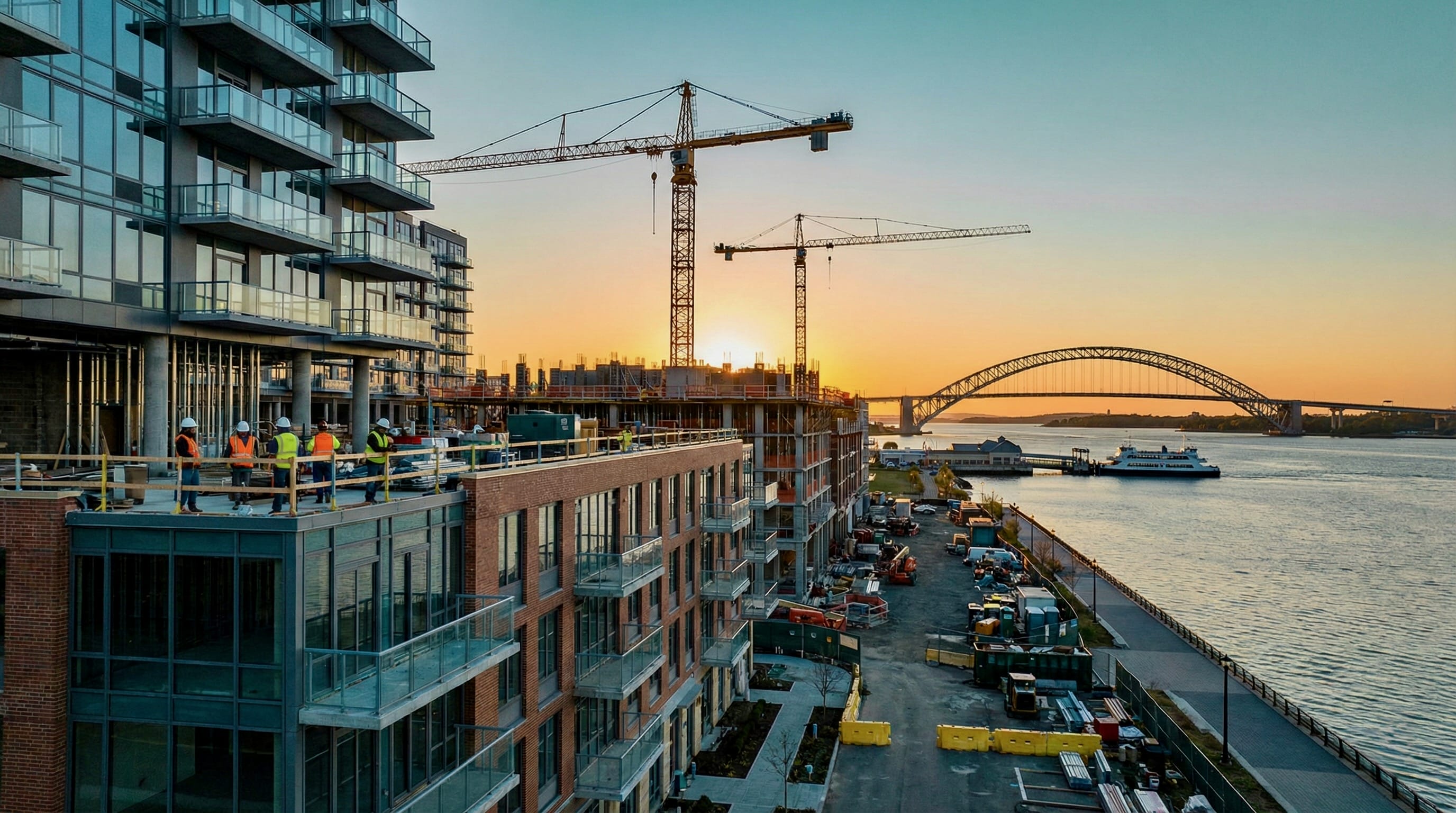
The Staten Island multifamily development pipeline tells a story of opportunity and constraint. While 5.4 million square feet of vacant land sits actively marketed for sale according to CoStar data from January 2026, new apartment construction remains notably slower than in other New York City boroughs. This gap between available land and completed housing units defines the borough’s development landscape.
What explains this gap between available land and completed projects? The answer involves zoning restrictions, infrastructure limitations, and a borough that has historically prioritized single-family neighborhoods over density. Understanding the Staten Island multifamily development pipeline requires examining both the projects moving forward and the barriers that slow progress.
Current State of the Pipeline
The housing pipeline shows modest but growing activity as of early 2026. According to recent housing data, the borough had 1,238 housing units actively under construction at the end of 2024, with an additional 2,302 units in pre-development stages.
By the third quarter of 2025, developers had completed 1,229 units across the borough. While these numbers represent progress, they fall short of addressing the housing shortage that has emerged as Staten Island’s population grew 6.4% between 2010 and 2022, with only 800 new homes added between 2021 and 2023. This creates persistent upward pressure on housing prices and rental rates.
The 5.4 Million Square Feet of Available Land
CoStar’s January 2026 report identified approximately 5.4 million square feet of vacant land actively marketed for sale in Staten Island. This land could potentially support high-quality multifamily housing at both market and affordable rates.
To put this in perspective, 5.4 million square feet equals roughly 124 acres of developable land scattered across the borough. The parcels vary in size, location, and zoning classification, meaning not all can immediately support multifamily construction without regulatory changes.
Larger parcels tend to concentrate on the North Shore and along former industrial corridors. Smaller infill lots exist throughout residential neighborhoods but face stricter zoning limits.
This land availability signals investment opportunity, but the gap between “for sale” and “under construction” reveals the challenges that define Staten Island’s development landscape.
Major Projects Shaping the Pipeline
Several significant projects are moving the Staten Island multifamily development pipeline forward, particularly concentrated on the North Shore.
North Shore Revitalization
The city’s North Shore Action Plan has the potential to add approximately 2,400 new homes to Staten Island. This initiative focuses development along the waterfront corridor, taking advantage of proximity to the St. George Ferry Terminal and existing transit infrastructure.
Key components include:
Stapleton Homeport Development: The former U.S. Naval base site will yield over 2,100 residential units along with ground-floor retail, a public school, and public open spaces. This large-scale mixed-use, mixed-income waterfront development represents one of the most ambitious projects in the borough’s recent history.
New Stapleton Waterfront Project: Announced in May 2025, this development will create over 500 new housing units at the corner of Front and Canal Streets. Approximately 25% of units will be designated as affordable housing.
What makes this project notable is its construction method. Developers selected mass timber construction, making it the largest such residential project in New York City. The choice was driven by the material’s low-carbon footprint and potential for faster construction timelines. Construction is anticipated to begin in 2027.
The Pearl at Bay Street
In November 2025, BFC Partners opened The Pearl, a 100% affordable housing development at 475 Bay Street in Stapleton. This project is part of the Bay Street Corridor Neighborhood Plan, which focuses on providing affordable housing, job opportunities, and public spaces.
The Pearl demonstrates that affordable housing development can succeed on Staten Island when projects align with broader neighborhood planning efforts.
Lighthouse Point
The 115-unit Lighthouse Point development in St. George launched in 2025 after nearly a decade of delays. This project illustrates both the demand for waterfront multifamily housing and the lengthy approval processes that characterize Staten Island development.
Clifton Rehabilitation
A plan to rehabilitate over 1,000 affordable units across an eight-building complex in the Clifton neighborhood addresses the need to preserve existing affordable housing stock. Rather than new construction, this project focuses on modernizing aging buildings to maintain housing quality and affordability.
Modular Construction Pilot
In November 2025, Urban Ecospaces Inc. began construction on 15 modular, flood-resistant homes in the Midland Beach and South Beach neighborhoods. These homes, including seven single-family and eight two-family structures, are being built on city-owned land previously damaged by Hurricane Sandy.
The project targets first-time buyers and is expected to complete before the end of 2026. While not large-scale multifamily, this modular approach could inform future development strategies for addressing first-time homebuyer demand on the island.
Why Development Lags Behind
Despite available land and identified projects, Staten Island’s apartment construction consistently underperforms compared to other boroughs. Several factors explain this lag.
Zoning Restrictions
Staten Island’s zoning map presents significant barriers to multifamily development. Large portions of the borough are zoned R1 and R2, classifications that permit only single-family detached homes.
R1 zones feature larger lot requirements, emphasizing spaciousness and privacy. R1-2 zoning, for example, requires a minimum lot width of 60 feet and minimum lot area of 5,700 square feet, exclusively for single-family detached homes.
R2 zones, found in neighborhoods like Westerleigh, Castleton Corners, and Sunnyside, have slightly smaller minimums: 40-foot lot widths and 3,800 square foot minimum lots. But these areas still prohibit multifamily construction.
This zoning framework means developers must either pursue costly and time-consuming rezoning processes or focus on the limited areas already zoned for higher density.
History of Downzoning
Staten Island has a notable history of intentional downzoning. In the early 2000s, the borough implemented extensive downzoning initiatives in response to what residents described as “piecemeal development that was too fast, too dense and poorly planned.”
These changes:
- Reduced maximum allowable development by 25%
- Cut areas allowing townhouses and apartment buildings by over 50%
- Established tighter controls on infrastructure impact
While these changes aligned with community preferences at the time, they created the regulatory environment that now constrains the Staten Island multifamily development pipeline.
Infrastructure Concerns
Local officials and residents consistently raise infrastructure capacity as a primary concern about increased density.
Transportation: Staten Island remains the only NYC borough without subway service. Most residents rely on cars, express buses, or the Staten Island Railway. Adding thousands of new housing units strains already congested roads and limited public transit options. The Staten Island Expressway already experiences heavy congestion during rush hours.
Express bus routes like the SIM1, SIM4, and SIM35 provide commuter connections to Manhattan, but service frequency and capacity have limits. For those considering different neighborhoods, our transportation guides explain options by area.
Schools: New residential development requires additional school seats. Community boards have criticized some rezoning proposals for not adequately addressing educational infrastructure needs. Department of Education capacity studies often lag behind development planning timelines.
Utilities: Sewer systems, water supply, and the electricity grid would require significant upgrades to support major density increases. These infrastructure investments often lag behind development approvals. Coastal areas also face flood zone considerations that complicate development.
City of Yes and Local Opposition
The citywide “City of Yes” zoning initiative aims to increase housing stock across all five boroughs, including allowing higher-density housing in previously single-family zones and reducing parking requirements in transit-rich areas.
The initiative faces significant resistance on Staten Island. Borough President Vito Fossella and community boards have opposed elements that could alter the borough’s “suburban character.” Specific concerns include:
- Proposals to permit accessory dwelling units in low-density zones
- Reduced parking requirements despite limited transit options
- Risk of indirect displacement as property values rise
- Approximately one-third of Staten Island’s acreage is dedicated to parks and natural lands, limiting development space
These tensions between citywide housing goals and local preferences continue shaping the Staten Island multifamily development pipeline outlook.
Investment Landscape
For developers and investors, Staten Island’s apartment development landscape presents both opportunities and considerations.
Land Costs and Availability
The 5.4 million square feet of available vacant land offers options at various price points. Staten Island land generally costs less per square foot than Manhattan, Brooklyn, or Queens, potentially improving project economics for developers who can navigate the regulatory environment.
For investors comparing opportunities, understanding Staten Island’s real estate market provides context for development potential.
Target Demographics
Staten Island’s multifamily demand comes from several sources:
Young Professionals: Priced out of Manhattan and Brooklyn, some young workers seek more affordable options while maintaining NYC residency.
Families: Larger units with outdoor space appeal to families who want suburban amenities without leaving the city.
Seniors: Aging homeowners looking to downsize from single-family homes create demand for accessible multifamily options.
Essential Workers: Healthcare workers, teachers, and first responders need housing near Borough institutions.
Affordable Housing Requirements
Many Staten Island multifamily projects include affordable housing components, either through inclusionary zoning requirements or to access public financing and tax incentives.
The Pearl’s 100% affordable model and the Stapleton Waterfront’s 25% affordable target illustrate different approaches. Developers must factor these requirements into project planning and financial modeling.
Affordable housing lotteries allow income-qualified households to apply for below-market-rate units. NYC Housing Connect administers these lotteries. Eligibility depends on household size and income relative to Area Median Income (AMI). Prospective renters should create Housing Connect profiles and monitor announcements as new developments reach completion.
For those exploring affordable homeownership rather than rentals, programs exist for income-qualified first-time buyers. Our first-time buyer resources explain available programs and eligibility requirements.
Comparing to Other Boroughs
Staten Island’s housing construction looks modest when compared to other NYC boroughs.
Brooklyn and Queens
Brooklyn and Queens have seen substantial multifamily construction, particularly in areas rezoned for higher density over the past decade. These boroughs benefit from:
- Extensive subway networks improving connectivity
- Commercial corridors supporting ground-floor retail in mixed-use projects
- Larger existing multifamily housing stock creating neighborhood precedent
Explore Brooklyn homes and developments or Queens options for comparison.
The Bronx
The Bronx has experienced significant affordable housing development, often on formerly industrial sites with existing higher-density zoning. Its subway access advantages multifamily projects compared to Staten Island.
Manhattan
Manhattan’s development focuses on luxury condominiums and renovations rather than new rental multifamily due to extremely high land costs and limited available sites.
Future Outlook
Staten Island’s apartment development faces a pivotal period as housing pressures intensify across New York City.
Population Growth vs. Housing Supply
Staten Island’s 6.4% population growth from 2010 to 2022 outpaced housing construction substantially. Only 800 new homes were added between 2021 and 2023, creating a gap that drives up prices for existing housing.
This shortage suggests continued demand for new multifamily units, particularly at affordable and moderate price points. For buyers navigating this market, resources on saving for a down payment and understanding mortgage options become essential.
North Shore Concentration
Development activity will likely remain concentrated on the North Shore, where:
- Existing zoning supports higher density in some areas
- Ferry access to Manhattan improves connectivity
- Waterfront sites offer development scale
- Public investment in the Bay Street Corridor creates momentum
Other parts of the island may see limited multifamily activity without significant zoning changes.
Price Appreciation
Market analysts predict modest home price appreciation of 3-4% for Staten Island in 2026, with low probability of price drops due to the persistent inventory deficit. This environment could attract developers willing to navigate regulatory challenges for potential returns.
The supply-demand imbalance affects both sales and rental prices. With limited new inventory reaching the market each year, existing housing stock commands stronger prices. Neighborhoods near announced development projects may see anticipatory price increases as buyers bet on future improvements.
For sellers considering timing, our Staten Island real estate market update provides current analysis. Buyers benefit from understanding how pipeline timing affects neighborhood-level pricing.
Rental Rate Trends
Average rents on Staten Island have increased as limited supply meets steady demand. Studio apartments, one-bedroom units, and two-bedroom rentals all show upward price pressure. The 44% renter population in some neighborhoods creates competition for available units.
New developments like The Pearl bring modern rentals to market, often at price points reflecting current construction costs. These units typically feature amenities absent in older buildings: in-unit laundry, modern kitchens, energy-efficient systems.
Innovations in Construction
The Stapleton Waterfront’s mass timber approach and Urban Ecospaces’ modular construction pilot suggest developers are exploring alternative building methods that could:
- Reduce construction costs
- Accelerate project timelines
- Address sustainability concerns
- Work within challenging site conditions
What This Means for Buyers and Renters
New apartment construction directly impacts housing options for residents and prospective residents.
Rental Market
Limited new construction keeps the rental market competitive. The 1,238 units under construction as of late 2024 will add supply, but absorption rates in this market have historically been strong.
New units in projects like The Pearl and Lighthouse Point offer modern amenities that older Staten Island rental stock may lack, potentially commanding premium rents.
Homebuyers
Single-family homes remain the dominant housing type on Staten Island, but new multifamily construction creates:
- Condominium purchase opportunities in new developments
- Two-family homes for buyers seeking rental income
- Options for downsizing empty nesters
Understanding closing costs and working with experienced local agents helps buyers navigate available options. Browse current Staten Island listings to see what’s available.
Affordability Considerations
The affordable housing components in new developments provide options for income-qualified households. The Clifton rehabilitation will preserve 1,000+ affordable units, while new projects add to the affordable inventory.
For those exploring options beyond Staten Island, understanding NJ property taxes helps compare across state lines. Communities in Bayonne and Jersey City offer alternatives accessible by ferry or bridge.
Timeline Expectations
Buyers and renters should understand that the Staten Island multifamily development pipeline moves slowly compared to other markets. The Lighthouse Point project took nearly a decade from conception to completion. The Stapleton Waterfront won’t break ground until 2027.
This means:
- New inventory comes online gradually rather than in large waves
- Competition for existing rentals remains strong in the near term
- Patience is required for those waiting for specific developments
Working With Local Experts
Navigating Staten Island’s housing market benefits from local expertise. Understanding which neighborhoods are seeing development, which projects are on track, and where future inventory will appear requires knowledge of both real estate and municipal processes.
Robert DeFalco Realty tracks these developments closely. Our team can explain how pipeline projects might affect specific neighborhoods and help clients time their housing decisions appropriately.
Economic Impact of Multifamily Development
Multifamily construction creates economic activity beyond the housing units themselves.
Construction Employment
Each major project generates hundreds of construction jobs during the building phase. The Stapleton Homeport development alone will employ significant numbers of workers over multiple years. These jobs benefit local workers and contractors, circulating wages through the Staten Island economy.
Property Tax Revenue
New apartment buildings add to the tax base. Unlike single-family homes that may sell infrequently, rental properties generate consistent assessments that fund schools, infrastructure, and services. The Clifton rehabilitation, while not new construction, will maintain property values and tax contributions from existing buildings.
Retail and Service Growth
New residents create demand for restaurants, shops, and services. The Bay Street Corridor’s ground-floor retail components in projects like The Pearl bring commercial activity to areas that previously lacked foot traffic. This diversification strengthens neighborhood economies.
Long-Term Investment Returns
For those considering property investment, understanding home inspection requirements and first-time homebuyer programs helps evaluate opportunities as new inventory comes online.
Key Neighborhoods for Development
Certain areas offer more potential for new apartment construction than others.
St. George
The ferry terminal area anchors transit connectivity. Lighthouse Point and other projects cluster near this transportation hub. Waterfront access and views command premium pricing.
Stapleton
The Homeport site and Bay Street Corridor represent the largest concentration of planned development. The Pearl and upcoming waterfront projects will transform this area over the next decade.
Clifton
The rehabilitation of existing affordable stock maintains this neighborhood’s role as an affordable option. New construction remains limited by zoning.
Mariners Harbor
Sanitation garage conversion plans could bring new housing and retail to this underserved area. Community benefits agreements will likely shape project details.
Frequently Asked Questions
How many multifamily units are in Staten Island’s development pipeline?
As of late 2024, approximately 1,238 housing units were under construction on Staten Island, with an additional 2,302 units in pre-development stages. The North Shore revitalization alone could add roughly 2,400 new homes once all phases complete.
Why does Staten Island have less multifamily development than other boroughs?
Staten Island’s extensive R1 and R2 zoning restricts most land to single-family homes only. Historical downzoning in the early 2000s reduced allowable density by 25% and cut areas permitting apartments by over 50%. Limited transit connectivity and infrastructure concerns also slow development.
What is the largest multifamily project planned for Staten Island?
The Stapleton Homeport development at the former U.S. Naval base site plans to deliver over 2,100 residential units along with retail, a public school, and open spaces. This mixed-use, mixed-income waterfront project represents the borough’s most ambitious multifamily development.
How much land is available for multifamily development in Staten Island?
According to CoStar data from January 2026, approximately 5.4 million square feet of vacant land is actively being marketed for sale in Staten Island. This equals roughly 124 acres scattered across various locations and zoning classifications.
Will the City of Yes create more multifamily housing on Staten Island?
The City of Yes zoning initiative aims to increase housing density citywide, including provisions for accessory dwelling units in single-family zones. The initiative faces significant local opposition from Staten Island officials and community boards concerned about infrastructure capacity and neighborhood character.
What affordable housing is being built on Staten Island?
Major affordable projects include The Pearl (100% affordable, opened November 2025), the Stapleton Waterfront development (25% affordable), and the Clifton rehabilitation (preserving 1,000+ affordable units). Affordable housing requirements apply to many new developments through inclusionary zoning.
When will the Stapleton Waterfront project begin construction?
Construction on the initial phase of the New Stapleton Waterfront development, creating over 500 housing units, is anticipated to begin in 2027. The project will use mass timber construction, making it the largest such residential development in New York City.
How does Staten Island’s housing shortage affect prices?
Staten Island’s population grew 6.4% from 2010 to 2022, but only 800 new homes were added between 2021 and 2023. This supply-demand imbalance has driven up prices. Analysts project 3-4% home price appreciation for 2026 with low probability of declines.
Staten Island’s apartment construction stands at a crossroads. Available land, identified projects, and demonstrated demand suggest potential for growth. Zoning constraints, infrastructure limitations, and community opposition create barriers that slow progress.
The Path Forward
For developers, success requires:
- Focusing on areas with existing higher-density zoning
- Building community support through affordable housing commitments
- Addressing infrastructure concerns proactively
- Exploring alternative construction methods like mass timber and modular building
For buyers and renters, understanding this pipeline helps set realistic expectations about housing options and timing.
Robert DeFalco Realty has served Staten Island for over 35 years, helping clients navigate the borough’s evolving housing landscape. Whether you’re interested in existing homes or curious about new developments, contact our team for expert guidance.
Sources: