
Living in Carroll Gardens, Brooklyn: A 2026 Neighborhood Guide
Carroll Gardens Brooklyn has a way of tricking smart people.
You walk the tree-lined blocks, see the brownstones with those signature deep front gardens, and think: “This is the Brooklyn I want.” But when you’re deciding whether to buy or rent here, the real questions aren’t romantic. They’re practical:
- What does my budget actually get me in Carroll Gardens right now?
- How competitive is inventory, and what do I need to do to win?
- Does the day-to-day lifestyle match my commute, my family plans, and my tolerance for walk-ups?
This guide answers those questions clearly, without fluff, and without pretending Carroll Gardens is perfect for everyone.
Here’s the market reality: Carroll Gardens is desirable because it has limited housing stock. And that same scarcity is why buyers and renters can feel like they’re always a step behind. StreetEasy describes the area’s housing stock as “older and somewhat limited,” with few condos/new apartments and fewer elevator/amenity buildings. Inventory tends to be low, with more co-ops than condos, and many rentals in walk-ups.
To ground this guide in real numbers (not vibes), we’ll reference current neighborhood snapshots like StreetEasy’s median sale price around $2.3M and median base rent around $4,500 (base rent excludes fees). Consider those figures a starting point. They’re useful for orientation, then we’ll break down what that means by property type, tradeoffs, and timing.
We’ll also cover the “deal-breaker” logistics people don’t want to Google 14 times. For commuting, Carroll Gardens is anchored by the F and G trains, with nearby Bergen St and Carroll St stations offering easy transfers between lines.
If schools are part of your decision (even “not yet, but soon”), you’ll see clear, verifiable details. Like the fact that P.S. 58 The Carroll (K058) is in Geographic District 15, serving grades PK through 5 (plus special education designations), located at 330 Smith Street, Brooklyn, NY 11231. (We’ll also include a quick “verify before you buy” disclaimer so you’re protected.)
And because “Is it safe?” always comes up: Carroll Gardens falls under the NYPD’s 76th Precinct, which lists Carroll Gardens among the neighborhoods it serves. We’ll show you how to interpret the precinct’s reported stats without fear-mongering or false precision.
If you’re ready to take action while you read, you can do that here:
The goal is simple: by the end of this guide, you’ll know whether Carroll Gardens fits your life. And if it does, you’ll have a clean next step to find the right home faster with a local team that works this neighborhood every day.
Table of Contents
Carroll Gardens Real Estate (2025–2026): Prices, Inventory, and What You Can Actually Buy
Carroll Gardens real estate is expensive for a simple reason: it’s a small neighborhood with limited housing stock, and a lot of people want exactly what it offers (brownstone blocks, a strong community feel, and a “Brooklyn classic” streetscape). StreetEasy frames the housing here as older and somewhat limited, with few condos/new apartments and fewer buildings with elevators or amenities. Which is a polite way of saying: if you’re shopping here, your “wish list” needs to match the neighborhood’s building reality.
A Quick Pricing Snapshot (and Why Numbers Don’t Always Match)
You’ll see different price points depending on whether the source is measuring sold homes, listed homes, or an index of “typical value.” Here’s a clean way to interpret the major data points:
- Median sale price (StreetEasy): about $2.3M (useful as a neighborhood-level reference point)
- Typical home value (Zillow ZHVI): $1,875,711, with data through Nov 30, 2025 (an index-based estimate across housing types)
- Median sale price (Redfin): $1,927,000 for Oct 2025, with 88 median days on market (closed-sale oriented, based on MLS/public records)
- Median listing home price (Realtor.com): $2.7M in Aug 2025, with 86 median days on market (active listings, not closed sales)
How to use this: if you’re a buyer, treat listing metrics as “what sellers are asking,” and sold metrics as “what the market is actually absorbing.” If you’re a renter, StreetEasy’s rent metrics are the fastest temperature check, but always verify your exact building/location.
Inventory Reality: Scarcity Is Part of the Neighborhood’s “Price”
Because Carroll Gardens is physically small, StreetEasy notes that inventory tends to be low, and you’ll typically find more co-ops than condos, with most rentals in walk-ups rather than large apartment buildings. That directly affects your search strategy: you may not get dozens of “perfect matches.” You win by being decisive when the right one appears.
Different platforms will show different inventory counts depending on timing and boundaries, but it’s still useful as a directional signal. Zillow showed 24 for-sale inventory as of Nov 30, 2025 on its Carroll Gardens housing-market page.
Pro Tips: How to Win in a Tight Market
When you’re competing in a neighborhood where good listings move fast, here’s what makes a difference:
Get pre-approved (not just pre-qualified) In tight-inventory neighborhoods, being ready is a competitive advantage. You’ll move faster and negotiate better when you’re already clear on your financing path, down payment, and closing budget.
Know your must-haves vs. nice-to-haves When inventory is limited, you can’t wait for perfection. Decide what’s non-negotiable (location, building type, commute) versus what you can live without.
Don’t underestimate historic-district logistics Carroll Gardens includes a NYC-designated historic district (designated Sept. 25, 1973). If your dream home needs exterior-visible work, factor in permitting and review time early.
Use neighborhood expertise Carroll Gardens can feel very different depending on your tolerance for quiet residential blocks vs. closer-to-action edges, train-walk distance, and school logistics. A local agent adds value by aligning listings with your day-to-day, not just the photos.
What You Can Buy in Carroll Gardens (Property Types + Tradeoffs)
Instead of thinking “I want a 2BR in Carroll Gardens,” it’s often smarter to decide what building type fits your lifestyle and tolerance for rules/maintenance:
Co-ops (common here)
- Pros: often a lower entry point than a townhouse; strong neighborhood value
- Tradeoffs: approval processes, house rules, and building financial health matter a lot (your agent should help you evaluate these)
Condos (less common than in newer neighborhoods)
- Pros: typically more flexible than co-ops on ownership/rental rules
- Tradeoffs: there are simply fewer condo options relative to demand, which can push prices up when good ones hit the market
Townhouses + multi-family brownstones (the “signature” inventory)
- Pros: space, classic architecture, long-term appeal
- Tradeoffs: higher price tags, plus real ownership responsibilities (systems, façade work, and—depending on the exact property—landmark-related constraints)
Days on Market: What “Normal” Looks Like Here
Even “days on market” varies by source and month, but the key takeaway is this: Carroll Gardens is not a neighborhood where you casually wait for the perfect listing forever.
- StreetEasy shows 66 days as a sales median days on market data point for the neighborhood
- Redfin shows 88 median days on market for Oct 2025
- Realtor.com shows 86 median days on market for Aug 2025
Practically, this means: some homes still move fast when priced right, but you can also find opportunities—especially when a listing needs work or is priced ambitiously.
Next step (do this while you read):
- Search Carroll Gardens Homes for Sale (live listings)
- Talk to a Carroll Gardens specialist if you want a short list matched to your budget + building type
Schools & Family Life in Carroll Gardens (What to Know Before You Sign a Lease or Make an Offer)
For a lot of buyers and renters, Carroll Gardens isn’t just a “pretty brownstone neighborhood.” It’s a systems neighborhood—meaning the day-to-day works: school logistics, walkability, playground routines, and the kind of community infrastructure that makes life easier (especially if you’re raising kids now, or planning to).
The only catch: NYC school admissions and zoning can feel confusing if you’re moving from out of state (or even from another part of the city). So the goal of this section is to give you a clear way to evaluate schools without overpromising anything that needs to be verified for your exact address.
Public Schools: What You Need to Know About P.S. 58 & District 15
Carroll Gardens falls within NYC DOE Geographic District 15. The neighborhood anchor is P.S. 58 The Carroll (K058), located at 330 Smith Street, Brooklyn, NY 11231.
NYC DOE lists P.S. 58 as serving grades PK through 5 (plus special education designations). The school has a solid reputation among families in the neighborhood, but—and this is the part you need to verify yourself—zoning boundaries can shift, and admission priorities sometimes change based on capacity and DOE policy updates.
Before you sign a lease or make an offer, use NYC DOE’s school search tools to confirm:
- Your exact address falls within P.S. 58’s zoned area
- Current waitlist status (if relevant)
- Any recent changes to admission priorities
What About Middle School & High School?
NYC’s middle and high school admissions work differently from elementary. Most families apply through a choice-based process rather than automatic zoning. District 15 uses a diversity plan that considers family income and other factors.
If you’re planning ahead for middle or high school years, familiarize yourself with the District 15 admissions landscape now. Popular choices fill up fast, and understanding the application timeline matters.
Private & Parochial Options
Carroll Gardens has access to several private and parochial schools in Brooklyn, both within the neighborhood and nearby areas like Brooklyn Heights, Cobble Hill, and Park Slope. These schools typically have their own application processes, tuition structures, and wait lists—so if you’re considering private education, start your research early.
Family-Friendly Infrastructure: Parks, Libraries, and Community Spaces
Beyond schools, Carroll Gardens delivers on the “systems” front:
Carroll Park The neighborhood’s centerpiece. It’s where you’ll see families on weekend mornings, kids playing on the playground, and neighbors catching up on benches. The park includes a memorial honoring local veterans and is well-maintained year-round.
Brooklyn Public Library The Carroll Gardens branch is currently operating as a pop-up location while the permanent building undergoes renovations (scheduled to reopen Summer 2026). Even during the interim, the branch offers children’s programming, story time, and community events—all free.
Carroll Gardens Greenmarket The Carroll Gardens Greenmarket runs Sundays year-round on Carroll Street between Smith and Court Streets (across from Carroll Park), typically 8:00 a.m. to 2:00 p.m. (vendors may leave early due to weather). It’s a Sunday routine for a lot of families: grab coffee, pick up produce, let kids run around the park.
Transportation in Carroll Gardens: F & G Trains, Commute Times, and Getting Around
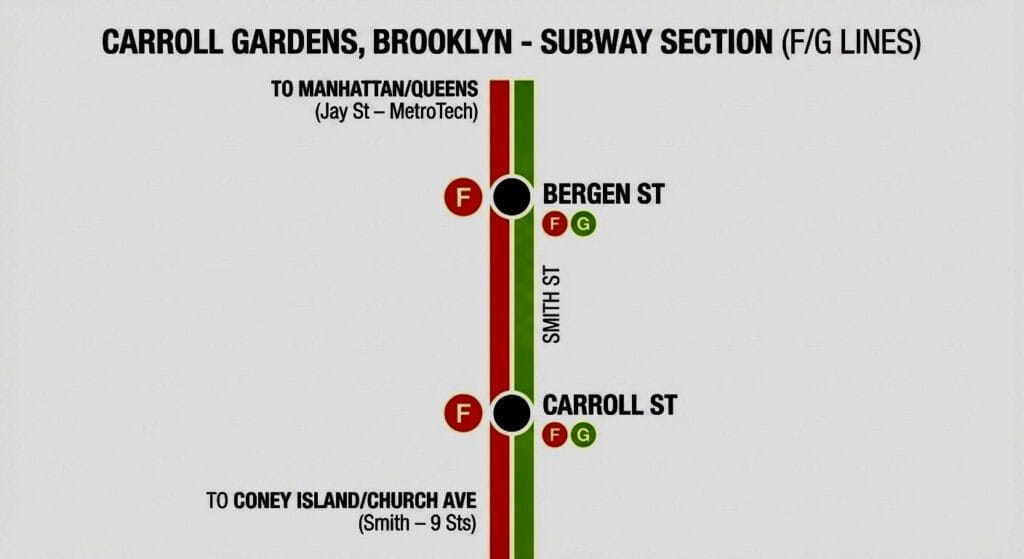
Carroll Gardens is anchored by the F and G trains. Both Bergen St and Carroll St stations serve the F and G lines, offering easy transfers between the two.
Key Stations & Transfer Points
Bergen St (F/G) Located at the intersection of Bergen Street and Smith Street, this station provides direct access to both lines and is one of the most convenient entry points for Carroll Gardens residents.
Carroll St (F/G) Just south of Bergen St, this station sits at Carroll Street and Smith Street and also serves both the F and G lines.
4 Av–9 St (F/G/R) A slightly longer walk for most Carroll Gardens residents, this station adds the R train option and provides additional transfer flexibility for commuters.
Commute Times to Key Destinations
From Carroll Gardens (using Bergen St or Carroll St stations):
- Manhattan (Lower Manhattan/Financial District): ~15-20 minutes
- Midtown Manhattan: ~30-35 minutes
- Williamsburg/Greenpoint: ~20-25 minutes (via G train)
- Downtown Brooklyn: ~5-10 minutes
Commute times vary depending on time of day, service changes, and which train you catch. The F train tends to run more frequently during peak hours, while the G train serves as a solid alternative for Brooklyn-to-Brooklyn commuting.
Getting Around Without the Subway
Carroll Gardens is a highly walkable neighborhood. Court Street and Smith Street both run through the heart of the area, offering shops, restaurants, cafes, and services within easy walking distance.
For longer trips, ride-share services and taxis are readily available. Citi Bike docking stations are also scattered throughout the neighborhood, making bike-sharing a viable option for short trips.
Is Carroll Gardens Safe? Crime Stats, Quality of Life, and What the Data Actually Shows
Carroll Gardens falls under the NYPD’s 76th Precinct (191 Union Street), which covers Carroll Gardens, Cobble Hill, Red Hook, and Gowanus.
The precinct publishes weekly CompStat reports tracking major felonies (murder, rape, robbery, felony assault, burglary, grand larceny, and grand larceny auto). These reports are publicly available on the NYPD website.
What the Numbers Show
The CompStat report covering Dec 8, 2025–Dec 14, 2025 shows:
- Total major felonies YTD: 485 (2025) vs. 528 (2024)
- This represents a decline compared to the previous year
(Note: These figures are preliminary and subject to revision.)
How to Read This Data (Without Overreacting or Under-reacting)
Precinct-level data is useful context, but it doesn’t predict what will happen on your specific block. Crime stats fluctuate week to week, and a single precinct covers multiple neighborhoods with different characteristics.
Here’s what matters more than raw numbers:
- Walk the neighborhood at different times of day
- Talk to residents (coffee shop employees, dog walkers, parents at the park)
- Pay attention to street lighting, foot traffic, and building maintenance
Carroll Gardens has a strong neighborhood-watch culture, active block associations, and a lot of longtime residents who know their neighbors. That “eyes on the street” factor contributes to the overall sense of safety people describe when they talk about living here.
Restaurants, Cafes, and Food Culture in Carroll Gardens
Carroll Gardens has a food scene that reflects the neighborhood’s Italian-American roots while embracing new spots that cater to today’s residents. You won’t find chains here. Most restaurants are independently owned, chef-driven, or family-run businesses that have been around for years (or decades).
Best Brunch Spots in Carroll Gardens
Frankies 457 Spuntino A neighborhood institution. Known for seasonal Italian dishes, a cozy backyard garden, and weekend brunch crowds. Expect a wait, but it’s worth it.
Cafe Luluc A French bistro on Smith Street serving classic brunch dishes. Known for their eggs Benedict, croque madame, and cozy neighborhood atmosphere. Cash-only, so come prepared.
Runner & Stone This bakery-cafe combo on Court Street offers fresh-baked bread, pastries, and a brunch menu built around high-quality ingredients. Great for a quieter, more low-key brunch.
Pizza Legends: Lucali vs. F&F
Carroll Gardens is home to two of Brooklyn’s most talked-about pizza spots:
Lucali Cash-only, BYOB, no reservations. Lucali is the kind of place people wait hours for. The pizza is thin-crust, wood-fired, and made fresh to order. Expect lines, especially on weekends.
F&F Pizzeria Run by a former Lucali employee, F&F offers a similar style of wood-fired pizza with slightly shorter wait times. Both spots have passionate fans who will argue endlessly about which is better.
Italian Classics
Carroll Gardens’ Italian heritage is still very much alive in its restaurants:
Marco Polo Ristorante A Carroll Gardens staple since 1983. Classic red-sauce Italian in a formal setting. Popular for special occasions and family dinners.
Court Street Grocers Not a sit-down restaurant, but a must-mention. Court Street Grocers makes some of the best Italian sandwiches in Brooklyn. Perfect for grabbing lunch to go.
Cafe Spaghetti Sicilian-inspired spot from Sal Lamboglia serving house-made pasta, Sicilian specialties, and classic Italian-American dishes. A newer addition that respects the neighborhood’s Italian roots while bringing fresh energy.
New Guard: Modern Restaurants Making a Mark
La Vara Spanish tapas with a focus on Moorish and Sephardic influences. Small plates, great wine list, and a date-night vibe. Reservations recommended on weekends.
Brooklyn Farmacy & Soda Fountain A vintage soda fountain serving ice cream sundaes, egg creams, and other throwback treats. Fun for kids and adults alike.
Nights & Weekends A newer addition to the neighborhood, Nights & Weekends serves wood-fired dishes and natural wines in a casual, neighborhood-friendly setting.
Fitness & Wellness: Yoga, Pilates, and Staying Active in Carroll Gardens
Beyond running in Carroll Park or walking to the Greenmarket, Carroll Gardens has a growing fitness and wellness scene:
Carroll Gardens Yoga Offers a range of classes including vinyasa, restorative, and beginner-friendly sessions. Small class sizes and a community-oriented vibe.
Brooklyn Barre Located on Court Street, Brooklyn Barre offers barre, Pilates, and strength-training classes. Popular with neighborhood residents looking for low-impact but challenging workouts.
The Grit Bxng A boutique boxing gym with group classes and personal training. High-energy workouts in a clean, welcoming space.
Equinox (nearby) While not directly in Carroll Gardens, Equinox has a location in nearby DUMBO for those willing to make the trip. Full-service gym with classes, personal training, and spa amenities.
History & Character: What Makes Carroll Gardens Look the Way It Does
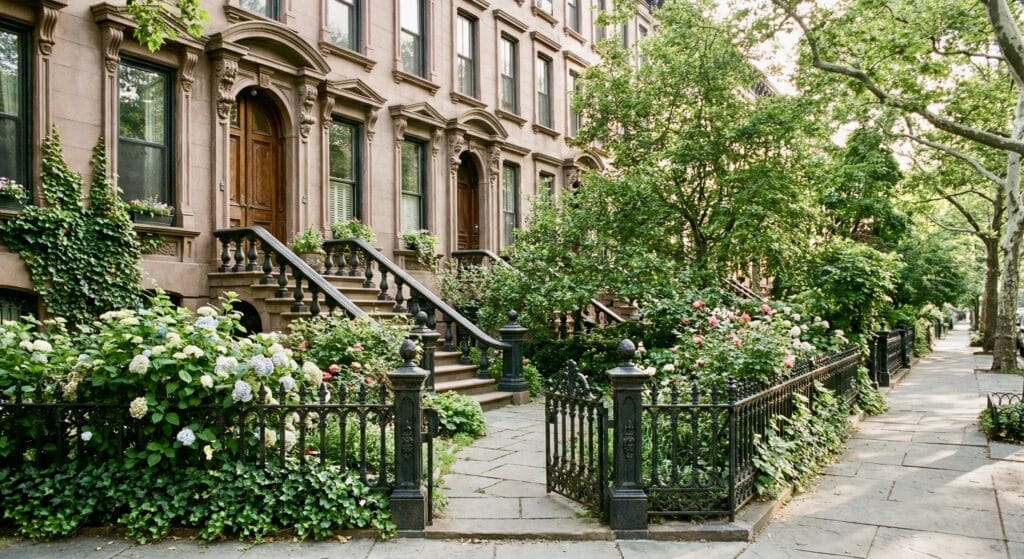
Carroll Gardens has a distinct streetscape: brownstones with unusually deep front gardens (often 20-30 feet), tree-lined blocks, and a residential feel that’s quieter than neighboring areas like Cobble Hill or Brooklyn Heights.
That look isn’t an accident. It’s the result of an 1846 land survey that set aside extra space for front yards—a decision that gives the neighborhood its signature “breathing room” compared to other Brooklyn brownstone districts.
The Historic District (and What It Means for Homeowners)
Carroll Gardens includes the Carroll Gardens Historic District, designated Sept. 25, 1973. The district covers roughly 130 buildings and is one of Brooklyn’s smaller historic districts.
Owning in a historic district doesn’t mean “no renovations.” But it does mean certain types of exterior work require Landmarks Preservation Commission (LPC) approval. If your dream home needs facade work, window replacements, or other visible changes, factor in permitting and review time early.
Comparing Carroll Gardens to Nearby Brooklyn Neighborhoods
| Factor | Carroll Gardens | Cobble Hill | Park Slope | Brooklyn Heights |
|---|---|---|---|---|
| Median Sale Price | ~$2.3M | ~$2.5M | ~$1.8M | ~$2.7M |
| Subway Access | F, G | F, G | F, G, R | 2, 3, 4, 5 |
| Vibe | Residential, Italian roots, tree-lined blocks | More refined, smaller footprint | Family-heavy, park-centric | Quiet, historic, waterfront |
| Building Stock | Co-ops, brownstones, limited condos | Brownstones, fewer apartments | Mix of co-ops, condos, rentals | Brownstones, co-ops |
| Best For | Families, long-term buyers seeking classic Brooklyn | Buyers willing to pay premium for cachet | Families prioritizing schools & park access | Buyers seeking prestige & Manhattan proximity |
FAQ: Living in Carroll Gardens, Brooklyn (Quick Answers)
Is Carroll Gardens, Brooklyn a good place to live?
Carroll Gardens is a strong fit if you want classic brownstone Brooklyn, a neighborhood-first feel, and walkable daily life (Court/Smith corridors + Carroll Park routines). The main tradeoff is housing: inventory is often tight, and the building stock skews older (fewer new condo/amenity buildings), so your wish list needs to match reality.
How expensive is it to buy a home in Carroll Gardens?
It’s one of Brooklyn’s pricier markets, but “price” depends on the metric. StreetEasy shows a ~$2.3M median sale; Redfin reports a $1,927,000 median sale price in Oct 2025; Zillow’s index shows a $1,875,711 typical value (data through Nov 30, 2025); and Realtor.com shows a $2.7M median listing price (Aug 2025).
What’s the average rent in Carroll Gardens?
StreetEasy lists a median base rent of $4,500 for Carroll Gardens—note that “base rent” excludes fees, so your all-in monthly cost can be higher depending on the building and deal terms. For renters, the bigger challenge is often limited inventory and the fact that many rentals are in walk-up buildings.
What subway lines serve Carroll Gardens?
Most residents anchor their commute around the F and G trains—especially via Bergen St and Carroll St stations. For broader flexibility, 4 Av–9 St also provides the R train with service notes.
What NYPD precinct covers Carroll Gardens?
Carroll Gardens is served by the NYPD 76th Precinct (191 Union Street). The precinct’s official page lists Carroll Gardens among the neighborhoods it covers and links to public crime statistics reports.
How can I check crime stats for Carroll Gardens in a reliable way?
Use the NYPD’s 76th Precinct CompStat PDF for a transparent snapshot of reported major felonies. The CompStat report covering Dec 8, 2025–Dec 14, 2025 shows total major felonies YTD: 485 (2025) vs. 528 (2024) (figures are preliminary). Treat precinct stats as context—not a block-by-block prediction.
What school district is Carroll Gardens in? (And what about P.S. 58?)
For public school context, Carroll Gardens is in NYC DOE Geographic District 15. NYC DOE lists P.S. 058 The Carroll (K058) at 330 Smith Street and shows grades including PK through 5 (plus special education designations). Always verify your exact address/zoning with DOE tools before you sign a lease or buy.
Is Carroll Gardens a historic district?
Yes—Carroll Gardens includes the Carroll Gardens Historic District, designated Sept. 25, 1973. Preservation is part of why the neighborhood’s streetscape feels so consistent. If you’re buying with renovation plans, you may need to plan around Landmarks Preservation Commission (LPC) permitting and review processes for certain types of work.
When is the Carroll Gardens Greenmarket, and where is it?
GrowNYC lists the Carroll Gardens Greenmarket on Carroll Street between Smith and Court Streets, Sundays year-round, typically 8:00 a.m. to 2:00 p.m. (with a note that vendors may leave early due to weather). It’s also described as being across from Carroll Park.
Conclusion: Is Carroll Gardens Right for You?
Carroll Gardens stays on serious buyers’ and renters’ shortlists for a reason: it delivers “classic Brooklyn” in a way that’s still genuinely livable. Tree-lined blocks, strong community routines anchored by Carroll Park, and local businesses that feel resident-first (not franchise-saturated).
But it’s also a neighborhood where the market reality matters. StreetEasy’s snapshot shows homes around $2.3M and median base rent around $4,500. Housing stock is older and somewhat limited, with fewer elevator/amenity buildings and fewer new condos.
If you’re deciding whether to make Carroll Gardens home, the smartest next step is to stop researching in the abstract and start comparing real inventory against your non-negotiables (budget, building type, commute, schools). Transit access via the F and G lines makes it workable for many Manhattan- and Brooklyn-based commutes. And for families, it helps to ground your plan in verifiable info—like NYC DOE’s listing for P.S. 58 (K058) at 330 Smith Street (District 15).
Ready to take action?