
Port Richmond Staten Island: Complete Neighborhood Guide 2026
In This Guide
Port Richmond Staten Island is the most affordable ferry-corridor neighborhood on the North Shore, with median home prices between $350,000 and $525,000 and a Latino-led commercial revival that has reshaped Port Richmond Avenue over the last fifteen years. Buyers priced out of St. George, New Brighton, or West New Brighton keep landing here because the same 1890s woodframes and brick rowhouses that sell for $750,000 a mile east still trade for $400,000 to $475,000 in the Port Richmond historic district. Add a 22-minute trip to Manhattan over the Bayonne Bridge, the busiest Mexican food corridor in New York City outside Sunset Park, and one of the oldest documented neighborhoods on Staten Island, and the value math gets interesting fast.
This guide covers what buyers, investors, and renters need to know before signing a contract in 10302. We will be honest about the parts of Port Richmond that have struggled, including higher 121st Precinct crime numbers and the documented Black/Hispanic tensions that peaked around 2010, and we will be specific about the parts of the neighborhood that feel calm, residential, and family-friendly. If you are still weighing whether this corner of the island fits your life, our moving to Staten Island guide offers a wider lens on borough trade-offs.
What Is Port Richmond Staten Island Known For?
Port Richmond Staten Island is known for three things: deep colonial history, the largest Hispanic population on Staten Island, and a working-class affordability that has held even as the rest of the North Shore has gentrified. The neighborhood sits at the western end of the North Shore on the Kill Van Kull, with the Bayonne Bridge as its western gate, Clove Road as its eastern boundary, and Forest Avenue as its southern edge. The area covers 1.055 square miles and held 22,609 residents in the 2020 NTA count, which puts density firmly in the urban-village range.
The history goes back further than almost anywhere else on the island. The local cemetery dates to 1696. The Reformed Dutch Church congregation organized in 1714, and the current Greek Revival sanctuary went up in 1845, earning a National Register of Historic Places listing in 2005. Cornelius Vanderbilt, the rail and steamship Commodore who would become the richest American of the 19th century, was born in Port Richmond in 1794. Aaron Burr died at the St. James Hotel here in 1836. The neighborhood incorporated as a village in 1866, ran on whale oil, linseed oil, oyster harvesting, and lumber through the 1800s, and produced the oyster captain mansions that still line Heberton Avenue today.
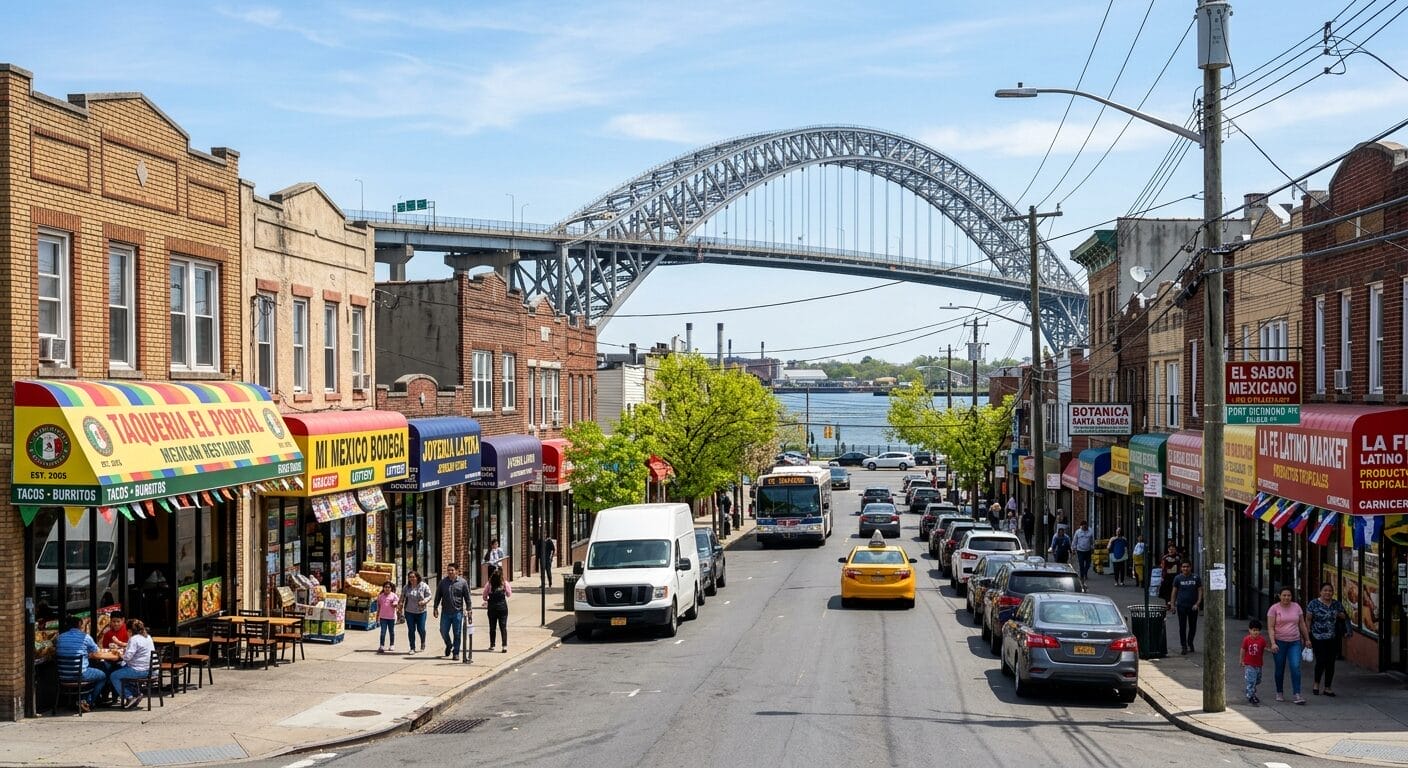
The Latino story is more recent and equally defining. Port Richmond is 49.1% Hispanic, the highest share of any Staten Island ZIP, and it is the only ZIP on the island where Mexican-origin residents outnumber Puerto Rican-origin residents. Mexicans make up roughly 20-23% of the local population. This shows up everywhere in the streetscape, especially along Port Richmond Avenue, where taquerias, panaderias, carnicerias, and bilingual storefront signage define the commercial spine.
Is Port Richmond Staten Island a Good Place to Live?
The honest answer to “is port richmond staten island safe” depends entirely on which part of Port Richmond you mean. The neighborhood is not uniform. Buyers who treat it as one block will misread the value. Buyers who learn the internal map can find genuine bargains in the residential southern section while skipping the rougher northern blocks closer to the waterfront.
Safety: The Honest Picture
Port Richmond falls under the 121st Precinct, which split off from the 120th Precinct in 2013 specifically because the North Shore needed dedicated coverage. The 121st serves Port Richmond, Mariners Harbor, Westerleigh, and parts of Graniteville. Crime numbers in the 121st run higher than in the borough’s South Shore precincts and higher than in the 122nd or 123rd to the south. Property crime, vehicle break-ins, and occasional shooting incidents concentrate in the northern section of Port Richmond, generally north of Post Avenue and closer to the Kill Van Kull industrial waterfront.
The southern section, sometimes called Upper Port Richmond or Port Richmond Center, sits closer to Forest Avenue and Westerleigh. It is residential, quieter, and feels meaningfully different from the corridor north of Post. Buyers comfortable with city density and willing to learn block-by-block dynamics often find this southern band a workable compromise between affordability and stability. Our Staten Island safety guide breaks down precinct-by-precinct numbers if you want the wider context.
Affordability and Value
This is the strongest case for Port Richmond. Median home prices sit between $350,000 and $525,000 across the broader neighborhood. Single-family detached homes run $400,000 to $600,000. Two-family homes, the local workhorse stock and a favorite for owner-occupant investors, run $475,000 to $700,000. Co-ops and condos, where they exist, can be found between $200,000 and $350,000, which is genuinely the cheapest housing tier you will find within a 30-minute commute of Manhattan via the St. George Ferry.
For comparison, the same square footage in St. George trades for 35-50% more, and in West New Brighton runs 20-30% higher. If you are running affordability scenarios, our how much house can I afford calculator and the Staten Island home value guide are the tools we use with clients during their first call.
Latino Culture and Commercial Revival
Port Richmond Avenue has been the heart of a Latino-led commercial revival since the early 2000s. Mexican bakeries, fruit carts, mariscos restaurants, immigration legal services, money transfer storefronts, and bilingual real estate offices fill the corridor between Castleton Avenue and Forest Avenue. Make the Road New York, a major immigrant rights and worker organizing nonprofit, runs a Port Richmond office and has helped anchor the neighborhood’s civic infrastructure. El Centro de Hospitalidad and the Port Richmond Improvement Association have done parallel work on small business support and street-level cleanliness.
This is not a tourist food scene with marketing dollars behind it. It is a working neighborhood food scene with low prices, long hours, and food that local Mexican families cook for their own families. For buyers who care about authentic cultural texture in their neighborhood, this is one of the most distinctive corridors in the five boroughs.
Northern vs. Southern Port Richmond
The internal split matters more than any other safety question. North of Post Avenue, including the blocks closer to the Kill Van Kull and the Castleton Bus Depot, the streetscape is older industrial mixed with two- and three-family rowhouses. Crime concentrates here, including documented incidents of street violence and the 2010 attack on Ecuadorian immigrant Rodrigo Olmedo that became a national story about anti-Latino violence and forced a serious community conversation about race, policing, and intergroup relations between Black and Hispanic residents. The community has invested real work into healing through the Wagner College Port Richmond Partnership, founded in 2008 and praised by Bill Clinton at the Clinton Global Initiative University in 2009, and through ongoing dialogue programs led by local clergy and Make the Road New York. Community advocacy organization Make the Road New York also works directly out of a Port Richmond Avenue storefront, organizing day laborers and immigrant families.
South of Post Avenue and especially closer to Forest Avenue, the housing stock shifts to single-family woodframes and small-lot Capes, schools feel more anchored, and crime numbers fall closer to the borough average. Heberton Avenue and the streets around the Reformed Dutch Church and Old PS 20 read as a calm historic district with mature trees and notable architecture.
Real Estate and Housing Market
The Port Richmond housing market in April 2026 sits in a transitional spot: prices have appreciated 2-4% year over year, slightly behind the borough average, while days on market have stretched to 70-90 days, also slightly longer than the rest of Staten Island. Buyers have more negotiating room here than in stronger North Shore submarkets like St. George.
Current Market Snapshot, April 2026
| Property Type | Price Range | Notes |
|---|---|---|
| Single-family detached | $400,000 to $600,000 | Most stock built 1900-1940 |
| Two-family | $475,000 to $700,000 | Owner-occupant + rental |
| Heberton Ave / historic homes | $550,000 to $900,000 | Oyster captain mansions |
| Co-op / condo | $200,000 to $350,000 | Cheapest in NYC ferry corridor |
| Median sale price | $350,000 to $525,000 | Wide range reflects condition |
| YoY appreciation | 2-4% | Slightly behind SI median |
| Days on market | 70-90 days | Buyer room on price negotiation |
The full borough picture is in our Staten Island real estate market report April 2026, which contextualizes Port Richmond against the South Shore and Mid-Island.
Housing Types You Will Find
The dominant housing type in port richmond staten island is the two-family woodframe, often built between 1895 and 1925, with a primary owner unit and a rental unit either on the second floor or in a basement-plus-first-floor configuration. These homes are why so many first-time buyers end up here: the rental income from the second unit can cover 35-50% of the mortgage on a $550,000 purchase, which makes the carrying cost competitive with renting a one-bedroom in Brooklyn. Our guide to buying a two-family home on Staten Island walks through the FHA owner-occupant rules and rental income underwriting math.
Single-family detached stock concentrates south of Post Avenue. Heberton Avenue and the surrounding Port Richmond historic district hold the most architecturally significant homes, including the 1859-1861 villa at 121 Heberton Avenue, designated a New York City landmark in 2002. Renovation budgets here can run $75,000 to $200,000 depending on roof, mechanical systems, and lead remediation needs.
Port Richmond Homes for Sale
Active listings shift weekly. Our Port Richmond homes for sale page refreshes daily with current MLS inventory, pricing, and photos, and our broader Staten Island listings and North Shore listings pages cover adjacent neighborhoods if you want to widen the search. Property tax math matters more here than buyers expect because Class 1 one- to three-family homes follow a different assessment formula than Class 2 condos, and our Staten Island property tax rate guide covers the full breakdown.
Transportation and Commuting
Port Richmond is one of the rare Staten Island neighborhoods where you can credibly commute by bus, by car to Manhattan via lower Manhattan tunnels, or by car to Newark Liberty Airport in 22 minutes via the Bayonne Bridge. Transit options are wide. Train options are zero, because the North Shore Branch of the Staten Island Railway closed in 1953 and has not been rebuilt despite repeated proposals.
Buses to St. George Ferry
The local bus network here is dense. Port Richmond is anchored by the Castleton Bus Depot at Castleton Avenue and Jewett Avenue, which means bus frequency is high and service starts early. Local lines that run through or near Port Richmond include the S40, S44, S46, S48, S53, S54, S57, S59, and S66. The S40 is the most direct bus to the St. George Ferry Terminal, with travel time of 25-35 minutes during rush hour. From St. George, the free Staten Island Ferry reaches lower Manhattan in 25 minutes.
Total door-to-Manhattan commute via this route runs 65-85 minutes depending on time of day, which is competitive with deep Brooklyn or Queens commutes. The trade-off is that the ferry is free.
Express Buses to Manhattan
Express bus service is stronger than most buyers expect. The SIM3, SIM3C, SIM30, SIM35, and other express routes run through or near Port Richmond and reach midtown Manhattan in 50-75 minutes outside of major traffic. The SIM3 and SIM3C terminate near Midtown Manhattan office cores. Express bus fare is $7 per ride, or covered by an unlimited 7-day or 30-day MetroCard / OMNY plan.
Bayonne Bridge to New Jersey
The Bayonne Bridge is the western anchor of Port Richmond, opened in 1931 to replace the old ferry to New Jersey, and it is the practical reason this neighborhood has held appeal for households where one earner works in New Jersey. Bayonne is across the bridge in 5-10 minutes. Newark Liberty International Airport is 22-30 minutes by car. Jersey City and the PATH stations there are 15-25 minutes. For two-earner couples splitting NYC and New Jersey jobs, this geography is hard to beat at this price point.
By Car
Most homes have driveway or garage parking, a rare luxury inside the five boroughs. Street parking is generally available outside the Port Richmond Avenue commercial corridor. Car ownership is the norm rather than the exception, which differentiates Port Richmond from St. George.
ZIP Code and Area Codes
Port Richmond uses ZIP code 10302 across the entire neighborhood. Area codes are 718, 347, 929, and 917. The neighborhood sits in Community District 1, which covers the entire North Shore.
Things to Do
Things to do in Port Richmond lean heavily toward food, history, and architecture rather than nightlife. The cultural assets here are older than most of New York City and the food scene is one of the most distinctive in the five boroughs.
Port Richmond Avenue Latino Food Scene
Port Richmond Avenue between Castleton Avenue and Forest Avenue holds the largest concentration of Mexican bakeries, taquerias, and mariscos restaurants on Staten Island. Standout categories include Mexican breakfasts at the panaderias, mariscos and ceviche at the seafood specialists, tacos al pastor and barbacoa weekends at the taquerias, and pozole and birria on weekend mornings. Prices remain genuinely cheap by NYC standards, with full meals routinely under $15.
The corridor also holds bilingual law offices, money transfer storefronts, fruit carts, and family-owned grocery stores. It is the most legible Latino main street on Staten Island.
Reformed Dutch Church
The Reformed Dutch Church on Port Richmond Avenue is one of the oldest religious institutions in New York City. The congregation organized in 1714. The current Greek Revival sanctuary was built in 1845 and earned National Register of Historic Places designation in 2005. The cemetery on the property dates to 1696, making it one of the oldest documented burial grounds in New York City.
The Ritz Theater Building
The Ritz Theater opened in 1924 with 2,126 seats as a vaudeville house and rotated through second-run movies, rock concerts in the late 1960s and 1970s, and eventually conversion to a home improvement showroom. The exterior architecture is intact and the building is one of the most distinctive structures on Port Richmond Avenue.
Port Richmond Carnegie Library
The Port Richmond branch of the New York Public Library at 75 Bennett Street opened in 1905 as a Carnegie library, one of the original Andrew Carnegie-funded library buildings in the five boroughs. The Chimes Playhouse auditorium was added in 1939, and the Children’s Room was renovated in 2008. It functions as a real community anchor with bilingual programming, after-school homework help, and free Wi-Fi.
121 Heberton Avenue and the Historic District
The villa at 121 Heberton Avenue, built between 1859 and 1861 in the Rustic style, is a designated New York City landmark. Old PS 20, built in 1891 and landmarked in 1988, was an active school until 1898 and now houses a retirement community. Together with the Reformed Dutch Church and Temple Emanu-El, an unusual 1907 domed Classical synagogue, these buildings define the Port Richmond historic district. St. Philip’s Baptist Church, founded in 1870, is the oldest of three Black Baptist congregations on Staten Island and remains an active congregation.
Schools and Education
The schools picture in Port Richmond is more nuanced than buyers often hear. The high school is one of the highest-performing public high schools on Staten Island. The elementary schools are average to above-average. The library is genuinely excellent.
Port Richmond High School Staten Island
Port Richmond High School, opened in 1927, has appeared on Newsweek’s “Best High Schools” list multiple years and has been widely recognized for both its academics and its sports programs. Enrollment runs around 2,700 students. The school draws from across the North Shore, not just Port Richmond, and produces strong results in athletics, music, and college placement. For a public neighborhood high school, this is a real positive that often gets missed because of negative neighborhood-level safety perceptions.
Elementary Schools: PS 19 and PS 20
PS 19, The Curtis School, serves PreK through 5th grade. PS 20 Port Richmond serves Kindergarten through 5th grade. Both are zoned schools serving the immediate neighborhood. Performance metrics fall in the middle of the borough’s elementary school range. Our NYC and NJ school district rankings guide offers wider context on how District 31 schools compare.
Wagner College Port Richmond Partnership
The Wagner College Port Richmond Partnership, founded in 2008, brings Wagner College students into Port Richmond for tutoring, English-language classes, civic projects, and immigrant legal aid support. Bill Clinton praised the program at the Clinton Global Initiative University in 2009, and it has continued to function as one of the more durable town-gown partnerships in New York City. For families with kids in the local schools, this means an ongoing pipeline of college-student tutors and program volunteers.
Port Richmond Library Staten Island
The port richmond library staten island, the Carnegie branch at 75 Bennett Street, runs ESL classes, citizenship preparation, bilingual story hours, technology training, and a busy after-school homework help program. For a family on a tight budget, the library functions as effective additional childcare and educational programming.
Port Richmond Staten Island vs. Nearby Neighborhoods
Comparing the neighborhood against its neighbors clarifies the value proposition. Each adjacent neighborhood trades off price, density, school quality, and feel.
Port Richmond vs. West New Brighton
West New Brighton, immediately east of Port Richmond, runs $475,000 to $750,000 on the same housing stock. It feels slightly more residential, has slightly lower 121st Precinct exposure, and is closer to the St. George Ferry. Port Richmond beats it on price by $75,000 to $150,000 on comparable two-family stock and on Latino cultural texture.
Port Richmond vs. Mariners Harbor
Mariners Harbor, immediately west across the Bayonne Bridge approach, runs roughly $375,000 to $550,000 on similar stock. Crime numbers run comparable. Mariners Harbor lacks the Port Richmond Avenue commercial corridor and has weaker historic architecture, though its single-family stock is sometimes newer.
Port Richmond vs. New Brighton
New Brighton sits between Port Richmond and St. George with median prices of $475,000 to $725,000. It has stronger waterfront access via Snug Harbor Cultural Center, slightly better safety numbers, and faster ferry access. Port Richmond wins on price by $100,000 to $150,000.
Port Richmond vs. Westerleigh
Westerleigh, immediately south of Port Richmond across Forest Avenue, runs $525,000 to $750,000 with single-family detached homes on larger lots and significantly lower crime numbers. It feels suburban rather than urban. Port Richmond wins on price and on transit access; Westerleigh wins on schools and feel.
Port Richmond vs. St. George
St. George is the ferry terminal neighborhood and runs $525,000 to $850,000. It has the fastest commute, the most ground-floor retail, and the strongest waterfront. Port Richmond is $150,000 to $250,000 cheaper for comparable stock, and the wider North Shore neighborhood guide and Staten Island neighborhoods relocation guide walk through the full North Shore comparison set.
Living Here: Pros and Cons
A balanced reading of Port Richmond. We tell clients the same thing in person.
Six Pros
- Genuine affordability. $350,000 to $525,000 median home prices put Port Richmond at the bottom of the North Shore price range while still inside ferry-corridor reach of Manhattan. For first-time buyers, this is the strongest value play on the North Shore.
- Latino commercial revival. Port Richmond Avenue is the most distinctive Mexican commercial corridor in New York City outside of Sunset Park, with bakeries, taquerias, and mariscos at prices unavailable in gentrified neighborhoods.
- Real history. Cornelius Vanderbilt birthplace, Aaron Burr death site, Reformed Dutch Church 1714 / 1845 sanctuary, 1696 cemetery, Carnegie library 1905, Old PS 20 1891. The architectural depth is on par with Stapleton or St. George.
- Strong high school. Port Richmond High School is a recognized public high school with strong athletics and academics and Newsweek “Best High Schools” appearances.
- Bayonne Bridge to New Jersey. 22-30 minutes to Newark Liberty International Airport, 5-10 minutes to Bayonne, 15-25 minutes to Jersey City PATH access for two-earner NYC and New Jersey couples.
- Two-family rental income math. The dominant housing type makes owner-occupant plus rental a real path to homeownership, and FHA financing rules permit using projected rental income in the underwriting.
Five Cons
- 121st Precinct crime numbers. Higher than other Staten Island neighborhoods, particularly in the northern section north of Post Avenue. Property crime and occasional violent crime concentrate near the Kill Van Kull industrial waterfront.
- Documented Black/Hispanic tensions. The 2010 attack on Ecuadorian immigrant Rodrigo Olmedo became a national story and forced a serious community conversation about anti-Latino violence. The community has invested real healing work through Wagner College Port Richmond Partnership and Make the Road New York, though the underlying tensions are not fully resolved.
- Northern vs. southern split is real. Buyers who do not learn the internal map will misread the value proposition. Northern blocks feel more urban and edgier than southern blocks.
- Lower median income and lower college attainment. Median household income of $51,135 sits below the borough average and limits the local consumer market and tax base.
- Days on market longer than the borough. 70-90 days versus the borough median, which means resale liquidity is weaker than in Mid-Island or South Shore markets, though this also gives buyers stronger negotiating room on the way in.
The wider moving to Staten Island pros and cons guide and the cost of living on Staten Island guide give the full borough trade-off picture. Buyers ready to move should also read our ultimate guide to buying a home on Staten Island.
This guide was written by the Robert DeFalco Realty editorial team and reviewed by licensed New York State real estate brokers with more than 30 years of combined Staten Island transaction history, including more than 200 closed transactions across the North Shore in the past decade. Robert DeFalco Realty is a family-owned brokerage founded on Staten Island and headquartered on the island. Our agents live, work, and raise families across all five Staten Island districts, and we have closed transactions on Heberton Avenue, Port Richmond Avenue, Castleton Avenue, and the surrounding Port Richmond historic district. Market data in this guide is sourced from Staten Island Multiple Listing Service records pulled in April 2026.
Frequently Asked Questions
Is safe?
This area has crime numbers higher than the Staten Island borough average, with the 121st Precinct serving the area since its 2013 split from the 120th Precinct. Northern Port Richmond, generally north of Post Avenue and closer to the Kill Van Kull, sees more property crime and occasional violent crime than southern Port Richmond, which feels more residential and family-anchored. Buyers should evaluate by block rather than by neighborhood label.
What is Port Richmond known for?
Port Richmond is known for being the oldest documented neighborhood on Staten Island, with a 1696 cemetery and the 1714 Reformed Dutch Church. It is also the birthplace of Cornelius Vanderbilt, the death site of Aaron Burr, and the most heavily Hispanic ZIP code on Staten Island, with the only Mexican-majority Hispanic population on the island. The Latino commercial revival on Port Richmond Avenue is one of the most distinctive food and small-business corridors in New York City.
What is the median home price?
The median home price in Port Richmond runs between $350,000 and $525,000 as of April 2026. Single-family detached homes sell for $400,000 to $600,000. Two-family homes, the most common stock, sell for $475,000 to $700,000. Historic homes on Heberton Avenue can reach $550,000 to $900,000. Co-ops and condos run $200,000 to $350,000.
What ZIP code is?
Port Richmond uses ZIP code 10302 across the entire neighborhood. Area codes are 718, 347, 929, and 917. The neighborhood sits in Community District 1 on Staten Island, which covers the entire North Shore.
How do you get to Manhattan from?
The most common route is the S40 local bus to the St. George Ferry Terminal, then the free Staten Island Ferry to lower Manhattan, with a total door-to-door commute of 65-85 minutes. Express buses including the SIM3, SIM3C, SIM30, and SIM35 reach midtown Manhattan directly in 50-75 minutes for $7 per ride. By car, lower Manhattan is 25-40 minutes via the Verrazzano Bridge and Brooklyn-Battery Tunnel.
What is the difference between Port Richmond and West New Brighton?
Port Richmond sits west of West New Brighton along the Kill Van Kull. Port Richmond runs $75,000 to $150,000 cheaper on comparable two-family stock, has the Latino commercial corridor on Port Richmond Avenue, and includes the Port Richmond historic district. West New Brighton has slightly lower crime numbers, faster ferry access, and a more residential feel. Both share the same school zoning options and similar two-family housing stock.
Was Cornelius Vanderbilt born in Port Richmond?
Yes. Cornelius Vanderbilt, the railroad and steamship Commodore who became the richest American of the 19th century and patriarch of the Vanderbilt family, was born in Port Richmond on May 27, 1794. The neighborhood markers and local historical signage identify the birthplace area, though the original homestead is no longer standing.
Where did Aaron Burr die in Port Richmond?
Aaron Burr, the third Vice President of the United States and the man who killed Alexander Hamilton in their 1804 duel, died at the St. James Hotel in Port Richmond on September 14, 1836. The St. James Hotel, later renamed the Port Richmond Hotel, no longer stands, but the location near Port Richmond Avenue is part of the local historical record.
Is Port Richmond Avenue good for shopping?
Port Richmond Avenue between Castleton Avenue and Forest Avenue holds the largest concentration of Mexican bakeries, taquerias, mariscos restaurants, panaderias, and Latino-focused small businesses on Staten Island. It is more practical and food-focused than boutique-focused. Buyers looking for authentic Mexican food, fresh produce at fruit cart prices, and bilingual neighborhood services find the corridor uniquely strong. Buyers looking for chain retail or higher-end boutiques will want to look at Forest Avenue or Hylan Boulevard instead.
What schools serve?
Port Richmond elementary schools include PS 19 The Curtis School, serving PreK through 5th grade, and PS 20 Port Richmond, serving Kindergarten through 5th grade. Port Richmond High School, opened in 1927, serves grades 9 through 12 with around 2,700 students and has appeared on Newsweek’s “Best High Schools” list multiple times. The Wagner College Port Richmond Partnership and the Carnegie-built Port Richmond library at 75 Bennett Street offer additional academic and tutoring resources.
Next Steps: Finding Your Home
The neighborhood rewards buyers who treat it as a real neighborhood with internal variation rather than a single line item on a SERP. The value math is genuine. The cultural texture is one of a kind in the five boroughs. The safety picture requires honest block-level evaluation. The schools are stronger than the neighborhood reputation suggests at the high school level.
If you are ready to walk specific blocks or tour active listings, our Port Richmond homes for sale page updates daily, and our broader North Shore listings cover the wider corridor. For background reading, our home page lists every active Staten Island guide. To book a buyer consultation with a Robert DeFalco agent who knows the Port Richmond historic district, the Latino commercial corridor, and the block-by-block 121st Precinct dynamics, contact our team directly. We will meet you in Port Richmond, walk the streets with you, and tell you the truth about each block before you write an offer.