
Greenpoint Brooklyn Neighborhood Guide for 2026 Buyers, Renters, and Investors
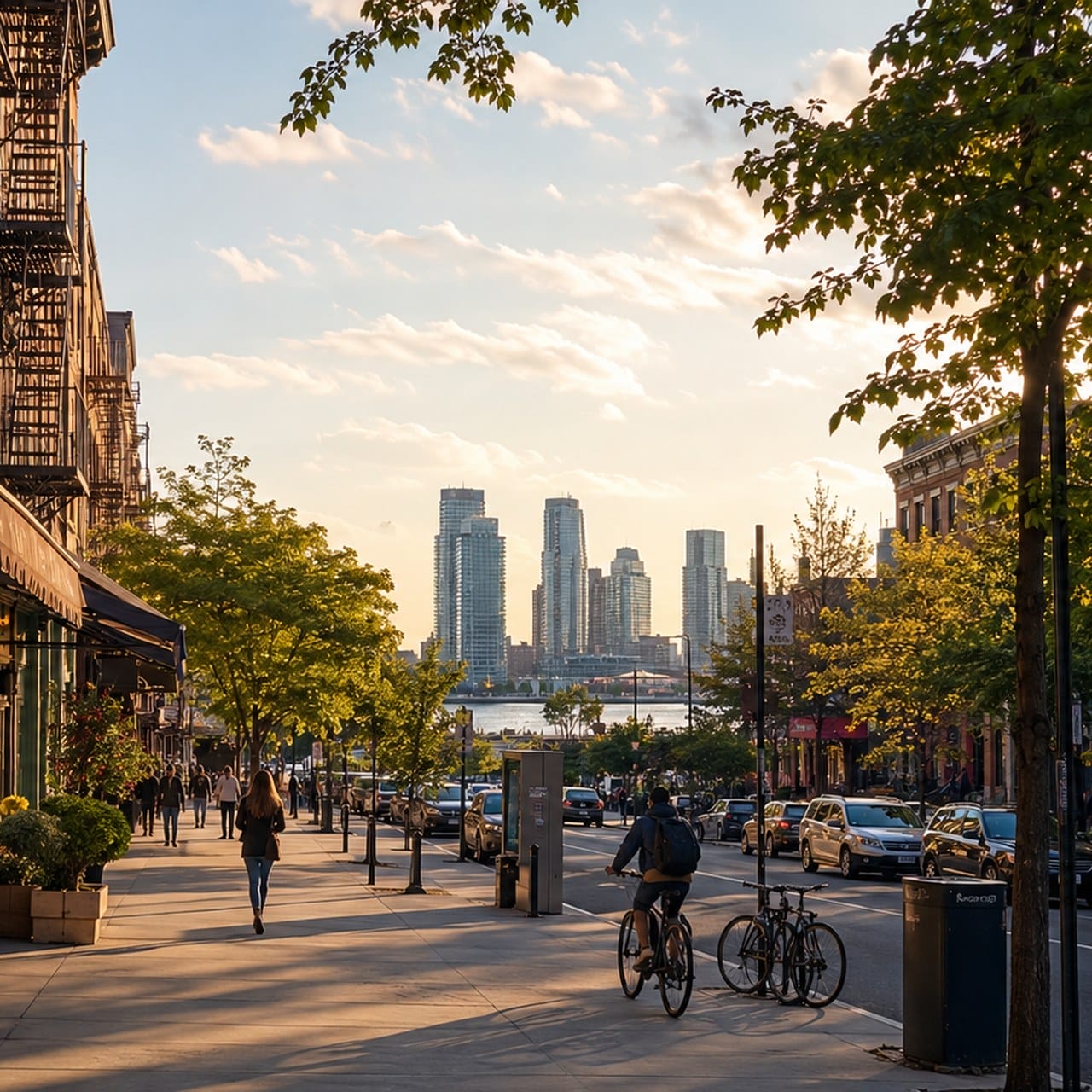
Greenpoint Brooklyn sits at the very top of Kings County, wrapped on two sides by water and pinned to the rest of Brooklyn by a single avenue named McGuinness. It is the kind of place where a Polish bakery selling pączki since 1952 shares a block with a glass condo tower priced like a TriBeCa loft. If you are weighing a move, a purchase, or an investment in this corner of north Brooklyn in 2026, this guide pulls the full picture together: history, daily life, zip code, transit, schools, parks, dining, the Greenpoint Landing build-out, market prices, and a head-to-head against neighboring Williamsburg.
Let’s break it down the way a buyer’s agent would walk you through it on a Saturday tour.
In This Guide
What Greenpoint Brooklyn Is Known For
Greenpoint is known for three things that rarely coexist anywhere else in New York. First, it is the city’s Polish stronghold, long called Little Poland, with churches, butcher shops, and language schools still anchoring Manhattan Avenue. Second, it is one of the last working waterfronts in Brooklyn, with active piers, the historic Greenpoint Manufacturing and Design Center, and the inlet at Newtown Creek that once made the area a global capital of shipbuilding and oil refining. Third, since the early 2010s it has become a magnet for the creative class, with film studios, design agencies, indie record labels, and a growing roster of restaurants that pull diners across the Pulaski Bridge from Long Island City.
Walk five blocks and you will pass a 19th-century clapboard rowhouse, a 40-story tower with a private dog spa, a pierogi counter, and a coffee bar that roasts its own beans. That collision is the brand.
Polish heritage and Little Poland identity
Polish families began arriving in Greenpoint in waves starting in the late 1800s, then in larger numbers after World War II. By the 1980s, Manhattan Avenue was lined with Polish butchers, delis, travel agencies, and a parish church, Saint Stanislaus Kostka, that still holds Polish-language Mass. The Polish & Slavic Center on Kent Street remains a hub for community classes and immigrant services.
Industrial waterfront turned creative-class hub
The shoreline along West Street and Commercial Street once held lumber yards, rope works, and the Eberhard Faber pencil factory. Many of those brick buildings are now studios, distilleries, and event spaces. Broadway Stages runs film and TV production out of converted warehouses, which is part of why so many shows you watch were quietly shot here.
A Quick History of the Neighborhood
Greenpoint was farmland until the mid-1800s, when shipbuilders set up along Bushwick Inlet and Newtown Creek. The USS Monitor, the ironclad that fought at Hampton Roads in 1862, was built at the Continental Iron Works on West Street. By the late 19th century the area had earned the nickname the “Garden Spot of the Universe,” not for parks but for its concentration of heavy industry: glass, gas, glue, printing, and pottery, the so-called “five black arts.”
Shipbuilding, pencil factories, and Newtown Creek
Newtown Creek, the four-mile waterway that forms Greenpoint’s eastern border with Queens, became one of the most polluted urban waterways in the country thanks to a century of oil refining. A major underground oil spill, larger by volume than the Exxon Valdez, was discovered in the 1970s and is still being remediated today. The creek is now a federal Superfund site managed by the EPA, with active cleanup work funded through 2030.
The Polish migration after 1945
After 1945, displaced Polish families resettled in Greenpoint in large numbers, joined by another wave after Poland’s 1980s Solidarity movement. They bought rowhouses for what would now be dinner-party money, opened businesses, and built the community fabric that still shapes the neighborhood’s signage, food, and street life.
Greenpoint in 2026: Vibe, Demographics, and Daily Life
In 2026, Greenpoint reads as quieter than Williamsburg, more residential than Bushwick, and more architecturally varied than Long Island City across the creek. The population sits around 38,000 according to recent NYC Department of City Planning estimates, with a median age in the early thirties and a household income that has roughly doubled since 2010.
You hear Polish on the bus, you hear startup pitches at the coffee shop on Franklin, and you hear strollers on the cobblestones around Java Street. Saturday mornings cluster around the McCarren Park greenmarket and the cafes on Greenpoint Avenue. Sunday mornings cluster around Mass at Saint Stanislaus or brunch at Five Leaves.
The trade-off most newcomers learn fast: the neighborhood is gorgeous, the food is excellent, the commute is the one thing you negotiate with on a daily basis.
Boundaries and Greenpoint Zip Code
Greenpoint is the northernmost neighborhood in Brooklyn. Its boundaries are well defined by water and one major road.
Where Greenpoint starts and ends
- North and east: Newtown Creek, which separates Brooklyn from Long Island City, Queens.
- West: the East River, with views of Midtown Manhattan.
- South: Meeker Avenue and the BQE, which form the rough border with Williamsburg.
- Central spine: McGuinness Boulevard runs north to south and feeds the Pulaski Bridge into Queens.
The 11222 zip code
The Greenpoint zip code is 11222. That single zip covers nearly the entire neighborhood, which keeps real estate searches clean on StreetEasy and Zillow. If a listing says 11222, you are in Greenpoint, full stop.
Is Greenpoint Brooklyn Safe?
Greenpoint is one of the safer neighborhoods in Brooklyn, and it has been trending safer over the last five years. The neighborhood falls under the NYPD’s 94th Precinct, which also covers a small slice of northern Williamsburg.
Crime trends and 94th Precinct stats
Per NYPD CompStat data tracked through early 2026, the 94th Precinct logs lower rates of major felonies than the borough average. Burglary and grand larceny remain the most common complaints, mostly package theft and unlocked-vehicle break-ins. Violent crime is uncommon, though not zero, and tends to cluster near nightlife corridors after midnight on weekends.
Safety by sub-pocket
- Around McCarren Park and Franklin Street: very safe, heavy foot traffic until late.
- Greenpoint Landing waterfront: well-patrolled by building security and city cameras.
- McGuinness Boulevard at night: cross with care, a redesign project funded through 2027 is adding pedestrian islands and slower speed limits.
- Eastern edge near the creek: industrial blocks are quiet after dark, fine to walk but feel different.
If safety is your top filter, ask a Brooklyn buyer’s agent at DeFalco for the block-by-block read before signing anything.
Transportation and Commute Times
Greenpoint has historically been the trade-off neighborhood: you pay Williamsburg-adjacent prices, you commute on the G train. In 2026 that math is improving, mostly because the NYC Ferry has added frequency and the G train received new signaling upgrades.
The G train and the East River tunnel link
The G is the only subway line that serves Greenpoint directly, with stops at Greenpoint Avenue and Nassau Avenue. It runs from Court Square in Long Island City down to Church Avenue in Kensington. To reach Midtown Manhattan you transfer at Court Square for the E, M, or 7. Expect 25 to 35 minutes door-to-door to Midtown East and 30 to 40 minutes to Midtown West. To reach Lower Manhattan, transfer at Metropolitan for the L and Union Square, about 30 to 38 minutes.
The 2025 to 2026 signaling work added new train sets and tighter headways, so the long G-train waits that the neighborhood used to joke about have shortened.
NYC Ferry from India Street
The Greenpoint ferry landing at India Street and the East River sits on the East River route. It hits Pier 11 in the Financial District in roughly 20 minutes and Midtown’s East 34th Street stop in about 18 minutes. The ride is one of the best commutes in the city when the weather plays along.
Buses, bikes, and the Pulaski Bridge
- B43, B62, and B24 buses connect to Williamsburg, Long Island City, and Downtown Brooklyn.
- The Pulaski Bridge has a dedicated, two-way protected bike lane that links Greenpoint to LIC and the Queensboro Bridge for a 20-minute ride to Midtown.
- Citi Bike coverage is dense throughout 11222.
For more on commute math when you compare boroughs, see our Manhattan vs Brooklyn buyer’s guide.
Schools and Family Life
Greenpoint sits in NYC Community School District 14. Families have a mix of public, Catholic, and charter options.
- PS 31 The Samuel F. Dupont on Meserole Avenue serves K-5 and has held strong state ELA and math performance for several years.
- PS 110 The Monitor on Monitor Street is another well-regarded K-5, named after the ironclad ship built nearby.
- Saint Stanislaus Kostka Catholic Academy offers Pre-K through 8th grade with a long-standing Polish heritage program.
- MS 126 John Ericsson Middle School picks up grades 6-8.
- For high school, families typically apply across the district through the NYC public high school choice process, with strong options in nearby Williamsburg and Long Island City.
Greenpoint also has a growing roster of small private preschools and a Brooklyn Public Library branch on Norman Avenue that runs storytime and homework help.
Parks, Waterfront, and Things to Do
For a neighborhood of its size, Greenpoint punches above its weight on green space.
McCarren Park
McCarren Park straddles the Greenpoint-Williamsburg border. It holds soccer fields, a track, a pool that opens in summer, tennis courts, and a Saturday greenmarket that runs year-round. It is the de facto town square for both neighborhoods.
WNYC Transmitter Park and the East River esplanade
WNYC Transmitter Park, opened on the site of old radio towers, gives you grass, a pier, and a clean line of sight to the Midtown skyline. The park connects into a developing East River esplanade that, when the final segments open through 2027, will let you walk from Greenpoint Avenue to North 5th Street along the water without breaking the route.
Greenpoint Skate Park and small green spaces
The Greenpoint Skate Park under the BQE has been a magnet for skaters since 2014. Smaller spots like American Playground, Newtown Barge Park, and the Box Street Park (still being built out) round out the local options.
Other things to do in 11222:
- The Pencil Factory bar inside an old Eberhard Faber building.
- Brooklyn Bowl-style live music at Warsaw, the Polish National Home that books touring acts.
- The Greenpoint Open Studios weekend every June, when local artists open their doors.
- Long walks along West Street with a Peter Pan Donut in hand.
Greenpoint Brooklyn Restaurants and Bars
The food scene is one of the strongest arguments for the neighborhood. Two traditions overlap on the same blocks.
Polish classics: Karczma, Lokal, and the bakeries
- Karczma on Greenpoint Avenue does rustic Polish food in a wood-paneled tavern.
- Lokal is a smaller, modern take on Polish home cooking.
- Christina’s is the diner version, open early, with pierogi and blintzes.
- Syrena Bakery and Rzeszowska Bakery keep the rye breads, babka, and pączki coming.
- W-Nassau Meat Market is the kielbasa heavyweight on Nassau Avenue.
New-wave dining: Five Leaves, Black Rabbit, Bernie’s
- Five Leaves at Lorimer and Bedford runs all day, with one of the strongest brunch lines in north Brooklyn.
- Black Rabbit is the neighborhood gastropub, dim and friendly, with a back garden.
- Bernie’s on Nassau brought a retro American comfort menu that has been booked out since opening.
- Oxomoco earned a Michelin star for its wood-fired Mexican cooking on Greenpoint Avenue.
- Chez Ma Tante is the bistro your friend in Paris would approve of.
Coffee, donuts, and beer halls
- Peter Pan Donut & Pastry Shop has been frying since 1953 and still draws a line on Manhattan Avenue.
- Greenpoint Beer & Ale Works runs a brewery and taproom on Dupont Street.
- Cafe Grumpy has its flagship coffee bar on Meserole Avenue.
You can eat your way through every dinner of the week without crossing McGuinness, which is more than most Brooklyn neighborhoods can claim.
Manhattan Avenue: The Commercial Spine
Manhattan Avenue runs the length of the neighborhood and serves as the main commercial strip. You will find the C-Town supermarket, the post office, three pharmacies, the public library branch nearby, hardware stores, Polish travel agencies, dry cleaners, and dozens of restaurants in roughly a fifteen-block stretch. Most daily errands happen here on foot.
Smaller commercial pockets exist on Franklin Street (boutiques, indie shops), Greenpoint Avenue (restaurants, the ferry), and Nassau Avenue (delis, neighborhood bars).
Real Estate Market in 2026
The Greenpoint Brooklyn real estate market sits in a band that has stabilized after the 2022 to 2024 condo build-out. Prices grew quickly through the late 2010s, dipped briefly in 2023, and have flattened with a slight upward bias through spring 2026.
Use these figures as a current snapshot, then ask a DeFalco agent for live numbers on the block you care about.
Condo pricing and Greenpoint Landing
- Median condo sale price: roughly $1.05 million.
- Price per square foot: $1,250 to $1,650 depending on building age and view.
- Greenpoint Landing, the multi-tower waterfront project led by the NYC Economic Development Corporation framework, holds the highest concentration of new inventory. Towers like One Blue Slip, Eagle + West, and 41 Blue Slip have set the modern price benchmark with sweeping East River views.
- Carrying costs: common charges run $1.20 to $1.80 per square foot per month in new buildings, plus real estate taxes that often benefit from a 421-a or 485-x abatement schedule.
For buyers comparing waterfront product across the borough, our Brooklyn real estate market guide and the spring 2026 market report break out building-level trends.
Brownstones and two-family homes
- Median brownstone sale price: roughly $1.6 million for a single-family rowhouse.
- Two-family townhouse: roughly $1.85 million, often with an owner’s duplex over a rental.
- Three-family and small multi-unit: $2.2 million to $3 million.
- Pre-war frame houses on the side streets can trade below those medians but usually need work.
If you are weighing an income unit, our mother-in-law suite NY/NJ guide walks through the legal and design pieces.
Rental ranges by bedroom count
Median asking rents in 11222 through Q1 2026:
- Studio: about $3,200 per month.
- 1 bedroom: about $4,200 per month.
- 2 bedroom: about $5,500 per month.
- 3 bedroom: about $7,200 per month and up.
- Luxury waterfront studio in a new tower: $5,000 per month is now common.
The rental market here is competitive year-round, with a small softening in January and February. Plan to move quickly on listings you like.
Greenpoint Brooklyn vs Williamsburg
The Greenpoint vs Williamsburg question is the single most-searched comparison in the neighborhood category. Here is the honest breakdown.
| Factor | Greenpoint | Williamsburg |
|---|---|---|
| Vibe | Residential, Polish-rooted, quieter | Denser nightlife, fashion-forward, busier |
| Subway | G only | L, J/M/Z, plus G |
| Median condo price | ~$1.05M | ~$1.25M |
| Median brownstone | ~$1.6M | ~$2.0M+ |
| Waterfront product | Greenpoint Landing | Domino, North Williamsburg towers |
| Nightlife | Modest, local-leaning | Heavy, destination-leaning |
| Park access | McCarren shared, Transmitter Park | McCarren shared, Domino Park, East River State Park |
| School zoning | District 14 | District 14 |
| Polish food | Deep bench | Some, mostly south Williamsburg |
Greenpoint usually wins for buyers who want quieter streets, a stronger sense of neighborhood, and slightly better entry pricing. Williamsburg usually wins for renters who prioritize subway redundancy and nightlife. Both work for the same general buyer profile, which is why a good Brooklyn buyer’s agent will tour both with you.
Pros and Cons of Living Here
Pros
- Strong neighborhood identity rooted in Polish heritage and waterfront history.
- Excellent food, from rustic taverns to Michelin-starred dining.
- McCarren Park and the East River esplanade right at your door.
- Lower entry pricing than Williamsburg or DUMBO for similar product.
- NYC Ferry to Manhattan with great views.
- 421-a tax abatements still active in many new condo towers.
Cons
- Single subway line (the G), with no direct Manhattan train.
- McGuinness Boulevard cuts the neighborhood in half and is still being redesigned.
- Newtown Creek Superfund cleanup is ongoing through 2030.
- Newer condo carrying costs and common charges can surprise first-time buyers.
- Limited big-box retail; you will run errands in smaller stores.
- Schools are improving but not yet at the level of Park Slope or Cobble Hill.
Who Greenpoint Is Right For
Greenpoint is right for:
- Young professionals trading space for a strong walkable neighborhood.
- Creative-class buyers who work in production, design, music, tech, or film.
- Out-of-state transferees who want a Brooklyn waterfront condo with a clear commute.
- Investors evaluating Greenpoint Landing units and rent-stabilized brownstone conversions.
- Families who value parks, the waterfront, and District 14 schools, while accepting the single subway line.
Greenpoint is probably not right for:
- Buyers who require a one-seat ride into Midtown.
- Households that need three to four bedrooms at a Queens or south Brooklyn price point.
- Anyone whose lifestyle depends on big-box retail at the doorstep.
For families weighing alternatives, our guides on Park Slope and Carroll Gardens cover deeper school networks.
How to Buy or Rent in the Neighborhood
The buying process in Greenpoint looks much like the rest of Brooklyn, with three local wrinkles.
- Condo boards in Greenpoint Landing buildings move fast. Offers often go best-and-final within 48 hours on well-priced units. Work with an agent who has the developer-broker relationships.
- Brownstone deals are paper-intensive. Many have certificate-of-occupancy quirks dating back to the 1900s. Get a lawyer who knows landmark and frame-house rules. Our closing process guide walks the steps.
- Rentals are agent-driven. Most listings still pay a broker fee, though the 2025 FARE Act shifted who pays it in many cases. Confirm in writing before you sign.
A typical 2026 Greenpoint buyer journey:
- Pre-approval letter from a local lender (4 to 6 weeks of statements).
- Tour roster of 6 to 10 units across condos and brownstones.
- Offer with 10 to 20 percent down on condos, 20 to 25 percent on townhouses.
- Inspection, board package if applicable, financing contingency.
- Closing in 60 to 90 days, faster on cash deals.
For step-by-step buyer mechanics, our how to buy a home in NY guide and the piece on making an offer in NY/NJ cover the playbook.
Ready to walk a Greenpoint block in person? Book a tour with a DeFalco Brooklyn agent and we will line up condos, brownstones, and rentals that match your filters.
Frequently Asked Questions
Is Greenpoint Brooklyn safe?
Yes, Greenpoint is one of the safer neighborhoods in north Brooklyn. The 94th Precinct reports lower major-felony rates than the borough average per recent NYPD CompStat data, with most issues clustering around late-night nightlife corridors and isolated industrial blocks.
What zip code is Greenpoint?
Greenpoint uses the zip code 11222, which covers nearly the entire neighborhood from Newtown Creek to Meeker Avenue.
Is Greenpoint Brooklyn gentrified?
Greenpoint has gentrified substantially since 2010, with condo development concentrated along the East River and rising rents across the older housing stock. Polish-owned businesses, longtime homeowners, and rent-stabilized tenants still anchor much of the neighborhood, so the texture is mixed rather than fully replaced.
Greenpoint vs Williamsburg, which is better?
Greenpoint is quieter, slightly cheaper on entry pricing, and stronger on neighborhood identity. Williamsburg has more subway lines, denser nightlife, and a deeper retail bench. Buyers who want calm streets pick Greenpoint. Renters who want subway redundancy often pick Williamsburg.
What is the median home price in Greenpoint?
As of spring 2026, the median condo sale sits near $1.05 million and the median single-family brownstone near $1.6 million, per StreetEasy and DeFalco internal data. Two-family townhouses trade around $1.85 million.
How long does the G train take to Manhattan?
The G does not run into Manhattan directly. You transfer at Court Square (for the E, M, or 7) or Metropolitan Avenue (for the L). Expect 25 to 40 minutes door-to-door depending on destination. The NYC Ferry from India Street reaches Midtown East 34th Street in about 18 minutes.
Is Greenpoint Brooklyn good for families?
Yes, for many families. Parks, the waterfront, and Polish-American community institutions make it strong on day-to-day quality of life. The catch is school zoning depth and the single subway line, both of which families should review before committing.
What is Greenpoint known for?
Greenpoint is known for being NYC’s Polish-American heart (Little Poland), the East River waterfront, the Newtown Creek Superfund cleanup, the G train, Greenpoint Landing’s tower cluster, Peter Pan Donuts, and a deep, layered food scene that runs from kielbasa counters to Michelin-starred dining.
Next Steps with a DeFalco Brooklyn Agent
If you are ready to act, the fastest path forward is a one-hour neighborhood walkthrough with a Brooklyn agent who knows 11222 block by block. Reach out through the DeFalco homepage and we will set the tour. For investors and off-market opportunities along the Greenpoint Landing corridor, our team flags new listings before they hit StreetEasy.
While you are mapping options, our Brooklyn neighborhood comparison, DUMBO guide, Fort Greene guide, Bay Ridge guide, and Bushwick guide round out the picture across the borough. For market-wide context, the affordable Brooklyn neighborhoods piece helps frame Greenpoint’s pricing band.
Robert DeFalco founded Robert DeFalco Realty in 1987 and built a Staten Island and Brooklyn brokerage on trust, local roots, and full-service representation that now spans neighborhood guides like this one across all five boroughs.