
New Brighton Staten Island: Complete Neighborhood Guide 2026
In This Guide
New Brighton Staten Island sits on the North Shore as one of the borough’s most architecturally important and most misunderstood neighborhoods, with median home prices running $400,000 to $650,000 in April 2026. That price band buys you a walkable address near the St. George Ferry, the only free 25-minute boat ride to Lower Manhattan in the country, plus access to Snug Harbor Cultural Center and a designated historic district full of Victorian mansions that would cost two or three times as much in Brooklyn or Hudson County.
If you are weighing the North Shore as a relocation target, our moving to Staten Island guide covers borough basics. This piece goes deep on New Brighton, the small (0.361 square mile) but layered neighborhood west of St. George that anchors the western edge of the North Shore. We will cover what the area is known for, who tends to buy here, the real estate market, transit, schools, and the honest tradeoffs around lower median household income and the New York City Housing Authority developments that sit inside the neighborhood. New Brighton rewards buyers who want architecture, history, and ferry access for less, and it asks those buyers to look the urban edges in the eye.
What Is New Brighton Staten Island Known For?
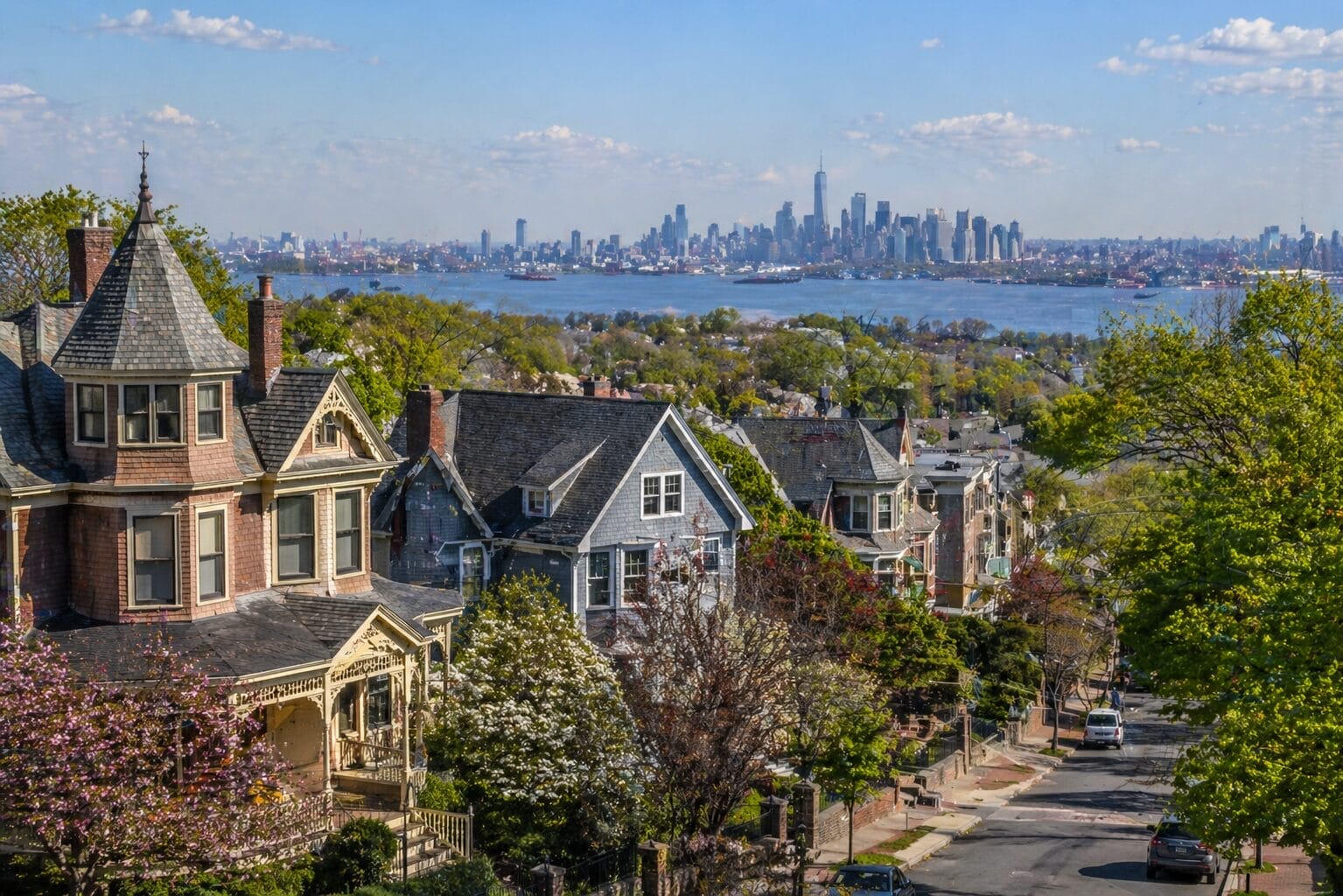
New Brighton Staten Island is known for three things that no other Staten Island neighborhood can claim together: an early planned suburban subdivision (Hamilton Park) full of Victorian mansions, the 83-acre Snug Harbor Cultural Center on the Kill Van Kull waterfront, and the oldest Roman Catholic church on Staten Island (St. Peter’s, dedicated 1844).
The neighborhood traces back to 1834 to 1836, when developer Thomas E. Davis bought roughly 230 acres on the hillside above the Kill Van Kull and platted a summer resort for wealthy Manhattanites. Davis named the area New Brighton after the British seaside resort. The plan worked. By the 1850s the hill above the harbor was filling with country villas, and in 1851 to 1852 the Hamilton Park section was laid out as one of the very first self-contained planned suburban subdivisions in the United States. New Brighton incorporated as a village in 1866 and originally included the section we now call St. George, which broke off as the borough’s civic center after the 1898 consolidation.
The neighborhood sits on the western edge of the North Shore, bounded by the Kill Van Kull to the north, Jersey Street to the east, Brighton and Castleton Avenues to the south, and Lafayette Avenue and the Snug Harbor grounds to the west. ZIP code 10301 covers most of the area, with a sliver of 10304 to the south. Area codes are the standard New York City set: 718, 347, 929, and 917.
In 1994 the area’s architectural inventory earned formal recognition through the St. George/New Brighton Historic District designation, which protects dozens of structures built between roughly 1840 and 1925. The Pendleton Houses at 1 and 22 Pendleton Place (1855 Gothic Revival and 1861 Stick style) carry individual NYC landmark status, while Christ Church New Brighton (Episcopal), the Hamilton Park Community Houses, and Neville House are listed on the National Register of Historic Places. For a wider read on how this North Shore character compares to the rest of the island, our North Shore Staten Island guide gives the regional view.
Is New Brighton Staten Island a Good Place to Live?
New Brighton Staten Island is a good place to live for buyers who want history and ferry access at a discount and who are clear-eyed about urban texture. It is not a good place to live for buyers who want a uniformly suburban feel with chain retail and big lawns. Below is the honest breakdown.
Safety
The 120th Precinct, which covers New Brighton along with St. George, Tompkinsville, and parts of the North Shore, ranked 12th safest of 69 NYPD precincts citywide as of recent reporting, and crime is down 83.3 percent since 1990. That is a striking improvement on the bad reputation the area still carries from the 1980s. Block-by-block variation matters a lot here. Hamilton Park, the Brighton Heights hill, and Pendleton Place feel like quiet historic streets. Lower-elevation blocks closer to Richmond Terrace and Jersey Street can feel more urban, especially after dark. For a wider safety frame, see our Staten Island safety and crime statistics guide.
Affordability
Median household income inside the combined St. George-New Brighton statistical area (NTA SI0101) runs around $49,807, well below the borough average. That number reflects a real economic mix: long-tenured working-class homeowners, NYCHA residents, young professionals priced out of St. George and Brooklyn, and architecture buyers restoring Victorians. Home prices in New Brighton are 25 to 40 percent lower than in adjacent St. George for comparable square footage, which is the core value thesis. Our Staten Island home value guide tracks how that gap moves over time.
Hamilton Park heritage
Few NYC neighborhoods can claim a planned Victorian subdivision laid out before the Civil War. Hamilton Park’s gingerbread mansions on Brighton Heights, Harvard Avenue, Pendleton Place, and Franklin Avenue are the visual signature of New Brighton. The Pendleton House at 22 Pendleton Place (Stick style, 1861) is one of the most photographed buildings on Staten Island. Buying inside the historic district means accepting Landmarks Preservation Commission review on exterior changes, which most architecture-minded buyers see as a feature rather than a friction.
Community mix
New Brighton is racially and ethnically diverse: roughly 21.4 percent White, 31.9 percent Black, 7.2 percent Asian, and 34.3 percent Hispanic in the most recent census tract reading. The largest age group is 25 to 39 years old at about 22 percent of residents, which skews younger than the borough average. The Cassidy-Lafayette Houses and Richmond Terrace Houses are NYCHA developments inside the neighborhood. They sit on specific blocks that are easy to identify on a map, and most of the historic-district housing stock sits notably uphill from them. Ignoring this geography would be dishonest. Naming it lets buyers make informed choices.
Real Estate and Housing Market
The New Brighton real estate market in April 2026 is best described as North Shore value with pockets of architectural premium. Below is the housing snapshot.
Current market snapshot
- Median single-family home price: $400,000 to $650,000
- Hamilton Park Victorian mansions: $700,000 to $1,200,000+
- Two-family and multi-family homes: $500,000 to $750,000
- Co-op and condo units: $250,000 to $450,000
- New construction (rare): $700,000+
- Year-over-year appreciation: 3 to 4 percent
- Days on market: 60 to 80 days
For real-time inventory, see our New Brighton homes for sale page and our broader Staten Island listings hub.
Housing types
The housing stock falls into four buckets:
Hamilton Park Victorians: The premium tier. Architectural styles inside the district include Greek Revival, Italianate, Stick, Shingle, Queen Anne, and Gothic Revival. Lot sizes are larger than typical Staten Island row plots. Restored examples regularly clear $1 million. Unrestored examples in need of work occasionally trade in the high $600,000s, which is where investor-buyers find their angle.
Two-family attached and semi-detached: The bread and butter of New Brighton ownership. Many of these were built between 1900 and 1940 along Castleton Avenue, Lafayette Avenue, and the side streets running down toward Richmond Terrace. The two-family format lets a buyer offset mortgage with rental income, a common North Shore strategy. Our guide to buying a two-family home on Staten Island covers the financing math.
Single-family detached outside the historic district: Smaller frame houses, often updated, in the $400,000 to $600,000 range. These are the entry points for first-time buyers.
Co-op and condo: Limited inventory, mostly in mid-century or 1980s-era buildings near the Snug Harbor edge or along Castleton Avenue. Co-ops can dip into the $250,000s for one-bedroom units, the lowest entry price on the North Shore.
For the math on what these prices mean for your monthly payment, our how much house can I afford calculator and guide walks through the New York property tax piece, and our Staten Island property tax rate guide gives the latest assessment context.
Where the market sits in 2026
Inventory is tighter than 2024. Buyers who can move quickly on a Hamilton Park Victorian usually face one or two competing offers. Outside the historic district, days-on-market sit closer to the 80-day end of the range, which gives negotiating room. Our Staten Island real estate market report for April 2026 has the wider numbers.
Transportation and Commuting
Transportation in this area runs on three things: the Staten Island Ferry at St. George, the local bus network, and the car. There is no Staten Island Railway station inside the neighborhood. The North Shore Branch of the SIR shut down for passenger service in 1953, and freight rails along Richmond Terrace are inactive for transit purposes.
Walking distance to the St. George Ferry
This is the key sell. Most New Brighton addresses sit a 10 to 20 minute walk from the St. George Ferry Terminal, which runs free service to Whitehall in Lower Manhattan every 15 to 30 minutes. Total ferry ride is 25 minutes. Walk plus ride beats most outer-borough commutes from comparable price points. From the ferry, the 1, R, W, 4, and 5 trains are all within two blocks at South Ferry/Whitehall.
Bus lines serving New Brighton
Local bus lines through and around New Brighton include the S40, S42, S44, S46, S52, S90, S94, and S96. The S40 and S44 connect along Richmond Terrace toward Mariners Harbor and the West Shore. The S46 runs Castleton Avenue toward the West Shore Plaza. The S42 shuttles to St. George Ferry from the south side blocks. The express S90, S94, and S96 head into Manhattan during peak hours.
By car from New Brighton
Drivers reach the Verrazzano-Narrows Bridge in 10 to 15 minutes via the Staten Island Expressway, the Goethals Bridge in 15 minutes via Richmond Avenue or the SIE, and the Bayonne Bridge in 8 minutes via Richmond Terrace. Street parking inside the historic district is generally available. Some Victorian properties have driveway access, which is a meaningful premium.
ZIP code and area code
New Brighton sits in ZIP 10301 (with a small 10304 sliver to the south) and is served by the 718, 347, 929, and 917 area codes. The neighborhood falls inside Staten Island’s Community District 1.
Things to Do
The amenity story in New Brighton is short but unusually deep. Five anchors carry the neighborhood.
Snug Harbor Cultural Center & Botanical Garden
Snug Harbor is the headline. The 83-acre campus is a National Historic Landmark District with 26 architecturally significant buildings dating to the 1830s, including five Greek Revival temple-front structures along the front lawn that are among the best-preserved examples in the country. Founded in 1833 by Robert Richard Randall as a retirement home for aged sailors (the original “Sailors Snug Harbor”), it operated as a sailors’ residence until 1976 and reopened as a cultural complex. Today the campus hosts the Newhouse Center for Contemporary Art, the Staten Island Children’s Museum, the Staten Island Botanical Garden, the Chinese Scholars’ Garden (the only authentic classical Chinese garden in the United States), the Tuscan Garden, and a working farm. Admission to the grounds is free. Walking from a New Brighton home to Snug Harbor takes 5 to 15 minutes depending on block.
Hamilton Park Historic District
Walking the Hamilton Park hill is the second amenity. Harvard Avenue, Franklin Avenue, Pendleton Place, and Park Place hold the densest concentration of pre-1880 Victorian housing on Staten Island. Bring a phone for photos. The painted lady color palettes and gingerbread trim work draw architecture buffs from across the city.
St. Peter’s Roman Catholic Church
Dedicated in 1844, St. Peter’s at 53 St. Mark’s Place (technically just over the St. George line, but historically a New Brighton parish) is the oldest Roman Catholic church on Staten Island. The Gothic Revival sanctuary is open for services and remains an active parish.
Atlantic Salt Company waterfront
Along Richmond Terrace sits Atlantic Salt Company, the working road salt operation owned by the Mahoney family since 1955. The operation stockpiles 350,000+ tons of road salt for New York City winters. The piles are visible from the Bayonne side of the Kill Van Kull and have become an unlikely Instagram landmark. The waterfront walk along Richmond Terrace gives port-industrial views you cannot get anywhere else in the city.
Gerardi’s Farmers Market
Gerardi’s, also on Richmond Terrace, is a longtime independent grocery and produce market. The store carries a striking exterior mural honoring 9/11 firefighters from the FDNY’s Staten Island companies. Locals shop here for produce that beats most chain supermarket options on the North Shore.
For more weekend ideas across the borough, see our Staten Island neighborhoods relocation guide.
Schools and Education
The neighborhood is part of New York City Department of Education District 31, which covers the entire borough.
Public schools serving New Brighton
- PS 31 William T. Davis (PK-5): The zoned elementary school, shared with St. George. Address 55 Layton Avenue.
- IS 61 William A. Morris (6-8): The zoned middle school for North Shore students.
- PS 373R (PK-7): A District 75 special education school serving students with significant disabilities.
For high school, New Brighton students apply through the citywide DOE high school choice process. Curtis High School in St. George is the historically zoned option and remains a popular choice for families who want a walk-to school. Our NYC and NJ school district rankings and home values guide explains how District 31 compares.
Libraries
The closest New York Public Library branches are the West New Brighton Library at 976 Castleton Avenue and the St. George Library Center on Central Avenue. Both are roughly a 10 to 15 minute walk depending on which side of New Brighton you live on.
New Brighton Staten Island vs. Nearby Neighborhoods
Comparing New Brighton to its neighbors is the fastest way to understand its market position.
New Brighton vs. St. George
St. George is the borough’s civic center, ferry terminal home, and price leader on the North Shore. Median single-family pricing in St. George runs $550,000 to $850,000, with renovated brownstones and condos pushing into seven figures. New Brighton offers the same ferry-adjacent walk for 25 to 40 percent less. The tradeoff: fewer restaurants and chain amenities, more historic-district restoration work. Buyers who tour both usually pick New Brighton on architecture and price, St. George on convenience. See our St. George Staten Island neighborhood guide for the head-to-head detail.
New Brighton vs. West New Brighton
West New Brighton sits immediately west of New Brighton across Lafayette Avenue, on the far side of Snug Harbor. Pricing is similar, with West New Brighton trending slightly lower on the median because the housing stock is less concentrated in historic Victorians. West New Brighton has more frame two-families and post-war singles. The ferry walk from West New Brighton is longer (20 to 30 minutes) and most residents bus to St. George rather than walk.
New Brighton vs. Tompkinsville
Tompkinsville sits south of St. George along the East Shore and the SIR line. It has its own SIR station, which is a real commuting plus. Pricing runs comparable to New Brighton at $400,000 to $600,000 median, with a different street feel: more diverse retail, some industrial edges, less Victorian housing.
New Brighton vs. Stapleton
Stapleton is the next neighborhood south of Tompkinsville and is in active mixed-use redevelopment around the URL Staten Island development on the former Homeport. Stapleton offers SIR access plus newer waterfront condo product. New Brighton wins on architecture; Stapleton wins on new construction. See our Stapleton Staten Island neighborhood guide for the comparison.
For wider context on what each part of the island offers, our moving to Staten Island pros and cons guide is worth a read.
Living Here: Pros and Cons
Below is the honest list. No whitewashing.
Pros
- Hamilton Park Victorian heritage. One of America’s first planned suburban subdivisions sits inside the neighborhood, with gingerbread mansions you cannot find this concentrated anywhere else in NYC.
- Snug Harbor on foot. An 83-acre cultural and botanical campus is a 5 to 15 minute walk from most addresses. Free admission to the grounds.
- Ferry-adjacent value. Walking distance to the St. George Ferry without paying St. George prices. The 25-minute free ferry to Lower Manhattan beats most outer-borough commutes.
- North Shore architectural depth. Greek Revival, Italianate, Stick, Shingle, Queen Anne, and Gothic Revival all within a half-mile.
- 120th Precinct safety improvement. Crime is down 83.3 percent since 1990, with a 12th-of-69 citywide safety ranking.
- Lower entry price than adjacent neighborhoods. Co-ops from $250,000 and single-family homes from $400,000 mark the most affordable ferry-adjacent inventory in NYC.
Cons
- Lower median household income. Around $49,807 inside the broader NTA, well below the borough average. This shapes retail and street feel.
- NYCHA presence. Cassidy-Lafayette Houses and Richmond Terrace Houses sit inside neighborhood boundaries. Block-level diligence matters.
- Mixed safety perception. Crime numbers are improving fast, but the 1980s reputation lingers in some buyer circles. Touring in person is necessary.
- No Staten Island Railway station. The North Shore Branch shut for passengers in 1953. Bus or walk to St. George covers the gap.
- Limited chain retail. No big-box stores inside walking distance. Grocery is mostly independent (Gerardi’s) or a short trip by car.
About the Author
Robert DeFalco Realty has been selling Staten Island real estate since 1989, with offices serving the entire borough and adjacent areas of New Jersey. Our agents specialize in North Shore historic districts, two-family investment properties, and ferry-corridor neighborhoods like New Brighton, St. George, Tompkinsville, and Stapleton. We have closed Hamilton Park Victorians, Richmond Terrace co-ops, and Castleton Avenue two-families across more than three decades, and we know the block-by-block character that makes New Brighton work for the right buyer. For listings, valuations, or a buyer consultation, contact Robert DeFalco Realty.
Frequently Asked Questions
What is known for?
This area is known for the Hamilton Park Historic District, one of the earliest planned suburban subdivisions in America (laid out 1851 to 1852), the 83-acre Snug Harbor Cultural Center and Botanical Garden, and St. Peter’s Roman Catholic Church (1844), the oldest Catholic church on Staten Island. The neighborhood was founded in 1834 to 1836 by developer Thomas E. Davis as a Manhattan-adjacent summer resort.
What is Hamilton Park in New Brighton?
Hamilton Park is a designated historic subsection of New Brighton on the Brighton Heights hill, laid out around 1851 to 1852 as one of the first self-contained planned Victorian suburban subdivisions in the United States. The area is full of Greek Revival, Italianate, Stick, Shingle, and Queen Anne mansions. The Pendleton Houses at 1 and 22 Pendleton Place carry individual NYC landmark status. Restored Hamilton Park Victorians typically trade between $700,000 and $1.2 million.
Is safe?
The 120th Precinct, which covers New Brighton along with St. George and Tompkinsville, ranked 12th safest of 69 NYPD precincts in recent reporting, and total crime is down 83.3 percent since 1990. Safety varies block by block. Hamilton Park and the higher-elevation streets feel residential and quiet, while lower blocks near Richmond Terrace and Jersey Street feel more urban. In-person touring at different times of day is recommended.
How do you get from New Brighton to Manhattan?
The fastest route is to walk 10 to 20 minutes to the St. George Ferry Terminal and ride the free Staten Island Ferry 25 minutes to Whitehall in Lower Manhattan, where the 1, R, W, 4, and 5 trains all connect within two blocks. Drivers can reach the Verrazzano-Narrows Bridge in 10 to 15 minutes for routes to Brooklyn and Manhattan via the Belt Parkway or BQE.
What is the median home price?
The median single-family home in New Brighton ran roughly $400,000 to $650,000 in April 2026. Hamilton Park Victorian mansions trade higher, between $700,000 and $1.2 million for restored examples. Two-family homes run $500,000 to $750,000, and co-ops can start as low as $250,000 for one-bedroom units, which is the lowest ferry-adjacent entry price in NYC.
What is the difference between New Brighton and West New Brighton?
New Brighton sits east of Lafayette Avenue and is closer to the St. George Ferry, with a denser concentration of Hamilton Park Victorians and the Snug Harbor campus on its western edge. West New Brighton sits west of the Snug Harbor grounds, has a longer ferry walk (20 to 30 minutes), more frame two-family and post-war single-family inventory, and slightly lower median pricing.
What is Snug Harbor Cultural Center?
Snug Harbor Cultural Center & Botanical Garden is an 83-acre National Historic Landmark District on the Kill Van Kull waterfront in New Brighton. Founded in 1833 by Robert Richard Randall as a retirement home for sailors, it operated as a sailors’ residence until 1976. Today the 26-building campus houses the Newhouse Center for Contemporary Art, the Staten Island Children’s Museum, the Staten Island Botanical Garden, the Chinese Scholars’ Garden, and a working farm. Grounds admission is free.
What ZIP code is?
New Brighton is primarily ZIP code 10301, with a small section to the south falling in 10304. Area codes serving the neighborhood are 718, 347, 929, and 917. The community district is Staten Island Community District 1 (North Shore).
Are there Victorian homes for sale in New Brighton?
Yes. New Brighton holds the densest inventory of Victorian housing on Staten Island, concentrated in the Hamilton Park Historic District along Harvard Avenue, Franklin Avenue, Pendleton Place, and Park Place. Architectural styles include Greek Revival, Italianate, Stick, Shingle, Queen Anne, and Gothic Revival. Restored examples list between $700,000 and $1.2 million; unrestored projects occasionally come to market in the high $600,000s.
What is the demographic makeup of?
The combined St. George-New Brighton statistical area (NTA SI0101) had a 2020 population of 20,549, with demographics breaking down to roughly 21.4 percent White, 31.9 percent Black, 7.2 percent Asian, and 34.3 percent Hispanic. The largest age group is 25 to 39 at about 22 percent of residents. Median household income runs around $49,807.
Next Steps: Finding Your Home
The neighborhood fits buyers who want history, ferry access, and value, and who can read a block map. The Hamilton Park Victorian story is real. The Snug Harbor walk is real. The price gap with St. George is real. The lower-elevation NYCHA blocks are also real, and any honest agent will walk those streets with you before you write an offer.
If you are ready to look at inventory, our New Brighton homes for sale page has current listings, and our ultimate guide to buying a home on Staten Island covers contract and closing. For a sense of celebrity-owned product on the borough, our piece on the Pete Davidson Staten Island condo sale is a fun read. To start a buyer consultation with a Robert DeFalco Realty agent, visit defalcorealty.com or check out our cost of living on Staten Island guide to confirm the budget side. New Brighton is a North Shore neighborhood that rewards buyers who do their homework.